

The IMF has warned of a possible new financial crisis, particularly in emerging markets, when central banks start raising interest rates. The US of course could well make a move in that direction later this year.
Here’s our economics editor Larry Elliott’s take on the IMF’s comments:
The IMF’s warning is timely. In recent years investors have piled into emerging markets in a pretty indiscriminate fashion looking for higher returns than have been available in the west. They haven’t looked too hard at the strengths and weaknesses of individual countries or companies....
The Fund fears that there could be a wave of corporate failures as western countries begin the process of returning policy to a more normal setting.
Financial markets think this will begin later this year with an interest rate increase from the US Federal Reserve, a likely catalyst for the crisis in emerging markets the Fund clearly fears.
If that proves to be the case, the west will feel the impact: losses in the financial sector and deflation as falling currencies make goods from developing countries cheaper. Attempts to “normalise” interest rates may prove short lived.
Larry’s full analysis is here:
On that note, it’s time to close up for the evening. Thanks for all your comments, and we’ll be back tomorrow.
Markets edge lower again
Following Monday’s stock market rout, prompted by growing fears for the global economy and a slump in commodity prices, European markets failed to regain any ground amid continuing volatility.
One bright spot was Glencore. After being hammered on Monday, the mining and trading group recovered nearly 17%, helped by the company saying it was “operationally and financially robust” and a Citi note suggesting the company could be taken private if the slide in metal prices continued.
But this revival did nothing to help the FTSE 100, which fell to its lowest level since 24 August. Other European markets slipped lower, but outperformed the UK benchmark which was hit by a 12% fall in building materials group Wolseley as it cut its revenue forecasts, and weakness in housebuilders. The final scores showed:
- The FTSE 100 finished down 49.62 points or 0.83% at 5909.24
- Germany’s Dax dipped 0.35% to 9450.40
- France’s Cac closed 0.31% lower at 4343.73
- Italy’s FTSE MIB fell 0.16% to 20, 726.75
- Spain’s Ibex ended virtually unchanged at 9393.9
- In Greece, the Athens market slipped 0.67% to 650.33
There was little help from the US markets, with the Dow Jones Industrial Average sliding from positive to negative and back again. At the moment it is down 23 points or 0.15%.
VW scandal could be "turning point" for car industry - Fitch
The VW emissions scandal could prove a turning point for the whole automotive industry around the world, according to ratings agency Fitch, beyond the immediate effect on the company itself.
It could see regulators review emission test targets, accelerate the growth of electric and hybrid vehicles and even see a shift back to petrol engines.
A shift away from diesel would have a bigger impact on European carmakers than their US or Asian rivals. Fitch said:
The Volkswagen emissions test scandal could prove a turning point for the auto industry worldwide, Fitch Ratings says. It could prompt profound and lasting repercussions far beyond the group’s own credit profile.
It is too early to assess the full implications for automotive manufacturers, suppliers and other industry constituents, but we expect the whole sector to be affected to various degrees. Regulators will reassess the timeline to reach planned more stringent emission limit targets and could review the targets themselves. Test protocols will undoubtedly also be toughened and the move towards real driving emission testing cycles will accelerate.
The scandal could accelerate the underlying growth of vehicles with alternative powertrains, including fuel cells, electric and hybrid engines. It could also lead to a shift back towards petrol engines in Europe, where diesel engines now account for more than half of sales.
A shift away from diesel would have a bigger impact on European manufacturers than on their US or Asian rivals. In particular, it may hit manufacturers of small diesel-engine cars harder than premium manufacturers, which have greater price elasticity to absorb higher costs.
R&D investments are likely to rise as manufacturers face more stringent rules and new test regimes. There is also the potential for business plan reassessment and material investment write-downs if manufacturers have to reassess product pipelines, particularly upcoming engines. Specialist suppliers of emission control technology could initially be hurt by a shift away from diesel, while those with expertise in turbocharging and downsized petrol engines could be at an advantage.
More broadly, the whole transportation sector could be affected if this emission test crisis fundamentally affects consumers and regulators’ attitude towards cars, driving and pollution. Volkswagen and regulators’ current and future measures in reaction to the crisis will be crucial to mitigating or, conversely, accelerating the impact of this scandal on the group’s own credit profile and broader industry transformations.
The report is here:
Fitch: Volkswagen Crisis May Have Lasting Impact Across Sector
Updated
VW to refit around 5m vehicles
Volkswagen has given more details of its plans to refit vehicles affected by the emissions scandal.
It says it plans to refit some five million diesel vehicles with EA 189 EU5 engines, including certain Golf, Passat and Tiguan models. The full statement says:
Volkswagen AG is announcing its action plan to correct the emissions characteristics of diesel vehicles.
In a first step, the customers affected will be informed that the emissions characteristics of their vehicles will be corrected in the near future. All vehicles are technically safe and roadworthy.
Under the action plan, Volkswagen and the other Group brands whose vehicles are affected will present the technical solutions and measures to the responsible authorities in October. Customers with these vehicles will be kept informed over the coming weeks and months. All of the Group brands affected will set up national websites to update customers on developments.
An internal evaluation on Friday established that a service procedure is required for some five million vehicles from the Volkswagen Passenger Cars brand out of a total eleven million Group vehicles worldwide. These vehicles from certain models and model years (such as the sixth generation Volkswagen Golf, the seventh generation Volkswagen Passat or the first generation Volkswagen Tiguan) are fitted with Type EA 189 diesel engines.
In Spain, VW has reportedly agreed to repay subsidies given by the state for purchasing energy efficient cars, in the wake of its admission it cheated diesel emission tests.
Spain offered subsidies of €1,000 when people bought supposedly green cars, but in a statement the country’s industry ministry said it would ask for the money back from VW not consumers, Reuters says.
Here’s a list courtesy of Pension Partners of easing measures taken by central banks so far this year, up to and including today’s surprise interest rate cut in India:
By my count, up to 63 central bank easing measures in 2015. Averaging about 7 per month. #easinglikesundaymorning pic.twitter.com/CIJjzN4qRl
— Charlie Bilello, CMT (@MktOutperform) September 29, 2015
Vodafone’s chief executive and finance director have spent nearly £1m between them to top up their stakes in the mobile phone company.
Chief executive Vittorio Colao bought 260,000 shares at 209.05p each, while chief financial officer Nick Read acquired 180,000 shares at the same price. The purchases came after news that a planned asset swap with Liberty Global had fallen through, sending Vodafone’s shares lower.
But the investment has got off to a bad start - Vodafone’s shares are currently at 205.6p, down 1.6p on the day so far.
There has been much talk about the effect the VW emissions scandal could have on the German car industry and indeed on the country’s economy as a whole.
But economy minister Sigmar Gabriel has said the scandal would not harm the economy as long as VW dealt with it promptly and comprehensively. He told reporters (quote from Reuters):
It’s up to the politicians to try to ensure that the jobs of the company’s 600,000 global employees...are not at risk.

US consumer confidence higher than expected
US consumer confidence figures have come in stronger than expected for September, which will not doubt prompt more suggestions that the Federal Reserve may indeed raise interest rates before the end of the year.
The Conference Board’s index rose from 101.5 in August to 103, up from the expected 96.1:
USA Consumer Confidence announcement - Actual: 103, Expected: 96.1 pic.twitter.com/kDHWZJBzeA
— Spreadex (@spreadexfins) September 29, 2015
After a wobbly start - up slightly, down, now up again - the Dow Jones Industrial Average is now up 31 points.
Updated
Wall Street edges higher
US markets have moved ahead in early trading after Monday’s sell-off, but it is not exactly a convincing rebound.
The Dow Jones Industrial Average is currently up around 10 points or 0.09%, while the S&P 500 is 0.15% better.
IMF warns rate rises could prompt new crisis
Rising global interest rates could prompt a new credit crunch in emerging markets, as businesses that have ridden the wave of cheap money to load up on debt are pushed into crisis, the International Monetary Fund has warned.
The debts of non-financial firms in emerging market economies quadrupled, “from $4tn (£2.6tn) in 2004 to well over $18tn in 2014”, according to the IMF’s twice-yearly Global Financial Stability Report.
The full story is here:
Updated
Back with VW and Belgium has argued the company should not face legal action because of its cheating of emissions tests:
Belgian minister @peeters_kris1 warns against legal action against #VW: "They provide 8600 jobs". #priorities https://t.co/Vacwrp5nFf
— Michiel van Hulten (@mvanhulten) September 29, 2015
World markets hit two-year low
Global stock markets have hit their lowest levels since September 2013, following this morning’s rout in Asia.
The MSCI all-country index of world shares nudged a two-year low last night, after Wall Street retreated. And the losses in Japan (-4%), China (-2%) and Hong Kong (-3%) today mean it has fallen further:
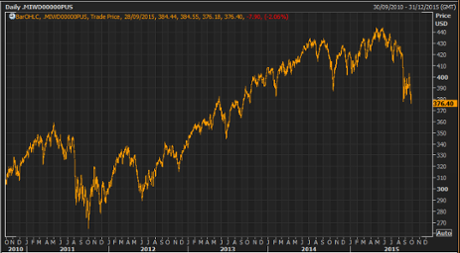
In Europe, the FTSE 100 is still in the red too - currently down 21 points or 0.3% at 5938.
German and French markets are now in the green, though, after the EC’s eurozone confidence hit a four-year high.
FXTM Research Analyst Lukman Otunuga says the markets remain edgy:
Anxiety continues to ripple through the financial markets as global developments concerning the lack of clarity on the timing of a US interest rate hike, anxieties over China entering a deep economic downturn, emerging market weakness and continual growth concerns in Europe, Japan and Asia are all weighing on global sentiment.
European investors are now looking to Wall Street, where the Dow is tipped to rise by around 0.5% after losing 2% yesterday.
U.S. stock-index futures rose, with investors betting that the selloff was overdone http://t.co/mfGeOTeFUS pic.twitter.com/WfdGTq9XD7
— Bloomberg Business (@business) September 29, 2015
Here’s the full statement from Glencore:
Glencore has taken proactive steps to position our company to withstand current commodity market conditions.
Our business remains operationally and financially robust – we have positive cash flow, good liquidity and absolutely no solvency issues.
We are getting on and delivering a suite of measures to reduce our debt levels by up to US$10.2 billion.
Glencore has no debt covenants and continues to retain strong lines of credit and secure access to funding thanks to long term relationships we have with the banks.
We remain focused on running efficient, low cost and safe operations and are confident the medium and long-term fundamentals of the commodities we produce and market remain strong into the future.
No shocks in the latest US housing report -- prices in the 20 largest US cities rose by 5% year-on-year in July:
BREAKING: US home prices rise 5% in July - S&P/Case-Shiller • http://t.co/sWBg3k5T0R
— CNBC Now (@CNBCnow) September 29, 2015
Glencore: We're operationally and financially robust
Newsflash: Glencore has just declared that it remains “operationally and financially robust”.
The mining and commodity player made the comments in a statement designed to calm fears over its financial robustness.
A spokesman said:
“Glencore has no debt covenants and continues to retain strong lines of credit and secure access to funding,”
(debt covenants are agreements between a company and its lender which prevent it from breaching certain financial limits)
Glencore seeks to reassure, says remains operationally & financially robust pic.twitter.com/IyUbrgZZeG
— Vikram (@vikramreuters) September 29, 2015
This has pushed its shares a little higher. They’re now up 13.5% at 77.8p, meaning they have recovered half of Monday’s slump.
If you own one of the 11 million Volkswagen cars designed to evade emission testing, you may hear from the company shortly:
Germany’s return to negative inflation raises the chances that prices across the eurozone are falling again. We find out for sure tomorrow....
German inflation turns negative after lower than expected Spanish one. Get ready for big DEFLATION screams tomorrow when EZ HICP is released
— Maxime Sbaihi (@MxSba) September 29, 2015
Germany's inflation rate turns negative again
Deflation alert! Germany’s inflation rate has turned negative, for the first time since January.
The German harmonised consumer prices index fell by 0.2% year-on-year this month, according to new data from the Federal Statistics Office.
Economists had expected the CPI to be unchanged; this negative reading could intensify calls for the European Central Bank to increases its QE programme:
German September CPI misses -> -0.2% YoY Vs 0% est pic.twitter.com/wUo6bmsicp
— Jonathan Ferro (@FerroTV) September 29, 2015
Update: This is the ‘harmonised’ German inflation data, adjusted to be comparable with other eurozone countries.
The unharmonised CPI showed that prices were flat year-on-year (ie, an inflation rate of 0.0%)
Updated
In London, the FTSE 100 index has climbed back from its early lows, thanks to Glencore (currently up 8.7%).
But the Footsie is still down by 31 points, or 0.5%, and on track for its lowest close since August 24 (when the markets were spooked by China).
Some calm has returned, with the futures market suggesting that Wall Street may manage a small rally after Monday’s selloff.
Jasper Lawler of CMC Markets says traders are still skittish:
Short-covering has prompted a dead-cat bounce across the commodities space but there isn’t the confidence to invest in some of the less beaten down areas of the market.
Updated
FT Lex writer Joseph Cotterill isn’t convinced by Citi’s proposal that Glencore’s management should take the company off the stock market (see earlier post for the details).
As he points out, it wouldn’t reduce Glencore’s net debt, and thus its obligations to existing bondholders......
But yes, tell me more about how taking its equity private (like Traf) will solve Glencore's bondholder problems.
— Joseph Cotterill (@jsphctrl) September 29, 2015

Our friends at the Economist are concerned by events in the financial markets:
The end of September and more bad news. The warning signs in the markets are mounting http://t.co/Kq5Zkv5FgD pic.twitter.com/T4xSIuwlIA
— The Economist (@TheEconomist) September 29, 2015
The Volkswagen emissions scandal has drifted to Spain today.
El Pais is reporting that five VW brands – Audi, Seat, Skoda, Volkswagen and Volkswagen Commercial vehicles – have pulled 3,320 vehicles from sale, while the crisis is investigated.
Separately, Seat’s Spain arm has just announced that it made 700,000 cars with rigged engines, which would have evaded emissions testing.
One of Glencore’s larger shareholders has uttered the L-word.
Legal & General’s CEO, Nigel Wilson, told Bloomberg TV this morning that Glencore has reached a “quasi-Lehman moment”, where speculation over its viability is fuelling the crisis gripping the company.
Wilson argued that Glencore’s managements need to respond to claims that its shares could become worthless unless commodity prices recover.
“There’s a lot of noise and there’s not enough signalling.”
“That lack of information causes a huge amount of uncertainty at Glencore, which is having a massive contagion effect across the world.”
More here: Glencore Must Stem Rumors, Stop Lehman-Like Moment, L&G Says
Glencore’s woes have certainly contributed to the nervousness in the markets this week. But that’s not just based on a lack of information. It’s basically because Glencore holds $30bn of net debt, twice its market capitalisation(!), in an environment where iron ore, copper, coal and oil prices are all weak.....
"You may have heard some rumours that we're a leveraged commodities trading firm. The truth is... " https://t.co/Q5t1jBHC1j
— Dan Davies (@dsquareddigest) September 29, 2015
Oher an
Platinum hits six-year low
Global growth fears are dragging commodity prices down this morning.
Platinum is leading the selloff, hitting its lowest price in six years. That’s partly due to the Volkswagen emission crisis, which could hurt demand for platinum-based catalytic converters used to clean up diesel cars.
Meanwhile, platinum drops to $899 for the first time since 2009. pic.twitter.com/uySjy3pDPN
— Eddie van der Walt (@EdVanDerWalt) September 29, 2015
The copper price has hit a one-month low, reflecting concerns about demand from China.
Copper grinds lower in London. pic.twitter.com/nYwAAjDaya
— Vonnie Quinn (@VonnieQuinn) September 29, 2015
European economic confidence hits four-year high
Business confidence across the eurozone has hit a four-year high, but the public are less upbeat.
The European Commission has reported that industrial firms, service group and retailers across the eurozone are all more confident this month, pushing its measure of economic sentiment to the highest since 2011.
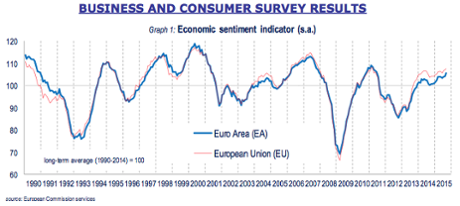
Economic sentiment rose in Italy (+3.4), Germany (+1.9), the Netherlands (+1.2) and France (+0.9), offsetting a small decline in Spain (-0.9).
The easing of the Greek debt crisis this summer may have cheered eurozone companies.
Consumers, though, are less upbeat, given the storm clouds gathering in the global economy.
The EC says:
While consumers were more upbeat on questions relating to their personal finances (expected financial situation, future savings), their views on macro-economic developments (future general economic situation, future unemployment) clouded over.
Glencore rallies after Citi suggests management buy it back
Citigroup has proposed an innovative solution to Glencore’s crisis -- the company’s managers could take it private again.
In a new research note, Citi analysts argue that the 40% slump in Glencore’s share price in the last few weeks was “overdone”.
Glencore could easily sell assets to cover the shortfall in revenue from commodity mining and trading, Citi argues. And if investors aren’t convinced, founder Ivan Glasenberg and co could simply take the problem off their hands.
Citi says:
“In the event the equity market continues to express its unwillingness to value the business fairly, the company management should take the company private, whereby restructuring measures can be taken easily and quickly.”
That would be quite a move; Glencore only floated four years ago at 530p per share, making Glasenberg a multi-billionaire. They have fallen steadily since, slumping to 68p last night, so anyone who took part in the IPO is already nursing major losses.
Citi are close to Glencore, having worked with the company on several deals including its flotation in 2011. So this may reflect the thinking at Glencore’s HQ in Zug, Switzerland.
#Glencore crisis: @Citi (de facto in-house broker for $GLEN) says Glasenberg could take the #commodities firm private pic.twitter.com/uqTTzaokHj
— Javier Blas (@JavierBlas2) September 29, 2015
This note may have helped spark the rebound in Glencore’s shares today -- they’re now up 10% today at 75p.
Glencore shares rebound almost 10% after Monday's big decline http://t.co/ioQsu45BpK pic.twitter.com/HjDcifl5uS
— Bloomberg Business (@business) September 29, 2015
Updated
UK mortgage figures beat expectations as demand rallies
Britain’s housing sector is heating up, according to new lending data just released.
A total of 71,030 new mortgages were agreed in August, more than expected, and the highest total in 18 months.
And the total amount lent rose by £3.4bn, the biggest increase since May 2008.
That suggests the housing market is strengthening, which may increase the chances of UK interest rates rising in the coming months (although there’s plenty of reasons for caution, including zero inflation)
U.K. Mortgage Approvals Rise to 71,030 in Aug. Vs. Est. 69,800
— World First (@World_First) September 29, 2015
Highest UK mortgage approvals in 18 months, most borrowed since 2008.
— World First (@World_First) September 29, 2015
Updated
Here’s our round-up of the Asian selloff:

Traders in Asia are catching their breath after a tough trading session.
In Hong Kong, the Hang Seng index has just closed 3% lower, with every share losing ground.
And China’s Shanghai index has shed almost 2%, following Japan’s 4% slide (see earlier post)
Stocks were buffeted by a cocktail of bad news -- from Glencore’s Monday slump and the wider commodities selloff, to the Volkswagen crisis and general worries over the global economy.
Volkswagen is being banished from Dow Jones’s index of companies with responsible environmental, social and governance policies, Bloomberg’s Caroline Hyde flags up:
Guess not massive shock...#VW to be removed from Dow Jones #Sustainability Indexes
— Caroline Hyde (@CarolineHydeTV) September 29, 2015

Volkswagen shares are leading the fallers in Germany again, down 3.5% in early trading.
The latest news is that Swedish prosecutors are considering launching an investigation into VW; a reminder of just how widespread this crisis could become.
Meet the new selloff, same as the old selloff:
Since this is still the same market slump as a month ago, I think the quest for a new reason is not necessarily a good use of time
— Dan Davies (@dsquareddigest) September 29, 2015
All the main European markets are down again, extending yesterday’s selloff.
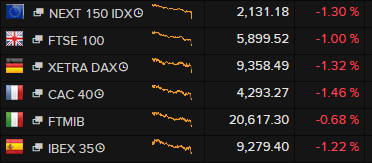
They’re heading towards the lows hit in late August, triggered by the turmoil in China.
De-risking continues in Europe. #Germany's Dax trades 1.5% lower after open. pic.twitter.com/7uq7XE3aPZ
— Holger Zschaepitz (@Schuldensuehner) September 29, 2015
If it looks like a rout and smells like a rout then it probably is one, says Mike van Dulken of Accendo Markets.
He blames the usual suspects - global growth fears, China, the commodity slowdown, anxiety that the US Federal Reserve might raise interest rates soon.... But there’s also politics to worry about:
On the geopolitical front, speeches by Obama and Putin at the UN yesterday highlighted the difficulties and strained relationships facing world leaders in coordinating efforts to calm things in the Middle East and Syria in particular.
#Glencore bounces after 30% plunge yesterday. @citi analysts say sell-off "overdone" But all other miners in the red pic.twitter.com/Rd9cn2731c
— Caroline Hyde (@CarolineHydeTV) September 29, 2015
Building materials and plumbing firm Wolseley is leading the selloff in London today, after warning that market conditions are tough.
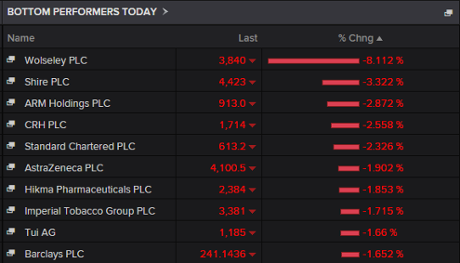
FTSE 100 falls 1% in opening trading
The London stock market has just opened....and shares are dropping.
The FTSE 100 index has lost 62 points, or around 1%, to 5892. That’s its lowest level since markets were roiled by the “Great Fall of China” a month ago.
There’s only one riser....and it’s Glencore! Its shares are up by 8%, or five whole pennies, at 74p, clawing back a little of Monday’s 29% slump.
It’s early days, though....
First trades going through in Glencore, +6% on yesterday's close. $GLEN
— David Jones (@JonesTheMarkets) September 29, 2015
Updated
Indian rate cut surprises economists
India’s central bank has responded to fears of a global downturn by cutting interest rates.
The Reserve Bank of India surprised analysts by slicing 50 basis points off its main refinancing rate, to 6.75% from 7.25%. Only one economist had predicted the move, which takes borrowing costs down to a four-year low.
Governor Raghuram Rajan explained that inflationary pressures are easing, in the face of slowing global growth.
“The weakening of global activity since our last review suggests that commodity prices will remain contained for a while.”.
Rate cut by India's central bank brings suddenly takes the key rate to a 4-year low #India #FX pic.twitter.com/25B2MLdkM9
— David Ingles (@DavidInglesTV) September 29, 2015
Updated
Australia’s stock market has also fallen sharply overnight.
The main ASX index shed almost 4%, led by heavy declines in the mining and energy sector.
Australia's #ASX absolutely hammered today... Closing down 3.8% or 195 points at 4918 #AUD $0.6945 #ausbiz #stocks #markets #selloff
— Matthew Taylor (@MattCNBC) September 29, 2015
Markets are falling because investors fear a global recession, says Steven Leung, a director at UOB Kay Hian in Hong Kong.
Leung warned (via Reuters):
“If you look at Japan ... its economy is in bad shape. And economic situation is not good in Europe, either.”
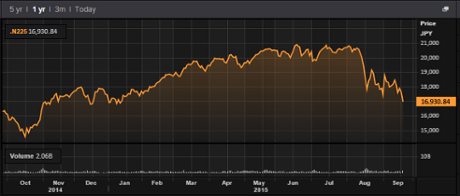
Asian markets hit 3.5 year lows

Asian stock markets have already been hit hard today, falling to their lowest levels since 2012.
Japan’s Nikkei slumped by 4%, or 714 points, to close at 16930. That’s an eight-month low, with every share down today.
Traders were alarmed by Monday’s selloff in Europe - particularly Glencore’s 29% tumble - and in New York.
The news that a Japanese shipping firm called Daiichi Chuo Kisen Kaisha had filed for protection from creditors also spooked Tokyo. It had suffered from the decline in dry freight, as demand for iron ore, copper etc has slumped.
The Agenda: 'Darkness descends' on gloomy markets
Good morning, and welcome to our rolling coverage of the world economy, the financial markets, the eurozone and business.
City traders would be advised to pack a tin hat alongside their lunch boxes today, as worries over the global economy grip the markets again.
The European stock markets are all expected to slide this morning, as the City hunkers down in the face of volatility, fears over China’s slowdown, and angst over the impact of higher US interest rates.
Chris Weston of IG says that darkness is descending on markets, as investors scramble to react to recent events.
Traders and investors alike are being schooled on the importance of adjusting portfolios to the effects of volatility.
If the global financial crisis taught us anything, it’s that it’s best not to own assets when you don’t understand why they’re going down (especially aggressively). Capital preservation is taking place now before our eyes.
Traders are alarmed that liquidity is oozing out of the financial sector, Weston adds:
Yesterday we heard Saudi Arabia had withdrawn $70b from outside fund holdings, adding to that of nations such as China who have been drawing down on its foreign exchange reserves.
The liquidity withdrawal is easily trumping the QE injections from the ECB and BoJ and this is causing a tightening of global financial conditions.
Our European opening calls: $FTSE 5909 down 50 $DAX 9423 down 61 $CAC 4314 down 43 $IBEX 9312 down 82 $MIB 20562 down 197
— IGSquawk (@IGSquawk) September 29, 2015
Commodity mining and trading firm Glencore will be in the front line again.
Yesterday, we watched nervously as Glencore tumbled by 29% after analysts warned that its shares could be wiped out by the commodity crash. Can it do better today?
IG's problem #Glencore. Total debt 50bn / Market Cap 15bn pic.twitter.com/xsiOWOvguq
— Guy Johnson (@GuyJohnsonTV) September 29, 2015
Glencore sinks to all-time low on continued debt fears http://t.co/n4i2Tqyat8 pic.twitter.com/Gb7MWsVAio
— Wall Street Journal (@WSJ) September 29, 2015
There’s a busy economic agenda ahead, with plenty of data to scrutinise for signs of weakening demand and deflation.
- 9.30am BST: UK mortgage approvals for August
- 10am BST: Eurozone consumer confidence for August
- 1pm BST: German CPI inflation data for September
- 2pm BST: US Case-Shiller house price survey for July
-
3pm BST: US Consumer Confidence survey for September
And we’ll also be watching Volkswagen, as prosecutors investigate the emissions scandal that has rocked the auto industry.
Updated







.jpg?w=600)



