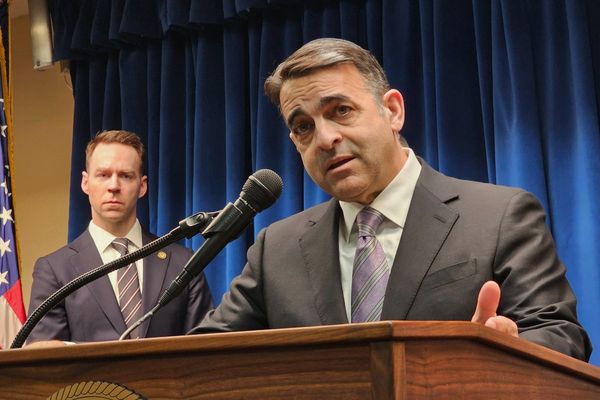
Apple’s Tim Cook is on stage now, promising “monster announcements” across several product lines.
Apple CEO Tim Cook skips the usual updates for what he promises to be monster announcements across many product lines pic.twitter.com/ynNUy9Ucga
— Gadjo C. Sevilla (@gadjosevilla) September 9, 2015
So, bang on cue, here’s the Guardian’s Apple liveblog:
I don’t think I have any ‘monster’ news to offer, so am going to clear off now. Will be back if there are any major developments....
There’s robust trading in Apple shares today, as Wall Street prepares to see the company’s latest wares unveiled.
28 million Apple shares have changed hands already, twice as many as the second most active company on the Dow, Intel.
This has pushed Apple’s share price up by 0.6%, as investors anticipate CEO Tim Cook’s appearance on stage shortly:
Panoramic view of the auditorium 15' before #AppleEvent kicks off (photo via @DanielEran) #Apple pic.twitter.com/f8noM9urt5
— george mastropavlos (@g_mastropavlos) September 9, 2015
My colleague Alex Hern explains what’s expected:
....but Wall Street dips
Over in New York, hopes of Asian stimulus measures have crunched into fears of a US interest rate hike.
After that solid start, the Dow Jones and the S&P 500 just dipped into negative territory.
Stocks go red.
— Joseph Weisenthal (@TheStalwart) September 9, 2015
And that’s because the number of job openings available across America has hit a record high of 5.8m in July, according to the latest Job Openings and Labor Turnover survey.
Never before have there been so many job openings: http://t.co/aqF8dmBPK6 pic.twitter.com/Zg1t4E3qXs
— MarketWatch (@MarketWatch) September 9, 2015
Upbeat employment data could prompt the Federal Reserve into the much (too much?!)-discussed rate hike this month.
Tony Cross of TrustNet reckons this could undermine market confidence, in the run up to the Fed’s meeting next week.
Wall Street is however proving to be something of a drag on sentiment – the latest employment numbers have shown a record number of job openings state-side and this is once again throwing open the possibility of the Fed gambling on a rate hike next week.
If conviction builds further here then even talk of renewed stimulus measures from Beijing will do little to placate a market that’s worried about the wider global consequences of higher borrowing costs in the US, but for now it’s the base metals miners that are pulling through much of the upside.
Updated
FTSE 100 closes up 1.35%
Another day, another chunky move in the stock market.
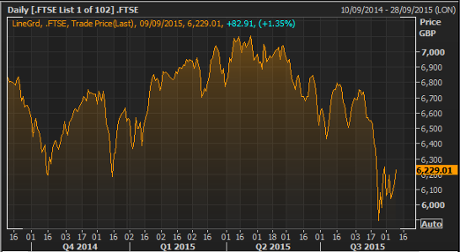
Britain’s FTSE 100 just closed for the day, up 82 points or 1.35% at 6229. That’s the highest closing level since the end of August:
Hargreaves Lansdown, which sells financial products, was the biggest gainer. It closed 6.9% higher after reporting record new business.
It was followed by three mining stocks -- Anglo American (+5.5%), Glencore (+4.7%) and BHP Billiton (+3.6%). That reflects hopes that China’s economy could enjoy a softer landing, now the government is a) sounding more positive, and b) promising to do more.
Updated
Hmmm, the rally is fading somewhat:
Dow gives up early gains, down 150 points from high http://t.co/5aC3AEsPCb pic.twitter.com/AKWM3CsGbW
— Bloomberg Markets (@markets) September 9, 2015
The NIESR think tank has warned that growth in the UK economy slowed over the summer.
It predicts that Britain’s GDP rose by 0.5% in the June-August quarter, down from 0.6% in the three months to July.
That would also be weaker than the 0.7% growth officially recorded in the second quarter of 2015.
NIESR adds:
Despite the slight softening, growth remains close to the estimated long run potential of the economy, but below the average rate of growth (0.7 per cent per quarter) observed since the start of 2013.
NIESR August UK GDP estimate +0.5% vs +0.7% prior http://t.co/cA2jNAIQ0E The GDP estimate from NIESR - Prior revised to +0.6% from +0.7% …
— Matt Baker (@BizDatabase) September 9, 2015
Wall Street has joined the rally. The Dow jumped 150 points, or nearly 1%, at the start of trading.
Dow rises 150 points after Japan's 8% surge buoys global stock markets. Apple up 1%, ahead of big event. http://t.co/A9OlUXl3FI
— CNNMoney (@CNNMoney) September 9, 2015
Lunchtime summary: Stimulus hopes drive markets

A quick recap:
World stock markets have continued their recent wild swings, by posting solid gains led by a big rally in Asia.
The cause? Hopes of fresh stimulus measures to pep up the global economy.
Japan’s Nikkei was the stand-out performer, surging 7.7% today. That appears to be sparked by prime minister Shinzo Abe’s pledge to keep cutting corporate taxes.
China’s Shanghai Composite rallied for the second day, up 2.4%. Optimism was rife after the Ministry of Finance vowed to strengthen fiscal policy, boost infrastructure spending and speed up reform of its tax system.
Premier Li X then tried to reinforce confidence, telling policymakers that the economy was moving in the right direction.
FXTM research analyst Lukman Otunuga says:
It appears that the noticeable decline in both imports and exports from the recent China economic data has been shrugged away, with this perhaps linked to expectations that the People’s Bank of China will ease monetary policy further.
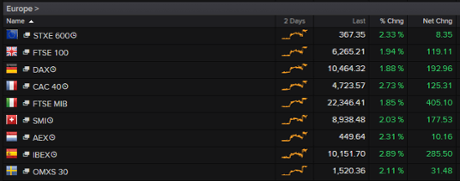
European stock markets have followed Asia’s lead, with the main indices gaining as much as 2.6%
Investors are scrambling to get back into the market after August’s selloff.
Jasper Lawler of CMC Markets says the City is calculating that the Federal Reserve is unlikely to raise interest rates this month (especially after the World Bank urged them to sit tight).
It’s still fear rather than fundamentals driving markets. On the way down its fear of losses but on the way up its fear of missing out.
World Bank chief economist Kaushik Basu’s view that a Federal Reserve rate hike would trigger “panic and turmoil” echoes that of IMF head Christine Lagarde. Top officials publically coming out against a rate hike will make it harder for Janet Yellen to move in September.
In addition, the latest economic news from the UK is worrying:
The TUC has warned that the recovery could be at risk, while analysts predict that UK growth is slowing in the face of international upheaval.
Updated
The decline in Britain’s manufacturing sector in July shows that the government’s pledge to rebalance the economy is floundering.
So argues Chris Leslie MP, Labour’s Shadow Chancellor:
“The increase in the trade deficit and fall in manufacturing output are both signs of George Osborne’s neglect of the need for a balanced recovery.
“The trade in goods has sunk to a five year low and exports have not kept pace with the Chancellor’s ‘march of the makers’ promise.
“Britain needs a serious strategy to help exporters – this means redoubling efforts to boost productivity, tackling infrastructure obstacles, addressing the skills deficit and ensuring innovators can access the capital they need.”
Here’s Heather Stewart’s full take on the data:
TUC General Secretary Frances O’Grady is concerned by that Britain’s manufacturers suffered the biggest drop in output since May 2014.
She says:
“The sharp falls in manufacturing and exports suggest that the economy is entering tougher times. And with the failure to fix long-term problems, like Britain’s low rates of investment and innovation, the government’s severe spending cuts will put the recovery at even greater risk.
“These are worrying times for working people and their families, who remain hard-pressed after the longest fall in living standards on record. We need a better economic plan for a stronger and fairer economy that works for the many, not just the few.”
These charts help to show why today’s UK trade data (details here) is worrying:
The global slowdown has arrived on Britain's doorstep http://t.co/90zrYtYvkm @jillianfward pic.twitter.com/ZOwZWOCrXX
— Jennifer Ryan (@jenryanews) September 9, 2015
2 things really worry me about the UK recovery. The 1st is productivity. The 2nd is this. Today's stats won't help. pic.twitter.com/X4nc8e3vQa
— Duncan Weldon (@DuncanWeldon) September 9, 2015
Wall Street is expected to rally by around 1% when trading begins, in 90 minute time.
Conner Campbell of SpreadEX says:
The US open looks set to continue the buoyant market atmosphere this afternoon, with the Dow futures suggesting a 150 point jump when the Wall Street bell rings.
Updated

Associated Press now has full details of premier Li’s upbeat comments at “Summer Davos” today:
China’s No. 2 leader tried Wednesday to mollify foreign concerns about its economic slowdown, saying growth is in the “proper range” and Beijing has no plans to allow its currency to decline further.
Speaking at a meeting of the World Economic Forum in the eastern city of Dalian, Premier Li Keqiang said Beijing will stick to plans for market-opening reforms despite recent “fluctuations” in economic performance.
Communist leaders are in the midst of an unusually high-level effort to calm global financial markets after a collapse in Chinese stock prices and abrupt downturns in manufacturing and exports.
The central bank governor, finance minister and securities regulatory agency issued similar statements last weekend that stock market turmoil was ending and the economy was stable.
“The underlying trend of the economy is still moving in a positive direction,” said Li, the country’s No. 2 leader and its top economic official. Pointing to data showing more than 7 million urban jobs were created in the first half of the year, he said, “all this shows the Chinese economy has been running within the proper range.”
Li announced no new initiatives but touched on a wide range of issues that are sensitive for foreign investors in a clear attempt to assure them business conditions would remain stable.
Despite today’s gains, many stock markets are still lower than at the start of this year.
America’s S&P 500, Britain’s FTSE 100, Hong Kong’s Hang Seng and China’s Shanghai Composite have all now fallen into the red.
But Japan’s Nikkei and Europe’s Stoxx 600 are slightly higher than on January 1st.
Select Equity Indexes (rebased to 100 at start of 2015): pic.twitter.com/i4BpgPA90K
— Michael McDonough (@M_McDonough) September 9, 2015
Photos: Stock markets rally
There were happy faces on China’s trading floors today, as hopes of fresh stimulus measures sent the Shanghai index up over 2%:


This fruit vendor kept an eye on stocks, while selling his wares at a market in Hangzhou, in eastern China’s Zhejiang province.

And over in Tokyo, there was excitement as the Nikkei posted its biggest one-day leap since October 2008:

Back in China, premier Li Keqiang has declared that the country has succeeded in fighting off ‘potential systemic financial risks’.
Li told a panel discussion at the “Summer Davos”, in the port city of Dalian, that recent measures taken to calm market instability had worked.
China has successfully fended off potential systematic financial risks, Premier Li Keqiang says at Summer Davos in Dalian city
— China Xinhua News (@XHNews) September 9, 2015
China must keep implementing reforms, Li continued:
“(We) will persist with a market-oriented, law-based system to establish an open and transparent capital market.”
Updated
The drop in Britain’s manufacturing output in July suggests growth is weakening this quarter, as the slowdown in China and beyond hits demand.
Howard Archer of IHS Global Insight says growth could drop to 0.5%, from 0.7% three months ago, or even lower.
Muted manufacturing activity and weakened exports is worrying for hopes that UK growth can become more balanced and less dependent on the services sector and consumer spending.
Mike Rigby, head of manufacturing at Barclays, says British factories are finding it tough to get export orders in the current climate.
Here’s his take on today’s gloomy industrial data:
“It hasn’t been a particularly good summer for manufacturing production and growth is hard-earned. Although macroeconomic conditions remain broadly supportive, it’s surprising that lower oil prices haven’t yet had more of a positive effect on the sector.
With demand in the Eurozone still sluggish and an uncertain international picture, manufacturing output appears to be is stuck in neutral.”
The UK' trade deficit widened in July. Latest leg in the services surplus vs goods deficit race won by goods. pic.twitter.com/ODtO3fnbAQ
— RBS Economics (@RBS_Economics) September 9, 2015
The disappointing drop in UK manufacturing output send the pound down almost half a cent against the US dollar, to $1.536
Weak UK manufacturing data sees sterling sell off, #GBPUSD down to 1.5360 RO pic.twitter.com/ejdJAnTbNp
— IGSquawk (@IGSquawk) September 9, 2015
The stock market remains upbeat, though -- probably because weak economic data means more chance of fresh stimulus measures from central bankers.
UK factory production slumps, and trade gap widens
Two disappointing pieces of economic data from the UK just hit the wires, showing that Britain’s manufacturing base is struggling.
UK industrial output shrank by 0.4% month-on-month in July, dashing hopes of a small rise. It was just 0.8% higher than a year ago.
And the picture at manufacturing firms is particularly worrying. Production fell by 0.8% month-on-month, the biggest decline since May 2014, and is 0.5% lower than in July 2014.
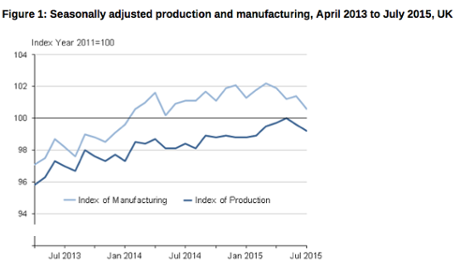
The Office for National Statistics says that output fell sharply at transport equipment makers, and manufacturer of basic metals & metal products.
It may partly be because UK car factories shut down for the summer earlier this year.
But that’s not the only bad news.
Britain’s trade gap has widened sharply in July. The deficit in goods widened to £11bn, the biggest since July 2014, as exports tumbled by almost 10%.
The ONS says:
Exports of goods decreased by £2.3 billion to £22.8 billion in July 2015, the lowest export figure since September 2010. This is attributed to decreases in semi-manufactures (specifically chemicals) of £1.0 billion and finished manufactures of £0.8 billion. Imports of goods increased by £0.3 billion to £33.9 billion over the same period.
Even when Britain’s surplus in Services is included, the overall trade gap was £3.37bn, compared to just £800m in June.
Updated

The prospect of more stimulus in Japan was a key factor behind today’s strong rally, which dragged the Nikkei back from a seven-month low.
Associated Press explains:
The Nikkei, which had earlier hit its lowest level since February, bounced after comments by Prime Minister Shinzo Abe raised expectations of more measures to shore up economic growth under his “Abenomics” stimulus program.
In remarks from Abe read to a Bank of America-Merrill Lynch conference in Tokyo, he pledged to cut corporate tax rates by at least 3.3% next year.
Passage of legislation making it easier to hire temporary workers and reports that Abe plans to keep his current economic team in a cabinet reshuffle next month also appeared to whet investor appetite.
Japan’s economy does still look weak - it shrank by 0.3% in the last quarter, despite Abe’s existing stimulus measures.
Japan's economy may require more emergency support... Which if you believe the markets is apparently great news.
— Duncan Weldon (@DuncanWeldon) September 9, 2015
Updated
Shanghai stocks jump 2.3%
The promise of fresh stimulus from Beijing had a predictable effect on shares in China.
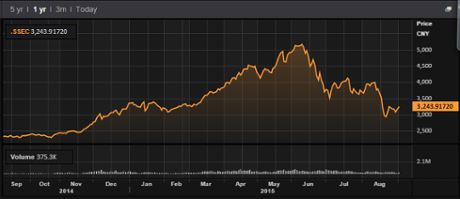
The Shanghai stock market joined the Asian rally with gusto, and closed 2.3% higher.
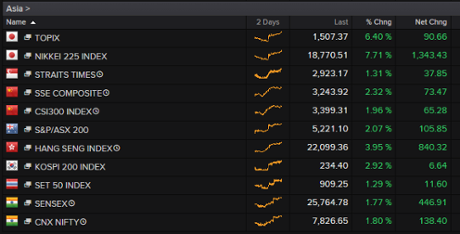
That’s a full 10% higher than its recent low, in late August, suggesting the selloff may have bottomed out.
Even so, it still leaves the Chinese market down a third since June as the equity bubble deflates.
Updated
China's pledge to boost spending

Reuters has a good take on China’s new pledge to boost spending, a day after trade data showed a worrying tumble in imports.
China will strengthen fiscal policy, boost infrastructure spending and speed up reform of its tax system to support the economy, the Ministry of Finance said, joining other steps by authorities to re-energize sputtering growth.
The ministry will accelerate major construction projects, bring in private financing through increased use of the public private partnership (PPP) model, standardize the management of local government debt and reform taxes, it said in a statement late on Tuesday.
Chinese policymakers have stepped up efforts to revive an economy growing at its slowest pace in decades, with a 40 percent plunge in mainland stock markets since mid-June roiling global financial markets.
On Tuesday, data showed China’s imports tumbled in August, raising concerns about the health of the world’s second-largest economy and its contribution to global growth.
“We will accelerate the implementation and improvement of proactive fiscal policy and related measures, do timely fine tuning, and speed up reform measures to support stable growth and promote continued healthy economic development,” the finance ministry statement said.
Full story: China finance minister targets fiscal policy, infrastructure to support economy
Japan’s stock market has been one of the worst performers since China devalued the yuan last month.
The Nikkei’s remarkable 7.7% leap today suggests that investors are now shaking off their worries.
Khiem Do, Hong Kong-based head of multi-asset strategy at Baring Asset Management, said (via Bloomberg):
“The selloff in Japanese equities has been excessive amid concerns over China’s economic slowdown. Today’s rally can be sustained once the market’s perception of the Chinese economy improves.”
Budget airline Ryanair can also take some credit for today’s upbeat mood.
Ryanair hiked its profit forecast by 25% this morning after stronger-than-expected passenger growth over the summer. Its shares have surged 9% in Dublin this morning to a new record high.
Updated
The main European markets are rallying too; with the German DAX up 2.1% and France’s CAC up 2.3%.
Shares in carmakers such as Renault, Daimler and BMW are all up around 5%, after China reported a rise in car sales last month.
. @BMW & @Groupe_Renault both up 5%...auto stocks getting lift after China auto sales August give some relief = +0.6% yoy
— Caroline Hyde (@CarolineHydeTV) September 9, 2015
FTSE 100 jumps 1.7% in early trading

Britain’s FTSE 100 has jumped by 100 points at the start of trading, a gain of 1.7%, to 6246 points.
Mining shares are leading the way, with commodity trader Glencore up 5.8% and Anglo American up 4%. Both companies would benefit if China does boost spending to avoid a “hard landing”, as it appeared to pledge overnight.
European stock markets are open, sending traders racing to buy shares.....
It's time. @RobinKwong http://t.co/VQA0NGhKVR pic.twitter.com/hVAfdRA2ga
— Martin Stabe (@martinstabe) September 8, 2015
World Bank: Fed shouldn't raise rates now
Today’s market rally is also being driven by hopes that the US Federal Reserve will not raise interest rates next week.
The World Bank’s chief economist, Kaushik Basu, told the Financial Times that the Fed risks triggering “panic and turmoil” in emerging markets if it hikes at its September meeting.
Policymakers hold fire until the global economy is on a surer footing, Basu argued.
More here:
World Bank chief economist warns Fed to delay rate rise
Introduction: Markets rally as China promises to do more

Good morning.
A new sense of optimism is racing through the financial world this morning, driving shares up sharply across Asia - with Europe due to follow.
Japan’s stock market has just posted its biggest one-day jump in seven years, as confidence returned to Tokyo’s trading floors.
The Nikkei surged by 7.71%, a gain of 1,343 points. to close at 18,770.
Every share gained ground, with many jumping over 10%.
We’ve not seen this sort of move since the wild days of the financial crisis in 2008.
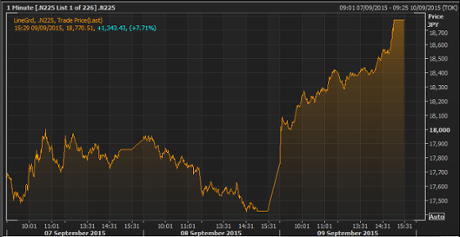
The surge was triggered by two factors.
1) Prime minister Shinzo Abe pledged to implement a planned corporation tax cut, and to go further if possible.
2) New optimism over China. Last night, China’s Ministry of Finance issued a statement focused on “fiscal measures to support growth” - seen as a sign that Beijing will spend more to support the economy.
Angus Nicholson of IG Index explains:
Global markets have been buoyed by China’s new market intervention and the announcement from the China’s Ministry of Finance (MoF) that they will speed up fiscal spending. Japanese markets have been the standout performer in Asia today, seeing a record daily rise off the back of plans to cut corporate tax rates....
Prime Minister Shinzo Abe announced plans for dramatic cuts to corporate tax rates. He stated that he planned to initially cut the current corporate tax rate of 35% by 3.3%, and push it down into the twenties over several years until it reaches as level that compares favourably in the international context.
The market was no doubt buoyed by this news alongside renewed Chinese stock market support and fiscal spending, as well as further weakness in the yen. However, the Nikkei 225 was also partly just very oversold and primed for a rally on short covering alone. The percentage of stocks trading below their 200-day moving average had reached 20.4%, its lowest level since mid-2012.
Good news for those who suffered losses after the Great Fall of China, three weeks ago.
A stormer of a session for the Nikkei sees it finish +1,343 points or 7.71% higher. FTSE100 forecast to start +100 points at 6246.
— David Jones (@JonesTheMarkets) September 9, 2015
"Billions wiped onto pensions" ™
— David Jones (@JonesTheMarkets) September 9, 2015
We’ll be tracking all the latest developments across the world economy, the financial markets, the eurozone and business through the day.
Updated