When I told my Dad I wanted to go to watch a football match, he thought I was mad. It was the 1994/95 season, and the game was Bradford City against Plymouth Argyle. I was offered free tickets through the local team I played for, and I was excited because I’d wanted to see a live match for ages. I didn’t support City – I was an Everton fan. But at the age of 11, I was just starting to get obsessed with the game, and getting to a match – any match – was the aim. Still, my Dad was adamant that he didn’t want to go. Why, he asked, would we want to go and sit with people doing monkey chants?
In the mid-90s, my dad’s attitude wasn’t unusual. City attracted thousands of fans each week, but I didn’t know one black or Asian person who had been. Football as a hobby was fine, as was watching it on television, but actually attending games was seen as a bizarre form of self-imposed punishment.
After a protracted period of begging, we went to the game. We sat in the family stand, and the match passed without major incident. It finished 2-0 to City, and the day felt like it contained two victories. The team had won and, more importantly for me, nothing even remotely racist had happened.
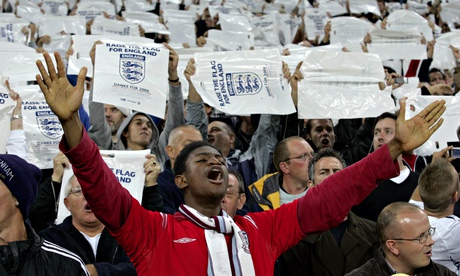
When I think back to that afternoon now – in the light of the video that appeared this week showing Chelsea fans subjecting a French man to appalling racist abuse on the Paris Métro – my dad’s concern seems more sensible than it did at the time. And yet it’s two decades later; the game is supposed to be a cosmopolitan, globalised, sanitised product, with any of those old prejudices banished altogether. So do those fans represent anyone other than themselves? Do they demonstrate a problem in the game, or in society? Do they prove that my dad was right?
That Argyle match came at the beginning of an ascent that concluded with Bradford’s arrival in the Premiership in 2000. During that period I went to about a dozen games, mostly with school friends, usually when the club offered its “quid-a-kid” deal. When we went, we’d stand in the kop, or sometimes sit in the Midland Road stand. During most of those games nothing of note happened in the stands. There was the time some Crystal Palace fans were thrown out for sitting in the home end, and the time a woman constantly referred to Jan Åge Fjørtoft as a “dirty foreigner”, but on the whole it wasn’t until my late teens that I saw anything racist.
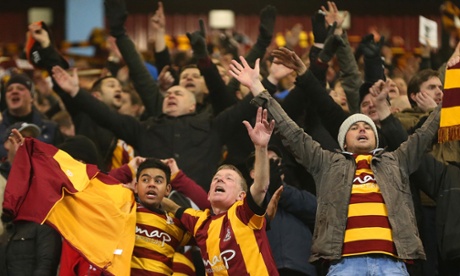
By that time, I didn’t really expect to see racism at a football ground. Post Euro 96 – a joyous moment of national belonging, excitement and ultimately disappointment – I felt that English football was something anyone could be a part of. There was, certainly among my group of friends, a sense of real pride in the England side. The racist tensions and far-right recruitment outside of grounds seen in the 80s felt long gone.
But it wasn’t that simple. At the start of the 2004-5 season, I went to City with a couple of friends, and sat in the recently renovated all-seater kop to watch Bradford play Chesterfield in the league. There were a group of middle-aged men sat in front of us. During the first half they mostly chatted between themselves, discussed their bets and watched City take a 2-0 lead. But in the second half Chesterfield rallied, coming back to 2-2 and eventually winning the game with a late Caleb Folan goal. When the strike went in, one of them stood up and launched into a tirade of racial abuse. Folan, he screamed, was a “cheating nigger”.
I’d never seen anything that overtly racist at a game – or anywhere else, for that matter. It was a vitriolic, hate-filled outburst that seemed to come out of nowhere. One of the friends I was sitting with wanted to say something, but I told him not to bother. It didn’t seem like a situation that you could talk your way out of, and this guy didn’t seem like the kind of person you’d have luck reasoning with.
The strangest thing was what happened next. When the guy in front of us had finished his rant, one of his mates turned his attention to Dele Adebola, a striker for Bradford at the time. “Sorry, Dele,” he said.
There was something sickening about seeing that happen in a place where I’d felt comfortable, coupled with the glib compartmentalisation used as a rationale to justify it. That was the tribalism that’s so often pointed out as one of football’s biggest drawbacks. He was able to convince himself that his abuse was a matter of character – of one guy being the enemy, and another a friend. Football fans do this all the time, of course, telling themselves that it’s fine to see a player who leaves your club for a bigger one as a traitor and one who joins in the same circumstances as a hero. But when that doublethink crosses into bigotry, the stakes are suddenly higher.
The video of those Chelsea fans reminded me of that moment, as did the disingenuous attempts to explain away the incident in the aftermath. It was the same mindless attitude that I thought, until that Chesterfield game, didn’t really exist in football any more – or did in eastern Europe or Italy, perhaps, but not in multicultural Britain. It was the kind of thing my dad warned me about.
One of the most shocking things about the Chesterfield incident was that it happened at City. The club has a hard-fought reputation for progressive policies, both in terms of transfers (they bought Ces Podd, one of the country’s first black footballers, in 1970) and community-based programs aimed at encouraging engagement with the city’s Asian population. That context leaves me with some sympathy for Chelsea (and even Nigel Farage) for being associated with that element of their support. Chelsea have taken the right course of action and banned three of the group from Stamford Bridge. But in recent years, what has really caused me to despair is seeing clubs get it completely wrong when it comes to race and racism.
The annus horribilus came in the 2011/12 season, which saw Luis Suarez and John Terry banned for racist incidents. The handling of the incidents highlighted that when a club fails to condemn racism, it legitimises it. Liverpool’s response to Suarez’s ban was to reject the decision and attempt to smear Patrice Evra. Victim-blaming at that level just plays into the hands of the ringwing elements that sour the game in the first place. Moments like that can undo years of hard work by groups such as the Kick It Out campaign, and undo the stigma that has been attached to casual and overt racism at a stroke.
I didn’t go to see City again for two years. That incident at the Chesterfield game stayed with me, and I had – rightly or wrongly – an expectation that something could happen. In fact, the only time it did was in north London. I took my father in law, who is Spanish, to see Spurs in the Europa cup against Lazio. During the game, the Lazio fans, who were directly below us, made monkey noises everytime a black Spurs player went near the ball. Again, that overt racism and fascism seemed completely foreign. I remember hearing the chants, but they didn’t really register until the second or third time it happened. After that I did consider whether it was worth going to games, but decided that what happened there, with one of the most notorious fan bases in world football, was just a throwback.
I’ve seen Bradford manage to throw away a lead at Wimbledon in the last minute, before losing 5-0 to Swansea in the League Cup final and then return to Wembley to win the League Two playoff final. I can’t imagine missing those games out of a fear that something might happen.
Perhaps all this is just football. On the other hand, perhaps it’s just life. One of the most interesting quotes to come out of the incident in Paris was from the man who was prevented from getting on the train, Souleymane S. “You know, I live with racism,” he said. “I wasn’t really surprised at what happened to me, even if it was the first time in the Métro.”
I’ve been on a flight with a bunch of Stoke fans, which was a nightmare. But I’ve also been on flights full of lads on tour, minus the footballing element, that were a lot worse. And yes, I saw that incident at Bradford, but I’ve been in more dangerous racist situations at taxi ranks after a night out.
This isn’t just a football problem; it’s a societal problem. It rears its head in football as it does in most walks of life. When a mother spews racist abuse on a bus or a politician says something beyond the pale, there’s usually plenty of hand-wringing and a nuanced discussion of how this happened. But with football there’s a tendency to blame the entire community, without ever considering that the vast majority of supporters are disgusted by incidents like the one in Paris.
If someone I knew was thinking twice about going to a game I’d say go, without a doubt. To turn away from the sport because of the actions of those idiots is to let them win. I live in the US now, so I can’t get to Valley Parade as much as I’d like. But as Bradford go on another unlikely cup run, I’ll be watching, and getting just as excited from this side of the Atlantic. And if I was back home, I’d certainly be going in person, no matter what a bunch of morons get up to on the Paris Métro.