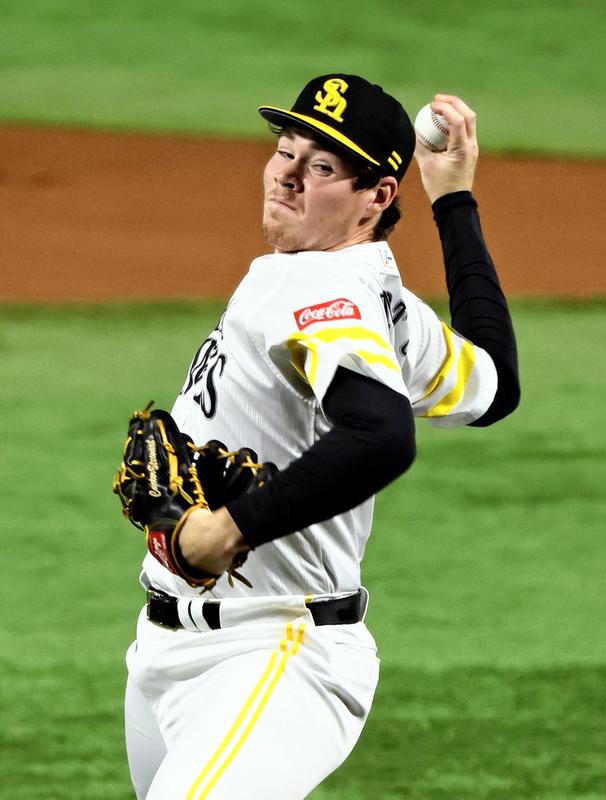
Carter Stewart Jr. was famous for the spin rate on his pitches as an amateur. He became well-known in 2019 for the way he made heads spin with his decision to start his professional career in Japan.
The right-hander, whom the Atlanta Braves selected with the eighth pick in the 2018 MLB draft, agreed to a six-year deal reportedly worth about 770 million yen with the Fukuoka SoftBank Hawks last year, opting for Nippon Professional Baseball in a reverse of an outdated trend that has typically seen older players join teams in Japan to play out the waning years of their careers.
Stewart was considered an elite pitcher in high school, and his career path appeared to be as straight as one of his 150-plus-kph four-seam fastballs. But, just like successful pitchers, he threw the baseball world a curve by eventually walking away from an Atlanta offer and playing in junior college. Stewart, who is listed at 198 centimeters and 101 kilograms, then packed his bags and brought his talents to SoftBank.

"I just, at the time, and now, thought it was the best opportunity for me," Stewart told The Japan News on Saturday by phone from Fukuoka.
"The baseball's fantastic, the whole player base, the fans -- everything's great about it. And with the timing, the way that everything happened back in the States for me, everything just came together and gave me the opportunity to do something overseas and gave me an opportunity to do something groundbreaking.
"I like trying new things and going down paths that people haven't tried before."
Stewart opted for a changeup by starting his career in Japan, but this is a route that is open to many players, if they so choose.
"A lot of guys can follow this path," said Tony Barnette, a former Tokyo Yakult right-hander who now works for the Swallows as adviser and scout, in an email to The Japan News. "Organizations must be prepared to fail in this endeavor, and try again. Not every first-rounder pans out."
But Barnette warned this might not be the best path at the moment for every NPB club.
"Japan's teams that can do this will depend a lot on financial security as well. Smaller-spending teams will probably bow out of this for now, so look for teams like SoftBank to continue.
"I've spoken about the possibility of jumping to Japan as an amateur in the past," Barnette added. "I'm glad to see it happen and I hope it is a successful venture for Carter."
Virus hampers learning process
Stewart, like much of the world, is waiting for the sports ecosystem to recover after the COVID-19 pandemic. He is trying to stay in shape amid the various shutdowns.
It might have been worse for the pitcher had he been in a big league farm system this year. MLB has a proposal to trim the number of minor league teams from 160 to 120, and farm players on all levels have endured low salaries that were brought to light last year, spurring the announcement in February of wage increases.
However, the 20-year-old hurler, who graded out as a top-flight amateur, said his jump to Japan was more about getting his career going on rich soil than the big bucks the contract brought him.
"Obviously that's something that's in the back of my head, but I don't think that was too much of a big issue," Stewart said about his lucrative contract.
"That's part of the way baseball is in the minor leagues in the States -- you just have to get through it, you're trying to grind through to the big leagues. And it's the same thing over here."
Sugihiko Mikasa, the Hawks' general manager, said Stewart is grinding through the process in Japan, thanks to veteran pitchers such as Dennis Sarfarte, NPB's all-time saves leader among imports, and veteran righty starter Rick van den Hurk.
"Living abroad is a learning process," Mikasa said. "[Those two] can teach him a lot. Those guys are good teachers."
And Stewart said he is working hard to absorb the lessons and make the most of his skills.
"My goal, really for the rest of this year, is do anything and everything I can to get better to prove that they made a good decision for me to come over here," the Florida native said.
"And that I can be better not just because I'm a foreigner and I got special privileges, but [also] because I worked my ass off to get better than them."
Looking into the future
When asked about a return to eventually pitch in the big leagues, Stewart left the door wide open to a room full of options.
"Obviously I'd want to, but at the same time, there's so many different things that can happen. You know, baseball -- it's a job until it isn't. You have baseball after baseball -- you can teach, you can be a coach and all that, but while you're playing baseball, you don't know how long your career's going to be," he said.
"I have a specific amount of time already allotted, but I want it to be longer than that. I want to perform well and I want to get better every day so I can play for a long period of time, and maybe at some point have an opportunity to go back to the States. That would be awesome, but at the same time, I have no restraints on staying over here until I'm 50."
When asked what would keep him in Japan for 30 years, he praised aspects on the field, at the ballpark and seemingly all points between.
"I really enjoy the fan base, I enjoy the people, I enjoy everything about it, so what is the driving factor for me to go back home?" said Stewart, who debuted on the top team in a March 20 exhibition game against the Chiba Lotte Marines at home this year after spending last season on the club's second farm squad.
"Maybe that will come around later in my career and later in my life, like if I want to have kids or stuff like that. But right now, I have no real reason to want to go back home."
Read more from The Japan News at https://japannews.yomiuri.co.jp/