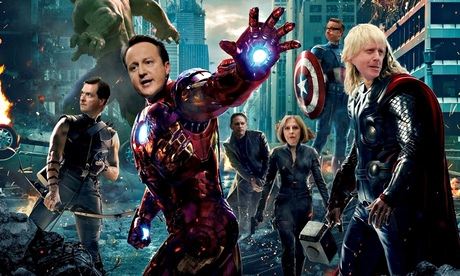
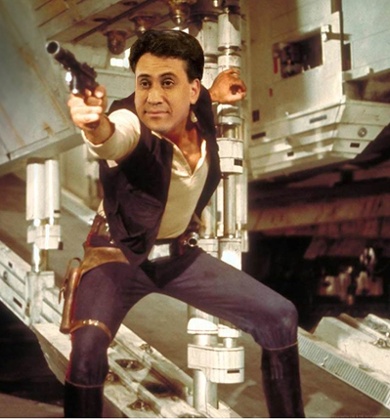
It is always pleasant when a general election brings us neologisms as well as new ways to twist old words. Perhaps this one will be remembered mainly for “Milifandom”, the term made popular by a teenage girl called Abby on Twitter. (Symptoms of this sudden adoration of “Bed Ed” included Photoshopping his head on to the rippling torsos of Sylvester Stallone and David Beckham.) The Conservative-fancying rival hashtag “Cameronettes” was definitely not a desperate spin tactic dreamed up by a 20-year-old spad, but it seemed ill chosen anyway. “Cameronettes” sounds like “marionettes”, or maybe sock-puppets. A more poetically satisfying twin to “Milifandom” would have been a grassroots movement of ordinary billionaires operating under the hashtag “Camer-non-doms”.
Before all this frivolity erupted, the key phrase of the first leaders’ debate had been “balancing the books”. If it doesn’t put you in mind of a weird literary game of Jenga, this probably seems a rather twee domestic metaphor. Oddly, everyone silently accepts that “balancing the books” specifically means “cutting spending”, even while most economists agree that deficit and debt reduction is more effectively achieved through economic growth (though that is a whole other rhetorical can of worms). It was certainly thrilling, though, to see Ed Miliband and Nick Clegg face off over who could use the phrase more often. By my somnolent count, Clegg won, with seven “balance the books” or “balancing the books” to Miliband’s six.
Clegg also promised to balance the books, and do everything else, “in a balanced way”, which surely reassured those among the electorate worried that he would topple over. For his part, Miliband wondered whether Cameron’s intentions really amounted to a “balanced plan”, as opposed to one of those school physics problems that take place on an inclined plan.
Perhaps the most intriguing rhetorical novelty by the Conservatives was one that was almost subliminal: using a possessive pronoun where one would expect a definite article. David Cameron referred archly to “our United Kingdom”, rather than simply “the United Kingdom”, perhaps as a subtler way of implying that we were, er, all in it together. This recalled the more established use of an unexpected “our” in the phrase “our NHS”. That phrase appears to have originated in 2005 with the campaign group Keep Our NHS Public, and was then quickly adopted by both the Labour government and the Tories in opposition. Some might think it especially cynical for Cameron to have begun going on about “our NHS”, given that he was plotting to privatise more of it – and so turn it piecemeal into something better described as “their NHS”.
Another big campaign issue was the zero-hours contract, which one politician bravely sought to rebrand. Iain Duncan Smith, the work and pensions secretary, complained: “[The] zero-hour contract is badly named – I don’t know whoever came up with that idea. It should be named the flexible hours contract because the people that actually use that contract are, for the most part, people who have caring responsibilities, students, people who can’t guarantee hours, fixed hours, over a series of weeks, but who are able therefore to flex their work and take the work as necessary.”
IDS must have momentarily forgotten where the term “zero-hour contract” came from. The phrase originated in the 1980s to describe contracts made possible by labour market “deregulation” of the kind performed by the Conservative government in the UK. Naturally, “deregulation” always means re-regulation in companies’ interests, just as in debates about employment law in particular, “flexible” is code for “convenient to employers”. A more “flexible labour market” is always one in which protections for workers are reduced. Just so, IDS’s preferred description of a “flexible hours contract” is accurate insofar as the contract is much more flexible for employers than for the workers themselves.
All this is transparent enough. But perhaps the most interesting part of his complaint was his creative verb use, celebrating people who are able to “flex their work”. Do you “flex” your work, as IDS flexes the English language? Or does this sort of thing during an election campaign make you want to flex your punching muscles?