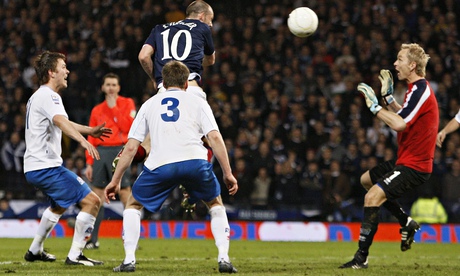
How Scotland has yearned for a prolific goalscorer. Outside of two legendary figures, Denis Law and Kenny Dalglish, no player has scored 20 times for the Scots since the late 1950s. That does not so much apply pressure to those in the modern day as highlight a glaring area for improvement. In their last, failed World Cup qualifying campaign, Scotland returned just eight goals from 10 matches.
Steven Fletcher’s record hardly augurs well. In 17 Scotland appearances the Sunderland striker has found the net only once, during a meeting with Iceland back in 2009. Concern about that poor ratio is readily offset by the small matter of history; for a spell it looked like Fletcher might be absent from the scene permanently, just as another Scottish multimillion-pound player, Duncan Ferguson, was years before him.
It seems fitting that the Republic of Ireland will provide the opposition for Fletcher’s most high-profile moment in Scotland colours. Martin O’Neill, after all, saw enough in him to spend £12m on his services when the manager of Sunderland. “Steven was worth every penny,” O’Neill said. He later branded Fletcher’s contribution to relegation-threatened Sunderland as “immense”.
Injury, as all-too often has been the case, curtailed Fletcher’s influence under the man now in charge of ’s challenger but there remains a mutual respect there. O’Neill had motivational qualities which Fletcher quickly came to admire.
There is past link, too, in the Scottish dugout. Gordon Strachan’s failure to sign Fletcher from Hibernian in January 2009 is widely cited as the reason Celtic failed to retain the title. Fletcher went so far as to publicly appeal to Hibs, in vain, to let him move. “I’m excited at the thought of moving to Celtic Park,” he said.
Strachan was to leave Glasgow a few months later, still undoubtedly frustrated by Hibs’ refusal to cash in on their prize asset. Celtic have tried since to land Fletcher, with a salary now in excess of £30,000 a week the barrier to such a move. When Strachan finally linked up with Fletcher, it was on the international scene.
In between times, Fletcher had been been a record purchase for Burnley and Wolverhampton Wanderers. He had made his debut at Hibs when still a teenager, with Real Madrid among those credited with at least a passing interest in a youngster who had been born in England and spent his formative years in military bases before the untimely death of his father, at 38 and after an 18-month battle with cancer, prompted the relocation of the family to Scotland.
Fletcher bears a tattoo carrying the name of his father, Kenny, alongside the motto “You’ll never walk alone”. Fletcher Sr was a fanatical Liverpool supporter. “Dad is my inspiration, always has been and always will be, and the biggest thing in my life has been granting his wish,” said Fletcher when recalling his father’s desire for him to succeed in professional football.
Tony Mowbray had spotted Fletcher’s potential during the early days of his Hibs tenure. “Young Fletcher is a player that I watched for the youth team when I first came and his talent jumps out at you,” Mowbray said a decade ago. “He can score spectacular goals. He can be a special talent.”
Fletcher’s infamous stand-off with Craig Levein took place as Scotland toiled and suffered. By the time the pair kissed and made up Levein’s tenure was already doomed to failure. It seemed tragically fitting that Fletcher’s second Scotland “debut” ended just two minutes into a meeting with Wales, with ankle damage.
This week, Fletcher spoke about his upset at the 16-game spell under Levein in which he was on the outside looking in. As heartfelt as that seemed, it was curious that the player did nothing about resolving the problem at the time. Levein later admitted his own stubbornness was a key aspect in the affair but the striker himself did not emerge from it with much credit. It was impossible not to infer Fletcher was simply biding his time before a new Scotland manager arrived.
It may be that Fletcher has matured. He certainly has on the field, where the 27-year-old’s link-up play is now vastly superior. Fletcher has never been blessed with stunning pace but he retains a wonderful touch and sense of position. Scotland’s current formation, which routinely sees three players in support of a main attacker, plays to his strengths.
Headed goals are as much of a feature of his game as ever; he has scored the most via that route in the Premier League over the past three years. Fletcher has a proven ability to find the net in struggling sides.
For now, Scotland are above such a status. Strachan has been perfectly happy for Fletcher to create rather than score. Still, it would be a highly significant moment if Fletcher should kickstart his international career, and begin to improve upon grim figures, when Ireland come calling.