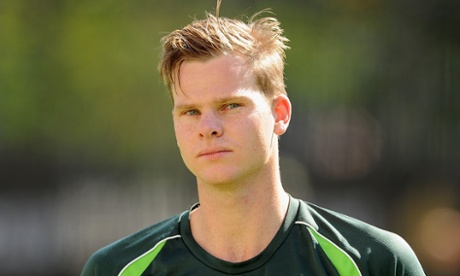
Steven Smith is Australia’s Test captain.
That isn’t something I was supposed to write this season. It’s not something I ever imagined I’d write a year ago, let alone two. But Michael Clarke’s failing body and Brad Haddin’s advanced years have led selectors to look to the future.
In the preferred scenario, Smith will only lead three Tests in the next few weeks before handing back to Clarke. But there remains the prospect that this could be a full-time appointment, and either way, the succession plan is clear.
Viewed in its entirety, the path Smith has taken to this point is a series of happy accidents gummed together with outrageous talent. Only 25, Smith has already been through half a dozen cricketing incarnations, and it was only against England at Trent Bridge last year that his most recent and stable upgrade was gradually made public.
First he was a cricketing hunch, a leg-spinning batsman who had taken 7/64 in a Sheffield Shield game in 2010. He debuted in Tests at No 8 against Pakistan in England, took a couple of wickets, made no runs in three innings, then belted an ODI-style 77 with the tail in his fourth. Six months on, Marcus North’s dwindling returns saw Smith come in at No 6 for the last three Tests of Australia’s 2010/11 Ashes hiding. A brisk 54* in a lost cause was his biggest reward, along with endless comments that he’d never make a Test batsman.
For the next two years he drifted, becoming the quintessential limited-overs player: handy bowling, great in the field, can whack. He did well captaining the Sydney Sixers without being distracted by their glaring uniforms, but he wasn’t quite enough of anything. His selection in the 2013 Test squad to India was hard to believe. The rationale was that he was strong against spin, but buckling in alongside Glenn Maxwell, Moises Henriques and Xavier Doherty, the impression was of a Test squad full of domestic limited-overs plonkers.
Even then, he wasn’t supposed to play: the batting was set and Usman Khawaja was next in line. But when coach Mickey Arthur’s faltering grip saw Shane Watson and Khawaja suspended, Smith was the last man standing. Australia’s batsmen were being tied in knots in a series where India’s spinners would take 82% of the wickets. Smith walked out to the dry pitch and played them with ease, lofting four down the ground from his fourth ball, a picture of serenity as he skipped to the pitch in attack and in defence.
But that was still supposed be that. Runs in Mohali didn’t count for much in Manchester. It was March 2013, and for the final close call of Smith’s rise, he wasn’t even included in Australia’s extended Ashes squad for the tour in June.
But when Clarke had back problems (sound familiar?) and David Warner got suspended (sound familiar?), Smith’s century for Australia A got him the nod as a back-up batsman.
Somehow, in the days leading up to the first Test at Nottingham, he got a further nod. When we settled into the stand at Trent Bridge I wasn’t expecting to see him on the team sheet, but there he was. I wasn’t expecting to see him in the middle, either, but at 3/22 he was out there in quick time. It still created unease. Steve Smith? Really? But there he was, after 6.2 overs, taking strike.
Compact, jittery, constantly moving. He held the bat cocked back like a wasp sting, twitching as the bowler ran in, then going gloriously still for an instant before that backlift became a flash through the line of the ball. Steven Finn went for four boundaries in no time. Graeme Swann came on, the esteemed spinner, six overs from stumps, Australia four wickets down now. Smith cantered down to put his fourth ball in the crowd. Then through cover for four. The next morning in glorious sunshine, Smith cracked a few more shots and then nicked a drive on 52, one of those dismissals where you feel there must be some mistake because he’s been playing so well.
As it happens, another dewy-eyed young pup showed off some elegant strokes that day, as Ashton Agar got within a whisker of a century from No11. The crowd went wild and Smith’s innings was lost in the wash. But that was the moment his rise really began, as someone who could play spin in India or seam in England.
Now you can add the deserts of Dubai and the wiles of Pakistan, the bounce of home and the Ashes rescue jobs, the tracks and attacks of fierce South Africa, and you have something of the story Smith has written in those 18 months.
Most impressive of all was the Test just gone, joining with NSW team-mates Warner and Clarke to deliver a trio of centuries in memory of a departed friend.
It seemed a different Smith who took off his helmet to salute that milestone: broader of chest, surer of stance, and providing the lasting image of the match as he pointed to the memorial 408 painted on the Adelaide Oval turf.
Smith didn’t need to be asked to take responsibility, he was already taking it. His resoluteness and reliability down the order was already leadership. His energy in the field was already infectious. As unlikely as it may have seemed, Smith made himself a Test player. Once that was done, he made himself indispensable.
Now that’s been achieved, his country has made him captain. It’s so much the right call that it no longer even feels strange writing it down.