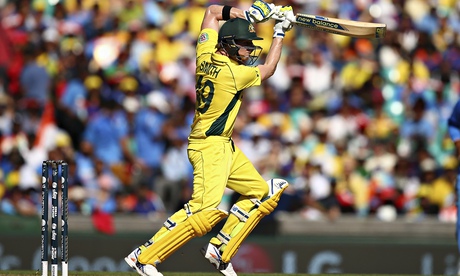
For the last time in this seemingly endless golden Australian summer, Steve Smith proved the difference between them and India. In his misleadingly assured 105 from 93 balls his batting seemed spoken in a different language than everyone else who followed. Australia’s 95-run win sets up a World Cup final encounter with New Zealand at the MCG.
Smith and the less fluent Aaron Finch (81) did well to counter Mohammed Shami, Mohit Sharma and Umesh Yadav, milking them for six, seven and eight apiece respectively at the business end of a tournament in which frugality had been the bedrock of India’s success.
This semi-final and Smith’s role in it was a decent metaphor for some prevailing trends in Australia’s batting lineup; he may wear a perma-smile but Michael Clarke must now slot himself in around the momentum of other batsmen and them adjust according to his. In the meantime, Smith has become the man Australia want at the crease for as long as possible when a game like this one is at stake. His talismanic presence is beyond repute now; Australia have won every ODI in which he has passed the half-century mark.
The result should have been a formality once Australia had posted 328 for seven from their full allotment. No less than 28 times has a side posted a 300-plus score in this tournament but only two were in successful chases. Often has been the observation that one-day international cricket has moved into new realms. A power-based game and two hard balls, batsman-friendly fielding restrictions, Popeye forearms and weapons-grade bat designs certainly are a heady mix.
Yet Smith’s innings was anything but the broad-shouldered destruction of bowlers that has occurred elsewhere. So evasively did he shuffle around the wicket and flick the ball off his pads that even India’s steadfast adherence to a leg-stump line – successful in a pre-tournament scratch match – proved not only futile but counterproductive. Dismissing him at the moment is like trying to jump into the driver’s seat of a car as it rolls downhill at ever-increasing speed.
Smith’s footwork is exemplary but it’s his hands that are really extraordinary. If you mentally removed the bat from the equation at times in this innings, the sideways contortions of Smith’s body and the extravagant flick of the hands to square leg had more in common with the motion of a busy scrum-half firing out a pass.
He also picked his targets. Umesh Yadav was under Smith’s constant surveillance in the knowledge that he’d give at least one loose delivery per over, five of which the Australian dispatched to the boundary. Conversely, Ravi Ashwin was treated with a degree of deference and pushed mainly for singles. Smith’s 182-run stand with Finch dwarfed all others in the game by at least 100 and proved decisive, though by comparison his partner looked like he was batting in sand at times.
In recent years we have lamented the passing into retirement of some batting greats in Sachin Tendulkar, Ricky Ponting, Rahul Dravid and Kumar Sangakkara but the new generation of Smith, AB de Villiers and Virat Kohli have brought with them an entirely new batting vocabulary and pushed things along. Seeing them pile up hundreds at this World Cup has rammed that home.
Smith’s serenity at the crease in this match might actually gloss over a few problems; Finch’s stodgy efforts to work his way back into form is possibly less a concern than David Warner’s inability to stay at the crease at all. In Warner’s five innings as an opener (he dropped down the order against Scotland) either side of his hammering of a fatigued and fading Afghani attack, he has lasted an average of 20 deliveries per innings. It would not be such a concern if Finch was running riot.
Though Australia did not always look comfortable in the early stages of India’s chase, the game eventually became a series of tropes, the same batsmen passing by the same bowlers in a pattern as predictable as kit bags on airport baggage carousels. Glenn Maxwell probably sees more of his opponents in this tournament than his team-mates in domestic ranks for Victoria.
After the high-tempo start of Rohit Sharma and Shikhar Dhawan, India’s innings fell in a disappointing heap. Virat Kohli’s torch was outshone in exaggerated style by Mitchell Johnson’s flame-thrower. The latter’s brief but impactful arousal was something he has rarely managed in this World Cup. What any of this tells us about Australia’s match-up against New Zealand in the final is less clear.
Fittingly, it was when Smith athletically ran out Ravi Jadeja in the 42nd over that Australia looked convincingly home. He stood jubilant as his team-mates swamped him, a familiar sight of the summer now but assuredly not the souvenir India wanted to take home.