
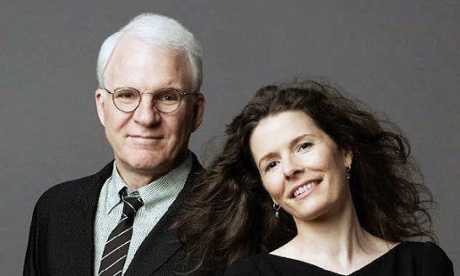
For the bulk of his legendary career, Steve Martin has been one of the most influential and successful comedians in entertainment history. Lately, however, Martin has temporarily stepped aside from the laughs and is focusing on folk music, another passion in which he’s equally well-versed. A student of the banjo since he was a child, the instrument that was once a major part of his 70s-era comedy albums has become Martin’s main means of expression, first with his bluegrass band the Steep Canyon Rangers and now with musical partner Edie Brickell, former frontwoman of the band the New Bohemians.
After first collaborating three years ago on the album Love Has Come For You (the title track of which scored a Grammy award for best American Roots song), Martin and Brickell are back with second effort So Familiar, a collection of tender tracks in Brickell’s smooth vocals and Martin’s slickness on the strings gel together delightfully. In between rehearsals for the March opening of their upcoming Broadway musical Bright Star, the duo spoke about the origins of their friendship, their creative process, and the relationship between comedy and music.
How did you two first meet?
Brickell: I was 23 the first time we ever met. We all went out to eat together and I was so excited that Steve was there because I had always been a very big fan. Steve turned out to be the sweetest one at the table. I couldn’t believe he was that talented and that wonderful, and the sweetest one. He was the only person to hand over this basket of crackers that was on his side of the table.
Martin: That’s not evidence of being sweet.
You passed the crackers.
Brickell: I was touched because I’m used to being a wallflower.
Martin: What kind of restaurant has crackers?
Brickell: It was that Italian place with those matzo garlic crackers and you broke one and said: “These are really good, you gotta try these.” I’ll never forget it. I was so happy. You were talking to me like a friend, and I wasn’t used to that meeting people. It was warm.
Martin: We’ve known each other for at least 20 years, but we really started to know each other in a closer way for I guess three years now. We were at a party and Edie complimented me on a song I had written and said: “Would you like to write a song together sometime?” And I said “sure”, not knowing what it would be like to write a song with anybody else because I had never done it. And now we’re 40 songs later with a musical going to Broadway.
Brickell: When he said OK I couldn’t believe it. Afterwards, he showed me his tune and it turned into a song called Sun’s Gonna Shine. He liked what I wrote and he sent me another tune and it was like a wildfire. So fun, song after song.
How do you two work together? I know you’re in the lyricist here, Edie. Do you write in the same room together?
Brickell: He’ll send me a banjo tune and I’ll just start singing into it usually when I’m walking outside or cooking. If I’m doing something else I find that the melodies flow out more naturally. His banjo melodies inspire images, like a projector of my thoughts. All I have to do is look at the images and say what I see. Then it’s the fun idea of paying attention to rhythm and making it rhyme.
I was thinking that comedy and music are similar in the way that they both rely on timing and rhythm.
Martin: Exactly. I don’t think comic timing is the same as music timing, but I definitely find that I’ve learned from just writing in general that songs can be narrative without having a story. I do think of the chordal progression of the banjo melodies as being implied; there’s one way for them to go in that particular song. So I do believe in flow, and it’s the same thing you would do in a musical, novel, or short story.
Steve, there’s a little gap in your filmography thanks to your dive into music. At the start, did anyone say: “Steve, do you really want to step away from movies for this long? Do you really not want to take any parts?”
Martin: Not a bit. These things aren’t decisions, they happen over time. I did just do a film with Ang Lee that will be out next fall, but it’s sort of a smaller role that I’m very happy with. But I don’t really want to leave town for three months at a time like I used to be able to. I’m just really happy with what I’m doing right now and don’t feel the need to do a film. I’m happy with the way things are.
Let’s say you have a really amazing script in your inbox. Would you still consider it?
Martin: All I know is that I’m supposed to have an amazing script in my inbox right now but I haven’t found the time to read it yet. You just reminded me that it’s there. Thank you.
Is it cathartic for you to write these songs and perform them, as opposed to the film-making process?
Martin: It’s not really cathartic, but it’s very interesting. I really enjoy the social aspects of music as much as anything. I was lucky to find Edie because when you have a banjo song, that’s all it is. It’s a banjo song. But when you add lyrics, you now have a story and a singer and so much more to work with.
Do you still get the same high today performing on stage as when you were in the 70s doing your insane, sold-out arena tours for stand-up?
Martin: Absolutely, but the 70s were actually scary. This is joyous. I was on stage alone in the 70s, here I’m on stage with other people who are contributing and we’re working together. To have someone play off and be with a band is more pleasurable.
Let’s talk about the musical, Bright Star, about two love affairs in the 20s and 40s. You’re in rehearsals now in preparation for opening night next year. Has this been a longterm dream?
Brickell: When I was a little girl, the first movie I ever saw in theaters was The Sound of Music. I thought it was the greatest thing I’ve ever seen in my life. I so related to the character of Maria that I’d run out of my house and sing and sing all alone in nature. When it opens with her singing I thought, ‘Hey! We’re alike!’ I love how every single song in that musical is something you can sing, with their beautiful, simple melodies. I love how she wanted to bring love into that house. So the story touched my heart and stayed with me forever. I used to wonder, gosh, I would love to write songs like that and bring to other people what gave me such tremendous joy as a girl. To be able to do that, that’s why it’s a huge dream.




.png?w=600)



