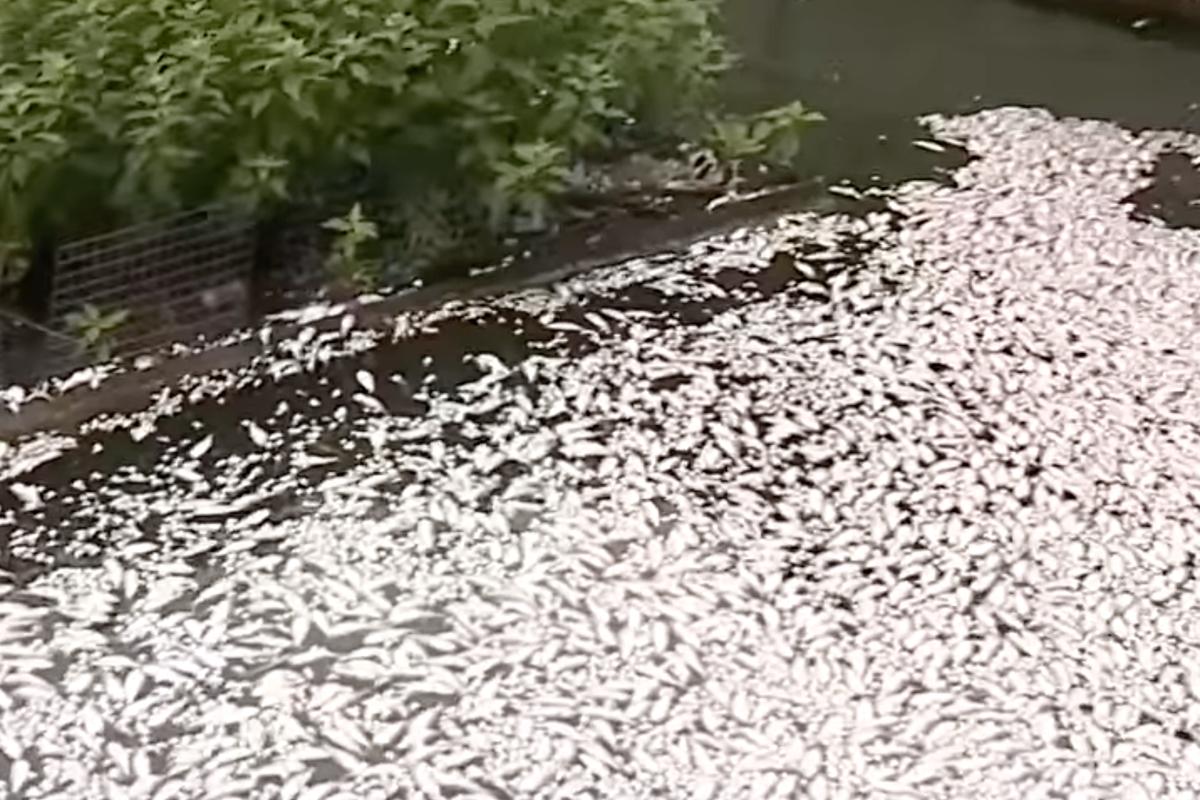
A mass fish die-off in Baltimore’s Inner Harbor may have been caused by an event called a "pistachio tide."
The Maryland Department of the Environment said on X that approximately 1,000 menhaden fish were killed in the die-off.
Officials said the fish kill was reported stretching from Canton Waterfront Park to South Ann Street in Fells Point. Some users on social media reported seeing dead fish in the water around the Domino Sugar plant at the Locust Point Industrial Area, WMAR reports.
MDE officials believe that the fish kill was likely the result of a "pistachio tide," which occurs when sulfur bacterial blooms produce sulfur odor during decomposition, CBS News reports. The resulting oxygen depletion in the water kills sea life in the affected area. The bloom also leaves a green sheen on the water's surface, hence the name.
"These bacterial blooms tend to happen in the Inner Harbor during stretches of dry, precipitation-free, sunny days followed by sharp temperature fluctuations. In Baltimore, this typically happens in the fall," according to the National Aquarium, which is located at Baltimore's Inner Harbor.
In addition to killing off the sea life, pistachio tide events often leave the Inner Harbor area smelling of rotten eggs.
When conditions in the Inner Harbor cause the underwater bacteria to surface, the bacteria reacts to the sun, producing hydrogen sulfide — and the rotten egg odor.
The underwater bacteria are moved to the surface through a process called "thermal inversion."
"When it's hot during the day and cold at night, that drastic swing can bring naturally occurring sulfur bacteria living on the bottom of the harbor to the surface, a phenomenon known as thermal inversion," the National Aquarium says on its site.
This isn't the first time the Inner Harbor has seen a fish kill. The city experienced three last year alone, all within the span of a few weeks.
After a September die-off, MDE officials said they found 25,000 dead menhaden. Shortly before that, on August 28, the agency recorded 120,000 dead fish between Harbor Point and Fort McHenry.
A few days before that, an unrelated fish kill wiped out 61,000 fish.
The Independent has requested comment from MDE.
Another fish kill occurred over the weekend in the Potomac River, but experts reportedly believe that incident was the result of high water temperatures and river conditions rather than low oxygen.
Baltimore’s neighbor to the south, Washington, D.C., is dealing with its own water issues; a stubborn algal bloom in the National Mall’s Reflecting Pool.
President Donald Trump and his supporters have blamed the algal contamination on Democrat saboteurs, but experts told PBS that algae in the Reflecting Pool is not new or unusual, and probably not the result of sabotage.