
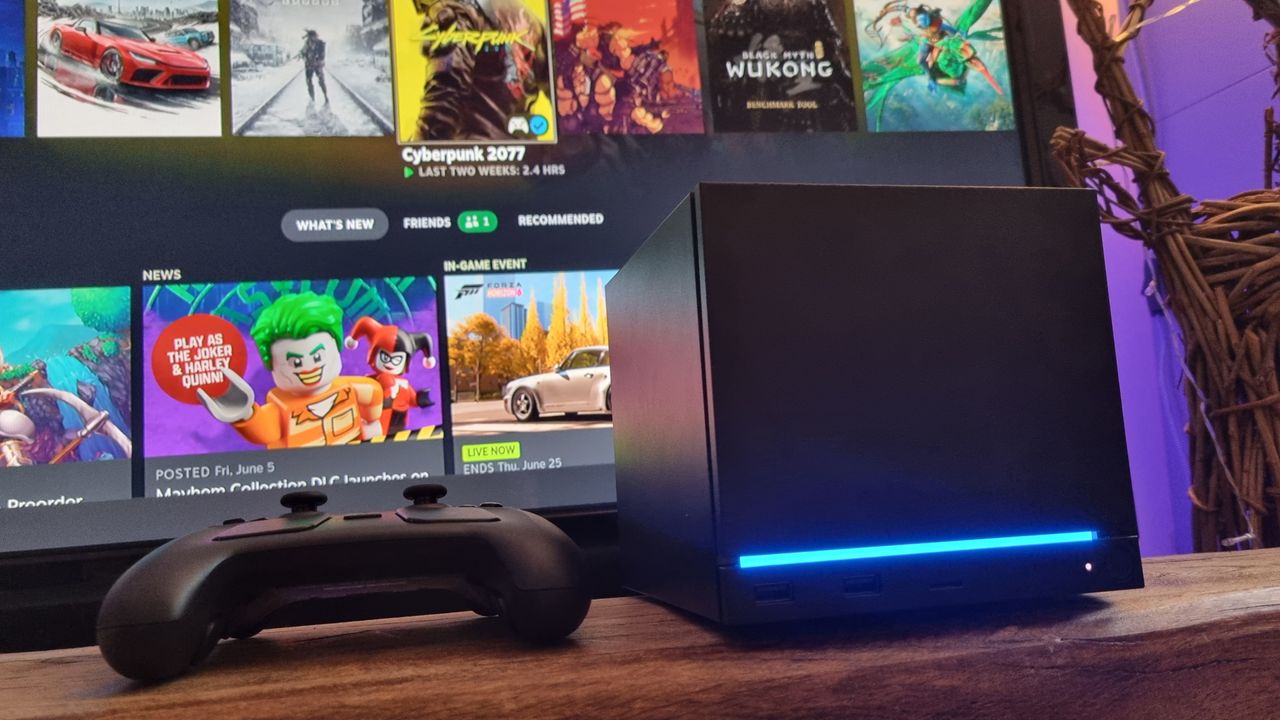
Last week PC Gamer's Andy Edser highlighted an article tracing a seeming massive drop in Steam Deck sales. I'm not entirely convinced by the maths involved—which was conducted by Boiling Steam—but whether the numbers are accurate or not, it does capture some of the anxiety around Valve's hardware and what kind of future it might have.
When Gabe Newell donated a smidge over $20 million to OpenAI back in 2018, he probably didn't anticipate that the industry arising from its tech would put a huge dampener on his company's future hardware plans. The Steam Deck OLED copped a dramatic price increase in May, with the 1TB model rising from $649 to $949 and the 512GB going from $549 to $789.
"These new prices reflect the current state of component costs and other global logistical challenges across the industry as a whole," Valve wrote at the time, alluding to the way AI datacentres are gobbling up the bulk of components needed for most of the hardware used to play videogames. In one fell swoop, the Steam Deck OLED—which turns three in November—morphed from a great entry level solution for budding PC gamers, into something only wealthy people can afford.
When Valve released that statement in May we didn't yet know how much the Steam Machine would cost, but anyone who hoped they might somehow hack the components crisis to ship an actually-affordable living room PC were, unfortunately, dreaming. As we now know, the Steam Machine is expensive and anyway, in extremely short supply.
As Andy Edser wrote in June just after publishing his 62 / 100 review of the box, the Steam Machine is "the biggest victim of the RAMpocalypse to date". What was predicted to cost around $600 in November 2025 comes bearing a minimum $1,049 price tag. I was with utmost certainty going to buy one if the price was closer to the former. But at the current going rate, there's just no way, and I'm sure there are droves who are in my position.
So I guess it's not surprising that the Steam Machine's "launch"—which was more of a waitlist launch—has been a bit muted. Even Valve's own compatibility module hasn't been updated to reflect the Steam Machine's existence: to see if something is compatible with the device you have to click on the Steam Deck Compatibility box, which then shows a nested result for the Steam Machine. That's the case in both desktop and Big Picture modes.
Browsing Steam, most of the time you wouldn't know the Steam Machine exists. Devs aren't talking about their games being compatible with Steam Machine either, like they increasingly do the Steam Deck. External forces seem to have demolished the viability of these things. It's sad, but true.
And yet! The Steam Deck consistently appears in Valve's list of Steam's top products by revenue: last week it hit 14, and the week before that, 9. That result is influenced by the fact that Steam Deck is much more expensive than your average game, but it still proves that people are buying them.
But I had hoped the Steam Deck and Steam Machine might mark a rapid shift in how PC gaming is perceived. Gaming on a PC is immeasurably easier in 2026 than it was even in 2016, but consoles are still considered the easier route by millions of people. With the Steam Machine and Steam Deck, Valve had a chance to prove everyone wrong.
From the vantage point of November 2025 the timing seemed immaculate, given the existential crises facing both Xbox and PlayStation. It's amazing how much difference three months makes. Steam Machine having any longterm effect on the industry seems hugely unlikely right now.
Top Steam games by revenue (July 21 - July 28)
Steam releases its top sellers charts on Wednesdays, so the chart below doesn't account for the sudden popularity of Mistfall Hunter, which released on Thursday. The "dark fantasy extraction ARPG" is currently third on the live concurrents list.
Rank |
Game |
|---|---|
1 |
Counter-Strike 2 |
2 |
Dota 2 |
3 |
Palworld |
4 |
Halo: Campaign Evolved |
5 |
Apex Legends |
6 |
DragonSword: Awakening |
7 |
Assassin's Creed Black Flag Resynced |
8 |
Battlefield 6 |
9 |
Shift at Midnight |
10 |
PUBG Battlegrounds |
Counter-Strike 2 holds tight to number one despite the release of a new (albeit actually old) Halo game and the 1.0 launch of Palworld.
DragonSword: Awakening is basically a non-gacha take on Genshin Impact, so its popularity is to be expected. Shift at Midnight is yet another one of those indies that blends retail sim trappings with horror, though this time with online cooperative play.
And while Meccha Chameleon is far from "a dead game" (it appears at 13 this week) last week was the first time it didn't appear in the top ten since launch.
Last week's Steam deep cuts

Steam review of the week
"I now understand why people push people in front of trains. It's super funny."
Alien Kink VR, taking the wrong learnings from Machine Party.