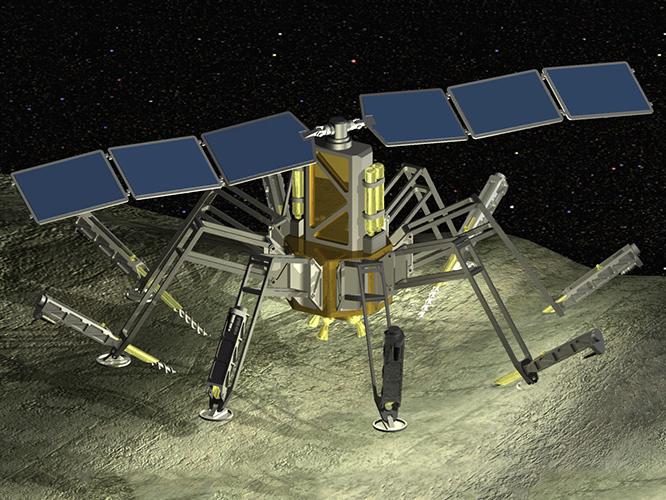
A steam-powered spacecraft has been created that could one day propel itself from asteroid to asteroid, extracting water as it goes to fuel its voyage.
Scientists say their microwave-sized device could theoretically travel through space “forever”, relying on an endless supply of fuel to propel its rockets.
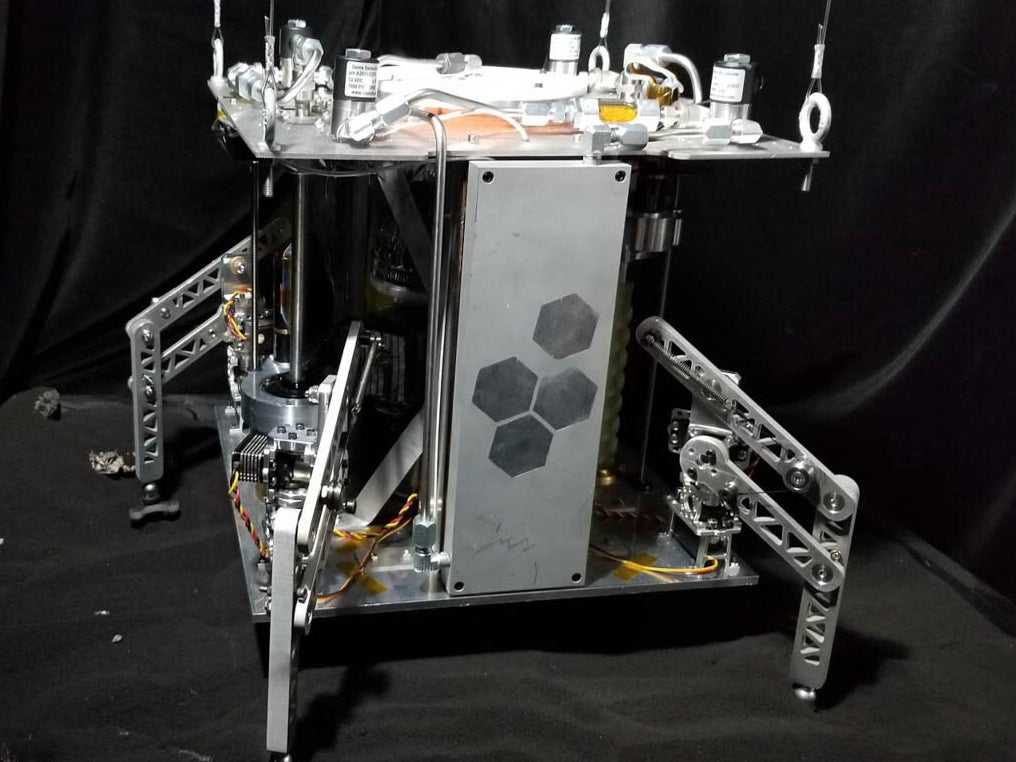
The Nasa-funded prototype craft called the World Is Not Enough (WINE) has been developed by scientists in partnership with a Californianrobotics company.
Planetary researcher Dr Phil Metzger from the University of Central Florida worked on the computer modelling that allowed Honeybee Robotics to create the device.
The first trials of the craft were conducted in the lab using simulated asteroid material at the end of December.
“It’s awesome,” Dr Metzger said.
“WINE successfully mined the soil, made rocket propellant, and launched itself on a jet of steam extracted from the simulant.
“We could potentially use this technology to hop on the Moon, Ceres, Europa, Titan, Pluto, the poles of Mercury, asteroids – anywhere there is water and sufficiently low gravity.”
Kris Zacny, vice president of Honeybee Robotics, said this new breed of spacecraft has “the potential to change how we explore the universe”.
The devices can work in different ways depending on where they are deployed.
Solar panels can be used to provide the energy for mining and making steam, which can then be used to propel the craft from the surface of a planet or asteroid back into space.
Alternatively, if it was operating further away from the Sun – for example on Pluto – it could make use of radioactive material on board gradually decaying to provide energy.
Currently, missions to other planets have to stop when the spacecraft runs out of propellant, meaning the loss of an enormous amount of time and money.
The WINE project was supported by Nasa’s small business technology transfer programme, which is meant to foster links between universities and businesses.
Honeybee Robotics specialises in creating space drilling tools, as well as systems for finding life on other planets.
The WINE project encompasses the company’s Spider Water Extraction System, which is designed to drill into the surface of asteroids and extract icy soil samples that can be sucked dry.