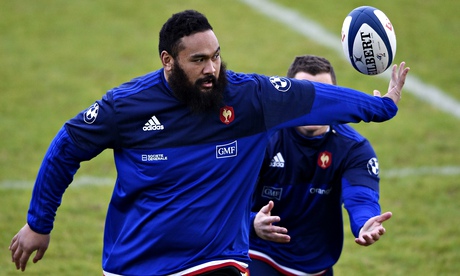
Shortly after the 6ft 5in, 24st Uini Atonio swaggered on to the Stade de France pitch to become the heaviest man to play Six Nations rugby, the TV cameras panned to the legendary French full-back Serge Blanco in the stands, shivering despite several layers of retirement fat and a collar smothering his ears. The images provided a vivid contrast – not just between two men, one a front-row bulldozer, the other once a high-spec Bugatti, but between the realism of modern French rugby and the carefree romanticism of a bygone era.
But France’s muscular approach against Scotland, a sort of power rugby deluxe, was far from unique in the opening weekend of the Six Nations. Italy and Ireland also embraced the crash and bash: at the Stadio Olimpico, there were 311 tackles, or one every 15 seconds. Italy made 206 tackles, two short of their own world record. Wales versus England, with 280 tackles, compared with 239 in the corresponding fixture last year, was not far behind, while there were another 218 in France’s game against Scotland.
To put those figures into context, in the 2011 World Cup final between New Zealand and France – seen as the epitome of dour, attritional rugby at the time – there were 198 tackles. The average in the Premiership this season is 104.9 tackles made per team, per game.
Watching Atonio and his team-mates attempting to obliterate Scotland’s line with a strategy barely more complex than smashing into a nearby opponent, it was tempting to yearn for the days when Blanco brought the rugby equivalent of a box of chocolates and a bottle of fine red to the game with his daring charges from deep. Tempting but wrong, because the research indicates that teams who play less in their own half and kick more tend to be more successful.
It might sound counterintuitive but in last year’s Six Nations there was a neat symmetry between a team’s average number of kicks out of hand and their final position. Ireland, with an average of 27.4 kicks, won the championship. England had the second highest (26.8) and finished the runners-up. Wales, with 25 kicks per game, were third, France (23.4) fourth, Scotland (22.0) fifth and Italy (17.4) last.
It would be unwise to read too much into such a small sample but Bill Gerrard, a professor of business and sports analytics at Leeds University Business School who also works for Saracens, points out that in the 77 games with a definitive result in the Premiership this season, winning teams have averaged 18.1 kicks in play whereas losing teams have averaged 15.5 kicks in play – a difference that is highly significant statistically.
As he explains: “When I joined Saracens, one of the first things I did was to show that the coaches’ intuitions about what was the most effective style of rugby was supported by the data: on the whole, teams that use a kicking game more tend to be more successful. Now that goes against the purists who want to play ball-in-hand rugby wherever they are on the pitch but the less you play in your own half and the more you play in the opposition half, the more likely you are to be successful.”
As Gerrard points out, there are two reasons. First, the more you play in your own half, the more likely you are to be turned over – and the closer that happens to your try line, the more you are likely to concede. Second, the more that you run the ball, the more energy-sapping collisions and rucks you are going to be involved in. The old adage of kick to gain territory and run to exploit it holds true.
Certainly the best sides know how vital the kicking game is. As South Africa’s kicking coach, Louis Koen, put it wryly last year: “Did you know the All Blacks kick the ball more than the Springboks do?”
There might be an element of cause and effect here too: does kicking lead to winning or does winning lead to more kicking? Even so, the data strongly suggests those romantics who roar every time a full-back bursts out of the 22, might be better holding their breath instead.
Incidentally, Gerrard’s research is backed up by a study in the Journal of Sports Science and Medicine from 2010 which found that, in Super 12 rugby, kicking the ball away and making more tackles than the opposition were the two most influential factors in determining winning from losing teams.
Rugby is too chaotic, fluid and complex to be reduced to simple prescriptions or blackboard equations. But, as Gerrard points out, the changing nature of the sport in the professional era has made the kicking game even more important. Territory matters. And with defences better organised, forwards faster, and space on the field choked, kicking is generally a less risky way of getting it than spraying it among the backs.
Sadly it means the sight of modern-day Blancos slipping past lumbering forwards with a side-step and a sharp stab of the afterburners happens more infrequently than it once did. Romantics will lament that fact. The rest of us have long made our peace with the biff and the boot.