1a. Cable Guy is what you want if you’re looking for classic Jim Carrey, but Dumb & Dumber holds up pretty O.K. as a “TBS on a Saturday afternoon, why not” kind of choice. Though some of the scenes are just, come on. The characters have to be grounded in some kind of reality, right? Like, Lloyd in this scene:
I’m to believe an actual person, who has failed so thoroughly at a job for which he was so clearly unqualified, is also so self-delusional that he’s going to call someone else a loser? That person doesn’t exist in real li—oh …
During a staff meeting, Meyer delivered a biting message that he’s a winner and his assistant coaches are losers, according to several people informed of the contents of the meeting, challenging each coach individually to explain when they’ve ever won and forcing them to defend their résumés.
That is from the NFL’s own in-house media arm—an operation that usually goes out of its way to avoid such stories—which is the latest indication of how well Urban Meyer’s first season in Jacksonville is going. But in light of those alleged comments, I was curious to see precisely who is a loser among Jacksonville’s staff (which, by the way, was assembled by Meyer).
Ergo, here is the rank order of career winning percentage as a coach at the highest level of professional football among the Jaguars’ current coaching staff. Meyer's name is in bold, in case you're having trouble locating where he falls:
1. Nick Sorensen, Special Teams Coordinator: .639 (89–50–1)*
2. Zachary Orr, Outside Linebackers Coach: .605 (46–30)
3. Sterling Lucas, Assistant Defensive Line Coach: .587 (54–38)
4. Darrell Bevell, Offensive Coordinator: .548 (181–149–2)*
5. Bob Sutton, Senior Defensive Assistant: .526 (183–165)
6. Will Harriger, Offensive Assistant Coach: .520 (64–59–1)
7. Brian Schottenheimer, Passing Game Coordinator: .493 (171–176–1)
8. Kyle Caskey, Offensive Quality Control Coach: .460 (85–100–3)
9. Todd Washington, Assistant Offensive Line Coach: .457 (64–76)**
10. Joe Dannam, Defensive Backs Coach—Nickels: .432 (95–125)
11. Bernie Parmalee, Running Backs Coach: .426 (87–117)
12. Sanjay Lal, Wide Receivers Coach: .419 (99–137)
13. Carlos Polk, Assistant Special Teams Coordinator: .391 (61–95)
14. Joe Cullen, Defensive Coordinator: .386 (91–145)
15. George Warhop, Offensive Line Coach: .3374 (139–273)
16. Tim Walton, Secondary—Corners Coach: .3372 (58–114)
17. Tosh Lupoi, Defensive Line Coach: .273 (12–32)
(tie)18. Urban Meyer, Head Coach; Charlie Strong, Assistant Head Coach and Inside Linebackers Coach; Tyler Bowen, Tight Ends Coach; Quinton Ganther, Offensive Quality Control Coach; Chris Ash, Defensive Backs Coach—Safeties; Patrick Reilly, Defensive Quality Control Coach: .167 (2–10)
24. Tony Gilbert, Assistant Linebackers Coach: .107 (3–25)
*—Super Bowl champion as a coach
**—Super Bowl champion as a coach and as a player
That is a lot of losing records on the staff (again, assembled by Meyer), but unless Meyer was really giving it to assistant linebackers coach Tony Gilbert that day, he doesn’t have much of a leg to stand on.
And if I’m a guy who has won games—or even a Super Bowl—at the highest level of professional football, and I’m getting the business from a guy with a 2–10 career record, claiming he’s a winner and/or implying I’m not, then yeesh… I can see how that ends up getting leaked to the league’s in-house media arm.
USA Today Sports (5)
1b. It takes a leader of men to, well, lead men—that’s probably where the phrase comes from. College players serving in what’s essentially an unpaid internship role, coming into your program as teenagers, are not fully formed adults. And in college the power dynamic, especially in the pre–transfer portal days, is tilted heavily (some might say outrageously) in favor of coaches.
That’s one reason coaching in the NFL is different than coaching in college. In the college game, you also often have a huge disparity in talent from team to team, especially if you coach at, say, Ohio State, a program often littered with 300-pounders who can move like the 200 pounders at a school like Rutgers. In the NFL, the talent is fairly evenly distributed throughout the league, and often games are decided by which sideline has the superior tacticians.
Coaching in the college game has its own unique challenges. But to succeed in the NFL, you must be able to manage and motivate grown men, and must be able to build a scheme—and craft a weekly game plan—superior to the often very good coaches on the opposite sideline. Twelve games into his professional football tenure, Meyer has not proven himself capable of either of those things.
That above passage from the league’s in-house media arm isn’t exactly Meyer bragging to his middle-aged coworkers about how cool he was in high school, but puffing your chest out because you won games in the Big Ten a decade ago comes uncomfortably close to that vibe.
1c. Two other things from that league in-house media report: (1) How in the world do you alienate Marvin Jones? The veteran receiver is an absolute pro’s pro, the kind of guy 31 other coaches could plug onto their team and get noting but good things out of it. But, more problematic is (2) Meyer’s continued lack of accountability when it comes to all of this. Most recently, the bizarre decision to bench James Robinson as if Robinson’s fumble last week against the Rams was the first mistake the team has made this season (or, as if Carlos Hyde belongs on the field). The fact that Trevor Lawrence—the most important and only indispensable person in the organization—was willing to speak out about the mismanagement of Robinson is something Meyer should take as a bright and garish warning sign.
1d. Also, since any good joke needs a clarification, I am indeed exaggerating with the Urban Meyer–Lloyd Christmas comp. However! It’s a coin flip which is more absurd: Meyer splitting summer reps between Lawrence and Gardner Minshew in the name of faux-competition or the fender bender that costs Lloyd his job as a limo driver.
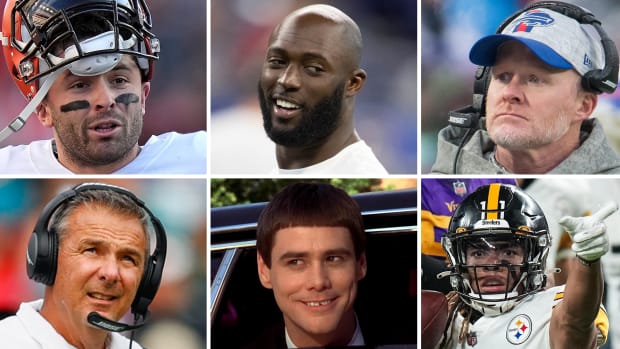
2. Many have been tempted to write the eulogy for the 2021 Cleveland Browns. I know I have been, I just need a word that rhymes with “Koramoah” (my eulogy is a limerick).
But there is reason to hold off. A couple of things about the Browns coming off their bye week, and entering what could be a season-saving stretch of games:
a) If they had gotten any kind of offensive production in Baltimore in their last game—the Sunday nighter two weeks ago—and won that game, they would be in first place in the AFC North right now.
b) They’ve beaten the Bengals in Cin City and get them at home in Week 18, and they get the Ravens at home on Sunday. Obviously, a sweep of the Bengals would give them the tiebreak there. And a win over Baltimore on Sunday would give them a season split, but the Browns will have only lost two division games, whereas the Ravens will have three losses against AFC North opponents. In other words, a win on Sunday would put the Browns in position to very likely have the tiebreaker over Baltimore.
c) They’re 3-point favorites against the Ravens. They’ll very likely be favored at home against the Bengals in Week 18. They’ll be favored against the Raiders at home on Saturday. And while they may be a slight underdog at Pittsburgh in Week 17, who knows what the Steelers’ situation will be at that point, between Ben Roethlisberger’s play and T.J. Watt’s ailments. Even assuming Cleveland loses at Lambeau in Week 16, winning those four imminently winnable AFC matchups would put them at 10–7 and likely in control of tiebreakers against Cincinnati and Baltimore.
d) It’s December. The Browns are very good in the trenches—the defensive line has been dominant at times this season, and the offensive line is still one of the league’s best, even without Jack Conklin. This team is built to win during the dog days.
The question is, quite obviously, what will they get out of Baker Mayfield and the passing game down the stretch? The last time we saw them—in that ugly loss in Baltimore—Mayfield was struggling, but wasn’t getting much help either (they have two high-pedigree tight ends who couldn’t create separation against Tyus Bowser on the game’s two biggest plays).
Mayfield needs scheme and supporting cast to lift him up, and that means the run game giving them more than it did in the Ravens loss. But if last year’s stretch run is any indication, he’s capable of getting it done when the Browns need him to. It starts on Sunday against the Ravens—if they don’t get that game, you can run that eulogy through spellcheck.
3a. There are two things in life that will earn you universal scorn: (1) peeing on a toilet seat, and (2) even the slightest bit of clock-management inefficiency in a football game.
There has been a mind-blowing amount of pearl-clutching over the literally-one-second delay caused by Chase Claypool’s first-down celebration on Thursday night. Claypool probably is immature—which you could also say of 60% of players age-23 and under across the NFL. And he shouldn’t have done the first-down signal, because it probably did ultimately cost the Steelers a second (though no official was prepared to spot the ball at that point, so it’s one second maximum), and you want to maximize efficiency in pretty much everything in life.
But what’s incredible about the reaction—whether it be on social media or freak outs on basic cable mid-day programming or the guy who claimed Claypool cost the team 14(!) seconds as if all 11 Steelers players would have otherwise manipulated the space-time continuum and materialized at the line of scrimmage the moment Claypool’s knee hit the ground—is that Claypool didn’t actually cause the delay.
The delay was actually caused by Eric Kendricks. How do I know? Because I have a television and fully operational optic nerves that allow me to process light and images that happen before me, and I could therefore see Kendricks grabbing the ball and throwing it in the opposite direction of where it would be spotted. Do you know who, incredibly, couldn’t see that? The seven officials on the field, who missed the blatant delay of game penalty. (My working theory is it was a simultaneous, extended blink.)
Take this hypothetical: Chase Claypool is driving to Target one day and looks at his phone to read a text while driving, and as a result taps the bumper of your car, which was stopped in front of him at a red light. You get out of your car to exchange insurance information with Claypool. Meanwhile, Eric Kendricks hops behind the wheel of legendary monster truck Grave Digger and drives over your car, flattening it, then speeds off. Claypool absolutely shouldn’t have been looking at his phone while driving, and it’s true that your car wouldn’t have been stopped in that very spot if Claypool had not rear-ended you as a result of looking at his phone—you can be a little upset with him. But who is more at fault for totaling your car: Claypool or Kendricks?
3b. I have thoroughly enjoyed folks on Twitter unveiling slow-motion shots of Kendricks’s uncalled delay of game penalty like it’s this generation’s Zapruder film, often terming it “a savvy veteran move.” There was nothing particularly savvy about it. It was absolutely reckless. He did what defensive players constantly do in those situations and are almost always flagged for. He walked up to the guy who had the ball—an area on which multiple officials should have been focusing—grabbed it, and whipped it in the opposite direction.
People are acting like they just got their minds freaked by Criss Angel. If you consider what Kendricks did to be impressive sleight of hand, I suggest you buy tickets to check out my burgeoning career as an amateur magician. I pull a rabbit out of a hat by loading the audience into a 14-passenger van, driving to a pet shop, purchasing a rabbit in front of everyone, placing it into a hat, and then taking it out of a hat.
3c. I don’t have any issue with what Kendricks did, but it was reckless at that point in the game to blatantly commit a penalty that would have stopped a running clock between plays. Had the officials properly administered the game on Thursday night, the conversation regarding Kendricks’s actions in light of the consequences (five-yard penalty and a clock stoppage that would have saved the Steelers three seconds or so) would be quite different.
3d. Our shop has put out approximately 50,000 words on Antonio Brown over the past 30 months, and I personally reported and edited 10,000 words of exposé in the summer of 2019, and I promise you this: Your “Chase Claypool is actually just like Antonio Brown” take is garbage.
4. Could you imagine what would have happened to the Bills defense on Monday night if the Patriots had the play-action passing game available? Well, good news for you! You’ll see it Sunday afternoon against the Bucs.
Tampa’s run game is not quite the same as the Patriots'. New England’s success on Monday night (not dominance, but consistent success despite making it clear the quarterback wouldn’t be throwing the ball) came primarily through heavy personnel. That meant fullback Jakob Johnson and/or six offensive linemen on the field, forcing the Bills to play three linebackers. And, pretty much across the NFL, every team’s third linebacker is worse than their fifth (and often sixth) defensive back.
The Bucs don’t have a fullback on the roster, and I don’t remember seeing them put a sixth lineman on the field at any point this year, so the Bills can get by with their preferred personnel packages. But two things to remember: 1) Despite a very, very small minority of Bills fans arguing the contrary, Buffalo hasn’t defended the run well this season. Buffalo got fat statistically against atrocious offenses (Miami x 2, Houston, Jacksonville, Mike White Jets, Washington). But they couldn’t tackle Derrick Henry when they needed to, they got embarrassed by Jonathan Taylor, and on Monday night—again, it wasn’t dominance—but yielding 222 yards to a team with, almost literally, zero passing threat is bad.
On Sunday, the Bucs will come at them with gap-scheme concepts not totally dissimilar from what the Patriots use, and Leonard Fournette will be a handful against a team that hasn’t tackled well enough (not to mention traveling on a short week). But just as big a problem is the fact that award-winning quarterback Tom Brady will throw the ball more than three times, and this is the first time the Bills pass defense will be tested since losing Tre’Davious White for the season.
Sean McDermott is in a position where he has to find solutions with a defense that, simply, might not be good. Otherwise, anytime the Bills face a quality opponent they're going to be relying on Josh Allen to be a superhero. With their own lack of a run game to regulate things offensively, that’s an unfair ask of any quarterback.
5. With—I dunno, Christmas approaching?—seems like a good time to revisit luck-adjusted point differential (through Week 13, not including the Vikings-Steelers TNF game, and the customary reminder that this does not take strength of schedule into account):
1. Buffalo, +7.5 points per game
2. Indianapolis, +6.4
3. Dallas, +6.1
4. Kansas City, +5.9
5. Tampa Bay, +4.9
6. New England, +4.8
7. L.A. Rams, +4.2
8. Green Bay, +3.890
9. Cincinnati, +3.887
10. Arizona, +3.4
11. Philadelphia, +2.5
12. Las Vegas, +2.2
13. Cleveland, +1.6
14. Carolina, +0.7
15. Denver, +0.6
16. Tennessee, +0.5
17. L.A. Chargers, +0.1
18. San Francisco, +0.0
19. Minnesota, -0.3
20. Washington, -0.5
21. Baltimore, -0.7
22. Pittsburgh, -2.8
23. New Orleans, -3.6
24. Miami, -4.2
25. N.Y. Giants, -4.5
26. Detroit, -4.6
27. Seattle, -4.8
28. Atlanta, -5.2
29. Jacksonville, -5.4
30. Chicago, -5.8
31. N.Y. Jets, -7.8
32. Houston, -11.4