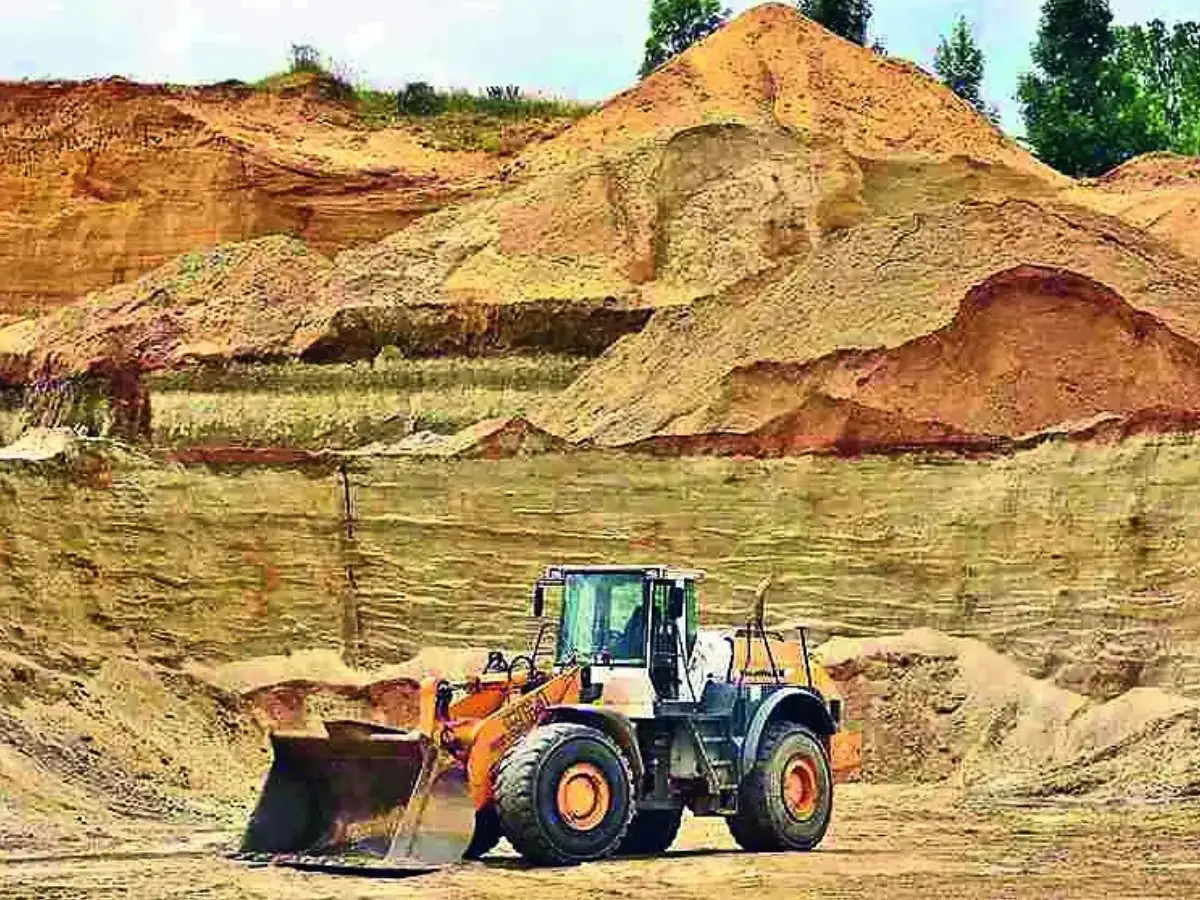
Once Mines and Minerals (Development and Regulation) Amendment Bill 2026, introduced on Monday in Lok Sabha, becomes legislation, states will lose the right to impose any levy or tax of their own on minerals. That may actually be good for state revenues. Additionally, higher levies deter investment and production. It is a steady increase in production, not a rise in levies, which leads to sustained fiscal gains. In fact, encouraging mining is the most promising pathway to alleviate fiscal stress in states.
Here are two test cases as proof:
Odisha The state's own FRBM statement projects mining revenue of ₹56,000 cr for FY27, accounting for nearly 80% of its non-tax revenue. That share has grown steadily since FY22, driven by lease renewals and auctioning of new mineral blocks, not by additional levies.
Odisha's non-tax revenue, at around ₹71,000 cr, has caught up with its own tax revenue of around ₹70,000 cr. Most Indian states depend almost entirely on direct (devolved from GoI) and indirect (mostly via GST) taxation for their revenue. Odisha has built a second engine that runs in parallel to it, powered by minerals. That second engine is now doing nearly half the work.
But Odisha didn't stop at building the engine. It also built a shock absorber to go with it. It set up a Budget Stabilisation Fund, a portion of mining surpluses banked every year. That single design choice is what helps sustain fiscal health from the vagaries of commodity prices.
Significantly, the state imposed no levies of its own. Unsurprisingly, it ranked 1st in NITI Aayog's Fiscal Health Index (FHI) released earlier this year.
Jharkhand 3rd on FHI isn't a traditional economic heavyweight, in terms of per-capita income, or size of GDP, but is rich in resources. Interestingly, the state imposed a cess in 2024-25 on mineral-bearing lands. But in 2025-26, mining revenue fell well short of target, confirming that higher levies don't necessarily translate into higher revenue.
States don't need to impose their own levies because revenue from GoI-levied royalty, District Mineral Foundation (DMF) funds, and auction premiums, all go to them. States need to focus on implementation. They must put more blocks to auction and ensure a quick start to production, since revenues only accrue if blocks produce.
Opportunity is only growing. An expanding demand for, and pipeline of, mineral blocks for emerging technologies that range from battery and clean-energy supply chains to AI infrastructure move the needle in ways GoI transfers and indirect taxation cannot. States that convert mineral wealth into steady revenue streams free up fiscal space for productive investment in infrastructure, human capital and public services.
Today, mining contributes to around 2% of India's GDP, while in countries with similar geology like Australia, South Africa and Canada, it contributes 8-10% of GDP. Minerals like copper, aluminium, nickel, lithium and even silver are critical to economic and national security. Along with oil and gas, they are at the centre of geopolitics and geoeconomics. India must produce much more to substitute imports and end dependency on a handful of nations, which dominate the current supply chains.
States can play a lead. There are plenty states with huge mineral - and hydrocarbon - potential, from Rajasthan in the west to West Bengal and Assam in the east to Karnataka, Tamil Nadu and Andhra Pradesh in the south. Since states have the most to gain in terms of revenue, job creation and growth, they must ensure, by working together with GoI, faster approvals and easier land acquisition so that production is not delayed.
Even Odisha and Jharkhand have only scratched the surface. Their production potential is much bigger. An emphasis on the production of natural resources - while adhering to GoI's philosophy of reasonable levies - will attract investment and offer a pathway to increase non-tax revenue (without burdening individual taxpayers with high fuel taxes, for example), increase productive expenditure (on infrastructure), and ensure sound fiscal health.
Nayyar is chief economist, andPathak is economist, Vedanta