The state of emergency will be expanded to include Hokkaido, Okayama and Hiroshima prefectures from Sunday amid a surge in novel coronavirus cases in those areas, the government announced on Friday.
The state of emergency is currently in effect in six prefectures, including Tokyo and Osaka.
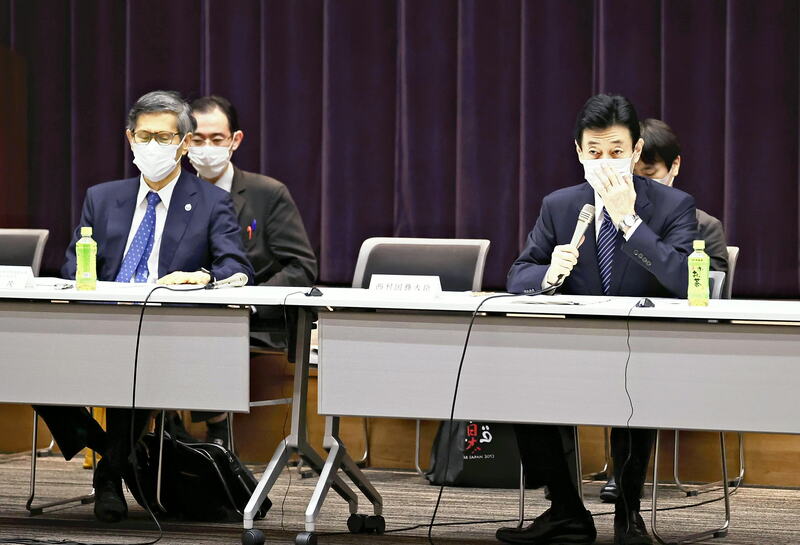
The government presented a proposal to expand the emergency declaration to a COVID-19 subcommittee meeting earlier in the day. The government also proposed the implementation of emergency-level priority measures for the prefectures of Gunma, Ishikawa and Kumamoto.
The government made the decision to expand the measures at a COVID-19 task force meeting on Friday evening.
The state of emergency for the three prefectures is scheduled to take effect from Sunday to May 31. The priority measures are set to be applied from Sunday to June 13.
The government initially proposed applying emergency-level measures for five prefectures -- Gunma, Ishikawa, Okayama, Hiroshima and Kumamoto -- but experts on the subcommittee called for the implementation of stronger measures based on the state of emergency.
Yasutoshi Nishimura, the minister in charge of the coronavirus response, left the subcommittee meeting to discuss the matter with Prime Minister Yoshihide Suga and others at the Prime Minister's Office and a new proposal was thrashed out.
It was the first time the government has changed its plan based on the opinions of the subcommittee.
"Hokkaido issued calls for a state of emergency declaration last night," a senior government official said. "I think the government must have decided to make prefectures where cases have surged subject to the state of emergency together with Hokkaido."
"The decision was made after taking into consideration the opinions of experts," a government minister said.
Five prefectures, including Gunma, had asked the central government to apply priority measures, while Hokkaido had asked for a state of emergency declaration for Sapporo only.
Priority measures are expected to be issued for 10 cities and towns in Gunma Prefecture, including Maebashi and Takasaki. The measures are also likely to be applied for the cities of Kanazawa and Kumamoto.
The government intends to call for staggered lunch breaks in workplaces to reduce the risk of infections through conversations among coworkers in its revised basic policy measures. Regarding the Indian variant, which is said to be highly contagious, the government plans to strengthen monitoring nationwide by utilizing private testing organizations, among other measures.
If the government's latest proposals are officially approved, nine prefectures will be under the state of emergency, and 10 prefectures will be subject to priority measures.
Read more from The Japan News at https://japannews.yomiuri.co.jp/