
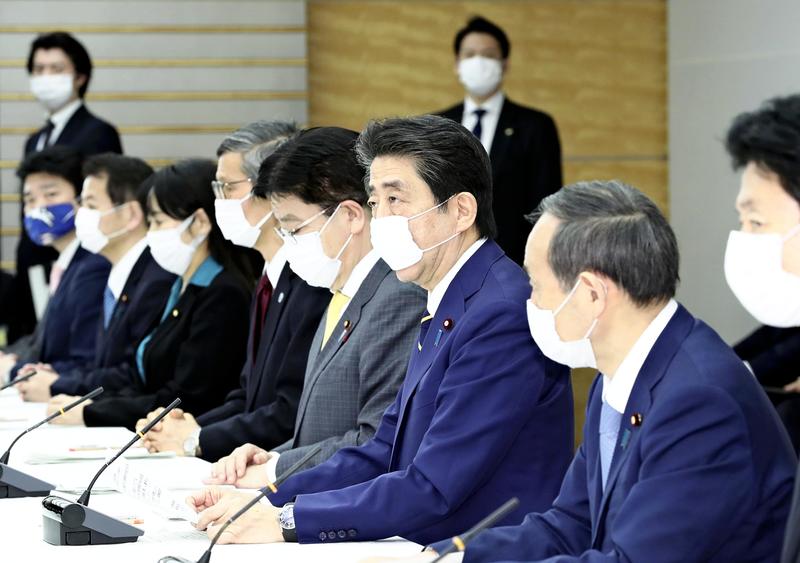
Prime Minister Shinzo Abe declared a state of emergency for seven prefectures, including Tokyo, on Tuesday evening in response to a surge in infections with the coronavirus. It is expected to remain in place until May 6. Prior to the declaration, Abe consulted the Advisory Committee panel of experts, which assessed the current situation in the affected areas as an emergency.
The seven prefectures are Tokyo, Kanagawa, Saitama, Chiba, Osaka, Hyogo and Fukuoka. This is the nation's first emergency declaration and is based on the revised law on special measures to deal with new strains of influenza following the enactment of the law in 2012.
Following the panel's decision, Abe explained the policy of the declaration to the Steering Committees of each chamber of the Diet from Tuesday afternoon. Later in the day, the government declared a state of emergency at its emergency headquarters. The government held a press conference at 7 p.m. to explain the details of the declaration to the public and call for everyone to remain calm.
Health Minister Katsunobu Kato and Economic Revitalization Minister Yasutoshi Nishimura joined the panel of the Advisory Committee, which is chaired by Shigeru Omi, President of the Japan Community Healthcare Organization. Nishimura vowed to keep the declaration in place until May 6. "The number of people infected with coronavirus has increased rapidly, mainly in urban areas, and the number of cases we cannot trace has increased significantly," Kato said.
In order to declare a state of emergency, two factors must be taken into account. First, whether the coronavirus could seriously damage the lives and health of the people; and second, whether it could cause serious damage to their daily lives and the economy due to its rapid spread nationwide.
The Advisory Committee is believed to have judged that the incidence of pneumonia among coronavirus cases is higher than for seasonal influenza, and that the number of patients in Tokyo, especially those whose infection routes cannot be traced, is increasing. Based on this, the Advisory Committee decided to declare a state of emergency. Omi suggested that the government issue a declaration in light of the situation in a meeting with Abe on Monday.
Click here
Read more from The Japan News at https://japannews.yomiuri.co.jp/








.png?w=600)



