Attention is now focused on whether Prime Minister Shinzo Abe will declare a state of emergency in Tokyo, where new coronavirus infections are rapidly climbing.
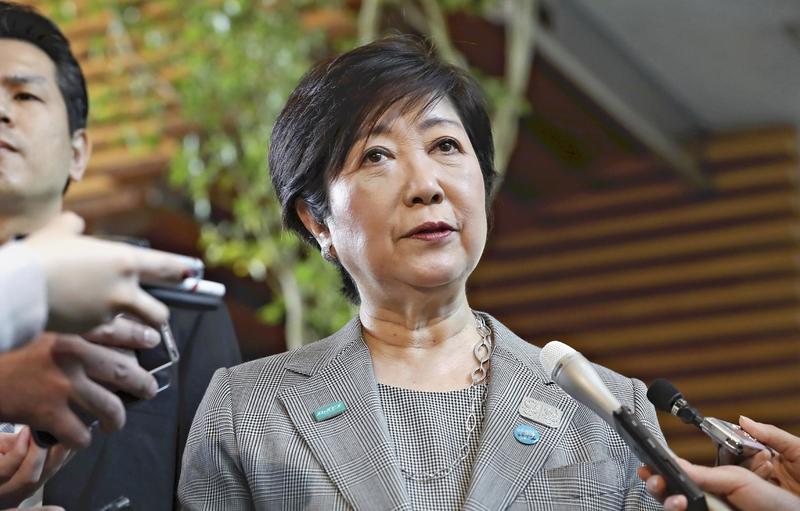
Even if a state of emergency is declared, Japan will not be able to carry out "lockdown" in the enforceable way that other countries are implementing. "After Gov. [Yuriko] Koike's remarks, her words took on a life of their own," a senior Tokyo metropolitan government official said.
If the declaration is issued, it is expected to be used as a compulsory measure to establish temporary medical facilities to cope with the rapid increase in patients. Prefecture governors will be able to use land and buildings without the consent of owners, and they will no longer be bound by regulations such as the Fire Service Law and Building Standards Law.
Also, governors will be able to request to purchase a manufacturer's drugs and other products, and orders for storage or expropriation of such products will be permitted.
Under a state of emergency, compensation is required should there be any suffering from economic damage.
However, there are some measures that are not enforceable. Authorities will only be able to ask people to refrain from going out, and instruct schools and large assembly halls to restrict or suspend facility usage. There are no provisions regarding compensation for the cancelling of events or closing stores. The government is considering rescue measures as part of an emergency economic package, as Koike said, "We request strong support from the government."
Strong measures, such as blocking railways and roads, are also difficult. The prime minister and governors are said to be able to request or instruct railway companies to suspend operations based on a special law, which authorizes them to coordinate designated public institutions such as railway operators. However, they have no authority to stop such operations.
According to a provision stipulated in the Infectious Diseases Control Law, traffic can be restricted for up to 72 hours near places where infected people have been. However, this is based on the assumption that disinfection of the location will be carried out. Health, Labor and Welfare Minister Katsunobu Kato said at a press conference, "This can never be interpreted as a provision to stop people from covering wide areas."
Read more from The Japan News at https://japannews.yomiuri.co.jp/