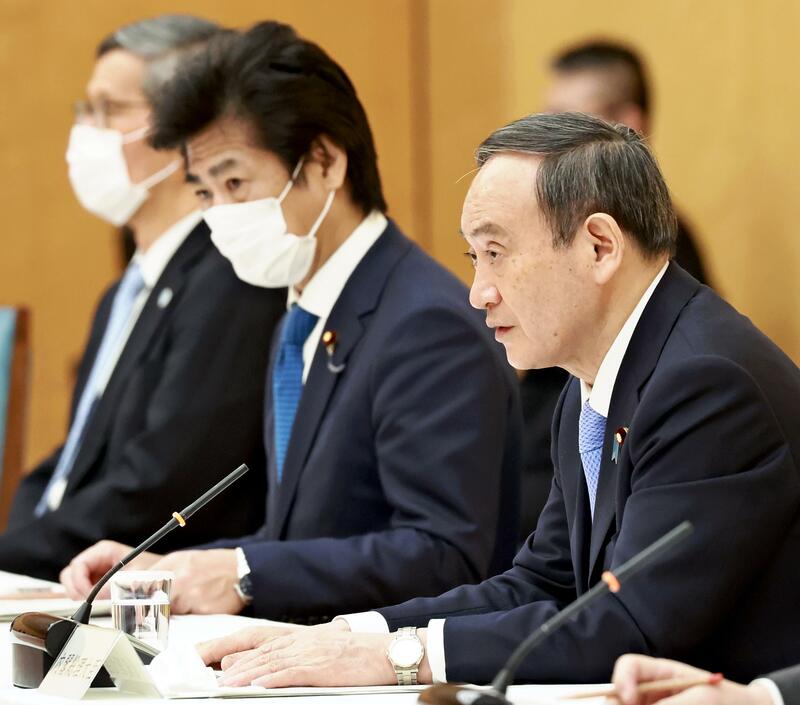
The government held a meeting of the Novel Coronavirus Response Headquarters Friday night and formally decided to re-extend the state of emergency imposed on Tokyo, Saitama, Chiba, and Kanagawa prefectures for two more weeks, until March 21. The measure had been set to be in place until March 7.
At a press conference following the meeting, Prime Minister Yoshihide Suga showed determination as he said, "We will secure the achievements [of measures taken] so far, so that we will be able to lift the [state of emergency] declaration."
The original one-month state of emergency was declared on Jan. 7 and was extended for another month in February.
About the re-extension, Suga said: "We will not have been able to lift it by March 7, as we initially promised. We feel very sorry for that and offer our sincere apology." As to the reason for making the extension period two weeks long, Suga said, "This is the period needed to contain the spread of infections, and at the same time to ascertain the situation more carefully," calling for thorough measures to be taken continuously.
As for resuming the government's Go To Travel campaign, now suspended across the country, Suga said, "It will be difficult to do so for the time being."
The government has decided to once again extend the declaration imposed on the Tokyo metropolitan area because the occupancy rate of hospital beds has not sufficiently improved. During the meeting, Suga referred to the infection situation in Tokyo and the three neighboring prefectures by saying, "The number of new cases has dropped by more than 80% from the peak period." But he added, "In certain areas, the indicators show a tight situation, such as the occupancy rate of hospital beds under strain."
The government has adopted six indicators as criteria for lifting the state of emergency. The state will end when they that show the infection situation has fallen from the levels set for Stage 4 -- the most serious stage -- to those for Stage 3.
One of the indicators is the occupancy rate of hospital beds. As of Wednesday, it stood at 47% in Chiba Prefecture and 42% in Saitama Prefecture. Both figures are close to the 50% level, set for Stage 4. The government intends to bring down the rate further by keeping the measures against infections in place.
The government will continue asking restaurants to shorten their business hours to end at 8 p.m. and asking people to refrain from nonessential outings. It will also keep the restrictions on large-scale events in place, capping allowable attendance at the lesser of 5,000 people or 50% of the venue's maximum capacity.
During the meeting, Suga called on people, including those living outside of Tokyo and the three neighboring prefectures, to refrain from dining together, except within families, or in groups of four people or less. He also indicated an intention to work out measures, within this month, to support women, nonregular workers and others who have become more isolated in society and have suffered distress due to the pandemic.
-- Tests at 30,000 facilities
At Friday's press conference, Suga announced a policy to conduct tests at about 30,000 elderly care facilities, among other sites, by the end of this month to prevent further cluster outbreaks at such facilities.
Suga also said the government will adopt a new testing system in every prefecture this month that can quickly detect coronavirus variants.
Regarding PCR tests for people who are not showing symptoms, the prime minister said the government "would expand testing in large cities" to detect signs of an infection resurgence.
Read more from The Japan News at https://japannews.yomiuri.co.jp/