In the first Star Wars film in 1977, Princess Leia appeared to be about the only woman in all of explored space. Thirty-five years later, The Force Awakens has a much more realistic gender balance; not only does the universe contain more than one woman, but the film actually passes the Bechdel Test.
Made famous online, the Bechdel test has become a staple of feminist film criticism. The test asks if a film (a) has more than one woman, and (b) if those women talk to each other about (c) something other than a man . It’s a simple and ingenious way to see how men in art often serve as the default. The original Star Wars has one great female character in Leia – but by the standards of the Bechdel test, it falls short.
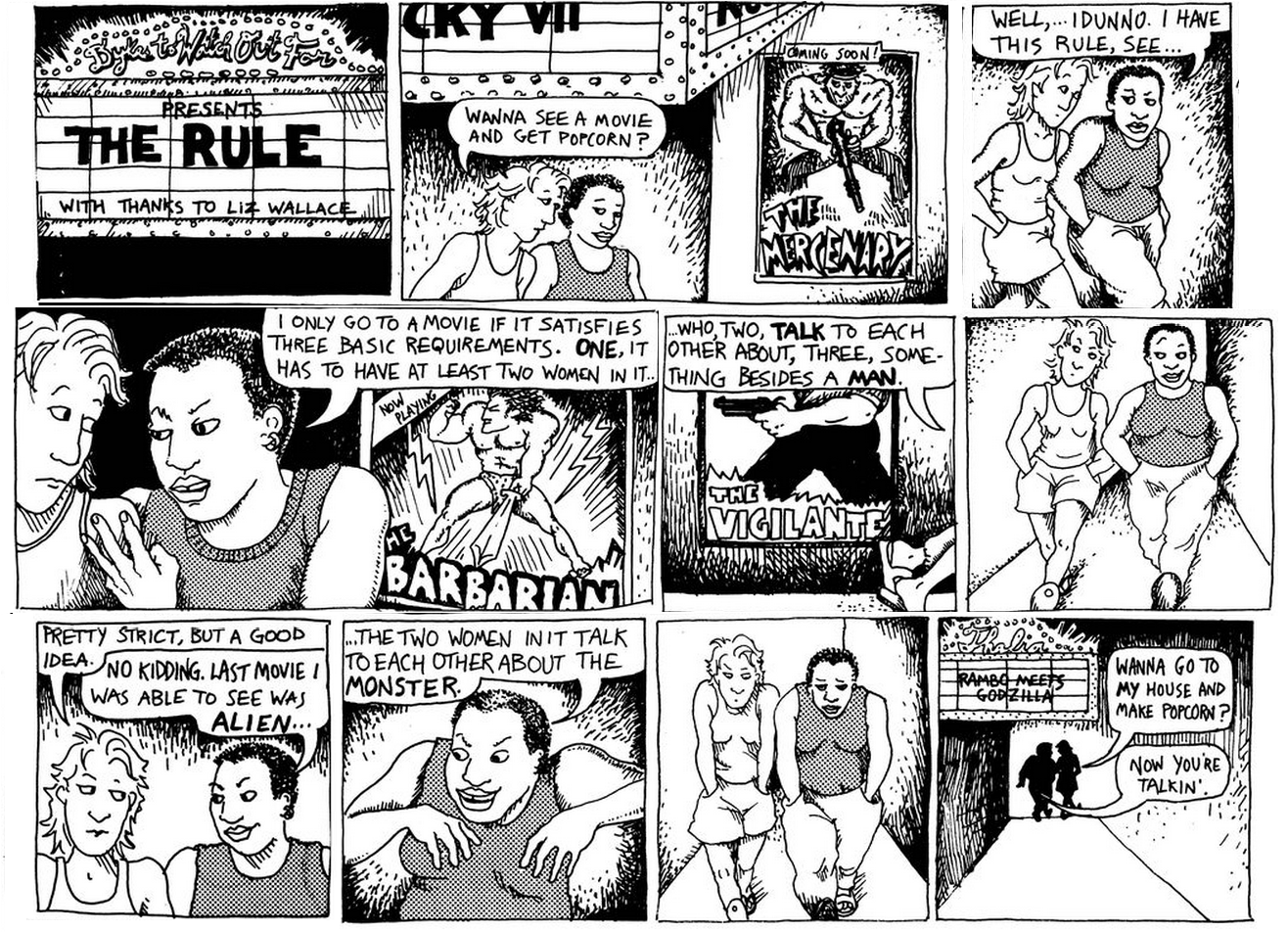
The Bechdel test is a useful rubric. But precisely because of that, its popularity has to some degree erased its origins. The test originated in the comic strip Dykes to Watch Out For, by Alison Bechdel. In 1985, Bechdel wrote a page-long gag inspired by a conversation with her friend Liz Wallace. In the strip, one of Bechdel’s characters explained that she only watched films that passed the test (or, originally, “the rule”.) The character added that the last movie she’d been able to see was Alien, because “the two women in it talk to each other about the monster”.
The character here is often said to be Mo, one of Bechdel’s regulars, famous for her grumpy political diatribes. In fact, though, Mo didn’t show up in the strip until some years later. Still, Bechdel herself sometimes links the rule to Mo these days. In correspondence with writer and critic Erica Friedman at my blog the Hooded Utilitarian, Bechdel said that she herself sees the test as being in part about whether “Mo would sit through these stories or not”.
Mo surely wouldn’t sit through the original Star Wars. But, judging by the Bechdel test, she probably wouldn’t be especially interested in sitting through lots of films or books explicitly aimed at female audiences either. If Mo doesn’t want narratives in which women are focused on talking about and thinking about men, then novels and films which center on heterosexual romance are going to bore her. Sixteen Candles, for example, technically passes the test, while the classic Audrey Hepburn/Humphrey Bogart romantic comedy Sabrina does not. But both films are almost entirely focused on a plot of “girl gets the guy”, and it seems very unlikely that Mo would want to watch either one.
Using Mo’s preferences as a feminist rule of thumb, then, results in denigrating, or questioning, stories that focus on heterosexual romance. That’s not especially surprising; many feminist critics have argued that romance is disempowering for women, since it positions loving and thinking about men over careers or female friendships and female solidarity. Romance writers and readers, though, have responded that the disdain for romance is part and parcel of a misogynist disdain for femininity, and for all those aspects of culture that are seen as being for women, or by women. Maya Rodale, in Dangerous Books for Girls, argues: “Romantic fiction relentlessly declares that women are worthy and their interests are valid and it is worth it for them to pursue their own happiness.”
Of course, the character in the original strip doesn’t necessarily see romance readers as deluded dupes. Rather, the character isn’t interested in heterosexual romance because she isn’t heterosexual. There are lesbian readers of m/f romance (and lesbian writers as well). But the original Dykes to Watch Out For strip is about the way that not just women in general, but gay women in particular, are erased from popular culture. I don’t think it’s an accident that the original film that passes the Bechdel test is Alien, which features Ripley, one of the few truly butch icons in popular film at the time.
As the Bechdel test has become more and more widespread, its original lesbian context has been forgotten or downplayed. As a result, ironically, a rule designed to show how lesbians are erased from popular culture has had its own lesbian roots erased.
The Bechdel test remains a great and revealing way to think about popular culture. But it’s also worth remembering where it comes from. The original test wasn’t meant to rule on the feminism of all film. It was meant to show how one not-coincidentally lesbian woman felt marginalised by popular culture. The fact that a strip about lesbian women has become such an important touchstone for everyone shows how important lesbian writers and thinkers have been to feminism, and to the culture in general. But it’s also a reminder that even when we’re paying attention to who’s allowed to speak and who isn’t, certain people, and perspectives, can get left out of the conversation.
- This article was amended on Tuesday 22 December 2015. We mistakenly named 1979 as the year Star Wars was released rather than 1977. This has been corrected.