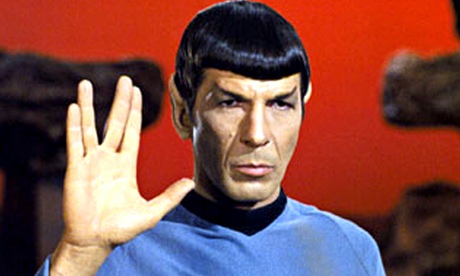
It’s easy to take Star Trek for granted, to forget just how groundbreaking it was. The recent, impossible to ignore outpouring of respect and affection for the passing of Leonard Nimoy showed not only how much his character Spock meant to people, but also how important the show was – and still is. The programmes it competed with at the time are almost forgotten (anyone remember Gomer Pyle and Hondo?) while Star Trek went on to inspire an entire generation of scientists, teachers and explorers.
Nimoy’s exceptional performance was just part of the considerable charm of the original series. Spock was one of an unbeatable trio of leads, completed by Captain James T Kirk and Dr “Bones” McCoy. Kirk … all staccato ... speech patterns … and, ahem, enthusiastic emoting, needed Spock’s brains and McCoy’s heart to make the tough decisions. The show’s creator, Gene Roddenberry, made sure the world they lived in, although futuristic, was always something you could relate to. Before Star Trek, spaceships had looked like rockets or saucers and had names like XB-ZERO, but the unusually unaerodynamic USS Enterprise came with a name that put it in a lineage with seafaring vessels. The ship had a recognisable chain of command, similar to the earthbound military, and some of its best innovations were simply a result of budget limitations: rather than have landing parties touchdown on planets with costly model shots, they simply beamed down with the aid of a fizzy special effect.
The adventures were wide-ranging: they explored, they checked up on far-flung settlers, they fought off (or fled from) attackers. They settled disputes with warring species – often mirroring US foreign policy, with Klingons standing in for Russians. We saw Kirk wrestle a lizard man in Arena, outsmart a superior spacecraft in The Corbomite Maneuver, and even fight to the death with Spock in Amok Time. These colourful, action-packed tales usually came with some depth, thanks to such writers as Robert Bloch, Theodore Sturgeon and Harlan Ellison.
It was Ellison who wrote what is often voted the best episode, The City On the Edge of Forever, a high point not just for Star Trek but for TV itself. Due to some time-travelling mishap, Kirk and Spock find themselves marooned in depression-era New York where Kirk falls in love with Edith, who runs the homeless shelter that takes them in (Spock being sure to wear a woolly hat at all times to hide his ears). But Edith, touchingly played by Joan Collins, is fated to meet her death a few days later. Crucially, if she doesn’t, she’ll go on to start a pacifist movement that keeps the US out of the second world war long enough for the Nazis to perfect their atomic bomb and seize victory. Can the captain stand by and watch the woman he loves die?
It was also a brave show, placing an African American on the bridge – Nichelle Nichols as Lieutenant Uhura – while there were race riots on US streets. Martin Luther King famously declared himself her biggest fan. Uhura and Kirk even shared American TV’s first interracial kiss in the episode Plato’s Stepchildren, gutsy stuff for 1968. Or how about adding a Russian, Pavel Chekov, to the crew at the height of the cold war? They even gave him a mop-top, so he looked more like a member of The Monkees than a threat to western democracy.
It was revolutionary in other, less heralded ways, too. Star Trek just didn’t look like other shows. This was because, in those early days of colour TV, networks banned the use of tinted lighting. Gerald Perry Finnerman, Star Trek’s main cinematographer, refused to play ball, using brightly hued colour schemes that gave the show an otherworldly look that is striking today, even on HD setups.
That’s not to say that everything was perfect. The less said about the reduced-budget third season the better. Roddenberry was replaced by the ill-suited producer Fred Freiberger (who later did a similar hatchet job on Space: 1999). The going went from boldly to badly and the series was cancelled shortly afterwards. Yet, largely thanks to unprecedented fan response, it became a phenomenon, spawning four spinoff shows (with The Next Generation arguably eclipsing the original in popularity), a cartoon series, countless books and comics, plus a dozen movies. Live long and prosper indeed.