On April 30 1999 David Copeland walked out of a gay pub in Soho leaving behind a nail bomb that would inflict appalling damage - and it is at that moment of destruction that Sinner, by Stan Won't Dance, begins.
Upended chairs and tables litter the stage as if frozen at the moment of blast; smoke swirls, cracked music plays, a limp figure is flung against the back. For writer Ben Payne the overwhelming question is how a man like Copeland (who also bombed black and Asian targets) got to feel such hatred. But in collaboration with dancers Rob Tannion and Liam Steel he also imagines what might have happened if Copeland had walked into that pub and instead of leaving his bomb had got himself a date.
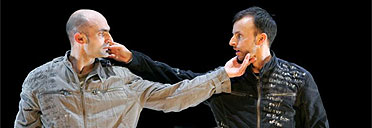
The Copeland character in Sinner is Robert (played by Steel) a man whose intense loneliness is ready to flip into intense loathing. In the pub he meets Martin (Tannion) and for a while the encounter works as a tense, often very funny comedy of gay manners. Martin, overbearingly relaxed, forces his hip chat-up routine so hard onto Robert that the latter ends up horizontal in his seat. They trade body language with vividly contrasting effect. When Martin rubs the sweat off his face its with sporty nonchalance of a footballer or a dancer. When Robert tries the same gesture he conveys only a wet prickle of fear.
This encounter is impeccably played, but as the material pushes into more complex terrain it loses focus. Gesture and dialogue thicken into dense, repeating exchanges in which the two personalities blur, and flirtation gives way to an ugly dance of hatred. Any sense that Robert's twitchy alienation might be deflected into sex is lost as cool Martin starts to reveal his vicious secret prejudices and Robert his homophobic racist code. Eventually it is impossible to tell one voice from another. Yet while Payne's point seems to be that bigotry is rooted in all of us, that we're all at some level akin to the Soho bomber, in pushing this idea he strays too far from his original character. When the work is suddenly wrenched back to Robert and his bomb, and he delivers a long ranting explanation about why he needs to free the world from gays, niggers and Pakis it feels just that - a rant. The frisson of hatred is shocking but it is too forced, too abrupt, to get under Copeland's skin.