Maya Angelou led the way in knowing why the caged bird sang, but she apparently wasn’t the first to assert enigmatically that “a bird doesn’t sing because it has an answer, it sings because it has a song”. Nevertheless, the US Postal Service went ahead this week with issuing a stamp bearing these words alongside a sizeable, smiling image of the author. An unruffled spokesman did have an answer when the problem was drawn to his attention, saying the quote may have come originally from Joan Walsh Anglund, a children’s writer, but it was often attributed to Angelou, notably by Barack Obama.
For connoisseurs of such cock-ups, the misattribution will perhaps be most reminiscent of East Germany’s 1956 blunder in issuing a Robert Schumann stamp with a score in the background that happened to be by Schubert. Normally, though, literary stamp controversies tend to involve objections to who’s chosen as worthy of the honour, and sometimes who’s implicitly deemed unworthy.
So when an anorak-clad, wand-firing Harry Potter began gracing US letters two years ago, there were all kinds of protests: patriots disliked having to lick a foreigner’s backside, progressives accused the Postal Service of cashing in on a film franchise’s success (as opposed to rewarding merit, in the yearly literary arts series the Angelou stamp belongs to), and hardcore Christians denounced the fêting of fantasy and witchcraft. Other rows have involved the private lives of authors selected, or their views (Marie Stopes’s support for eugenics).
Sets of stamps have also come in for criticism, as when Australia Post rather guilelessly chose as its “Australian legends of the written word” in 2010 Peter Carey, Bryce Courtenay, Thomas Keneally, David Malouf, Colleen McCullough and Tim Winton – all white, and all bar one male, it was immediately pointed out.
The UK’s Royal Mail has largely managed to avoid such philatelic fiascos, but not necessarily because it’s more rigorous – its way of staying row-free seems to be to issue as few such stamps as possible, aided by two factors: the ban on depicting living figures other than the sovereign up to 2005 (when Ashes cricketers appeared, followed in 2012 by Olympians but not so far living writers), and artists’ discernible reluctance to put a second head on a stamp that automatically has one already.
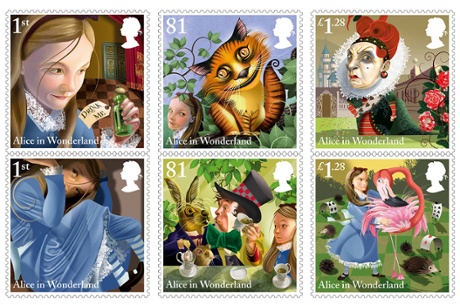
The latter factor means that, whether the authors are living or not, their characters will usually be shown rather than their faces, as seen (following recent issues similarly honouring, among others, Jane Austen, Charles Dickens, Ian Fleming, Roald Dahl and JK Rowling) in this year’s Alice anniversary set, offering a choice of 10 scenes from the book but no image of Lewis Carroll.
Look at a list of British writers who have appeared on stamps and the gaps are consequently glaring and the number remarkably small – roughly the same as the 27 in the US’s literary arts series, produced by a nation with only a 240-year history. The great British literary stamp scandal? It’s that they so rarely celebrate authors themselves in the way that the Maya Angelou stamp splendidly does.