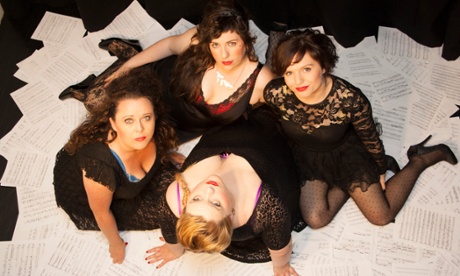
When a song like Robin Thicke’s Blurred Lines or Shaggy’s It Wasn’t Me is released, feminists around the world are usually up in arms. Not so cabaret group Lady Sings It Better. “When one of those songs comes out that’s really offensive, everyone else is just angry,” says artistic director Maeve Marsden. “We’re angry, but we also schedule a rehearsal.”
Marsden leads the Sydney-based group who rework popular songs – the Police’s Every Breath You Take sung as a choral piece; Jason Derulo’s Wiggle as a doo-wop song – to reveal some concerning lyrics couched in their catchy beats.
The idea for the show came to Marsden in 2009 as she watched Alan Cumming sing Mein Herr from Cabaret. As a teenager, she has been told by a singing teacher to change the pronouns of the song if the singer was male, because audiences had “an expectation of heterosexuality”. Yet here was Cumming – and the cabaret fraternity – playing with gender and sexuality.
It was then she decided to put together a group of female singers to interpret songs traditionally performed by men. “What stories or challenges to gender or moments of comedy would we get out of that?” she wondered.
The concept clearly struck a nerve. Lady Sings It Better, which these days also includes performers Libby Wood, Annaliese Szota and Fiona Pearson, have played Edinburgh fringe festival in 2012, Sydney comedy festival in 2013 and 2014, and the 2015 Adelaide fringe among others. In April, they play the Melbourne international comedy festival.
Their set list is constantly evolving because there’s so much material to mine. While R&B and hip-hop artists are the obvious and repeat offenders, the group find new content in unexpected places.
“You don’t expect to find the same aggressive sexuality in old 60s music,” says Marsden, but songs like Tom Jones’s Delilah (“I crossed the street to her house and she opened the door, she stood there laughing, I felt the knife in my hand and she laughed no more”) and the Beatles’s Run For Your Life (“I’d rather see you dead, little girl, than to be with another man”) reveal the depths of pop’s potential back catalogue.
Nothing is sacred. Marsden says audiences are horrified when they hear the Knack’s My Sharona (“I always get it up for the touch of the younger kind”) or Hunters and Collectors’s Throw Your Arms Around Me (“I will come for you at night-time, I will raise you from your sleep, I will kiss you in four places as I go running along your street; I will squeeze the life out of you ... ”)
The only thing the group won’t do is bland. “We keep looking at Red Foo songs, but they are such bad songs that we can’t find anything to do with them musically that we actually want to sing,” Marsden says with a laugh.
From Bridget Christie’s A Bic for Her to Adrienne Truscott’s Asking For It, feminist comedy has proved critical and box office gold in recent years. Comedy is a useful way of tackling issues, says Marsden. “If I wanted to write an essay about misogynist lyrics in music, it would never get me to as wide an audience as a comedy cabaret show does. The more tools, approaches and strategies feminists have in their kit, the further the message goes.”
And there’s nothing more pleasing than winning over the doubters. “It’s satisfying when we draw in a guy who thinks he’s been brought along to a feminist cabaret and wasn’t keen and, by the end, he’s really on board – when he says: ‘I was really into that and I didn’t think I was going to be.’”
There is still some way to go. Although the number of women performers has increased at Melbourne international comedy festival, they are still underrepresented, with only 19% of shows performed by women compared with 73% by men in 2015. And while it’s encouraging to see the increase and be part of the accompanying debate, it’s still a frustrating situation, says Marsden, who was similarly disheartened by the male-dominated lineup of Sydney’s Vivid Live festival.
“Programmers have a responsibility to program extra women and to provide platforms if they care about diversity in the arts,” she says. “You can’t cut out half the population of a creative space and not be cutting out audience experience. We should do it for quality, not just equality.”
Two more Lady Sings It Better medleys
1) The horse medley
2) The fat girl medley
-
Lady Sings It Better play The Butterfly Club, Melbourne, from 15 to 19 April