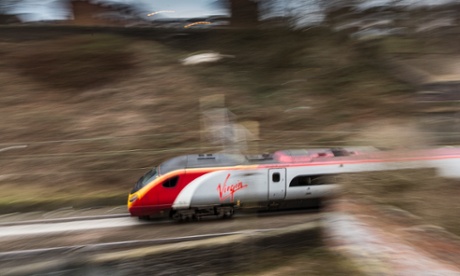
A downbeat broker note has put the brakes on transport group Stagecoach.
Its shares are down 10.6p to 344.2p after analysts at Investec cut their recommendation from add to sell and their target price from 435p to 300p. Investec’s Alex Paterson said the market was expecting the company to keep an unrealistically high share of the UK rail business, while it was also particularly exposed to the national living wage. He said:
Stagecoach has been successful in increasing its market share of UK Rail considerably above its long-term average. However, we believe this share will be difficult to maintain and estimate that even if it retained the largest market share at 20%, there would be downside to our valuation. We also believe the margins on two current rail franchises are high, and even if retained, it would likely be at a lower margin. In our view, a return of capital is unlikely in 2016.
Giving more detail on the franchises he said:
Stagecoach’s operational performance has been undeniably strong and it has been very successful in winning franchises. It has been shortlisted for the TransPennine and Greater Anglia franchises and we include an option value of over £26m in our sum of the parts based on its proportionate ownership and our estimate of the franchise value. We also assume the East Midland franchise is extended through a direct award until March 2018. We estimate that East Midlands and West Coast mainline, in which Stagecoach has a 49% share, are generating margins of around 3.5% and 4.8% which we believe are unsustainable in the long term. If the franchises are retained, we expect it will be at a margin nearer to the industry average of 3%.
On the living wage:
In our view, Stagecoach is particularly exposed to the Living Wage given its high exposure to Regional Bus, at around 55% of group profit. We estimate staff costs typically represent around 60% of the cost base for a bus business.
Stagecoach also has a fairly high proportion of its Regional Bus business in Northern England and Scotland, where volume growth post the financial crisis has tended to be lower than in Southern England.
Therefore, Stagecoach’s ability to offset staff cost pressure with price increases (as occurred in the early 2000s) is now limited, especially given the lower price of fuel which may encourage a modal shift (making private car use a relatively cheap alternative to bus).
[So] we believe a return of capital is unlikely in the next year although the dividend payout ratio could increase.