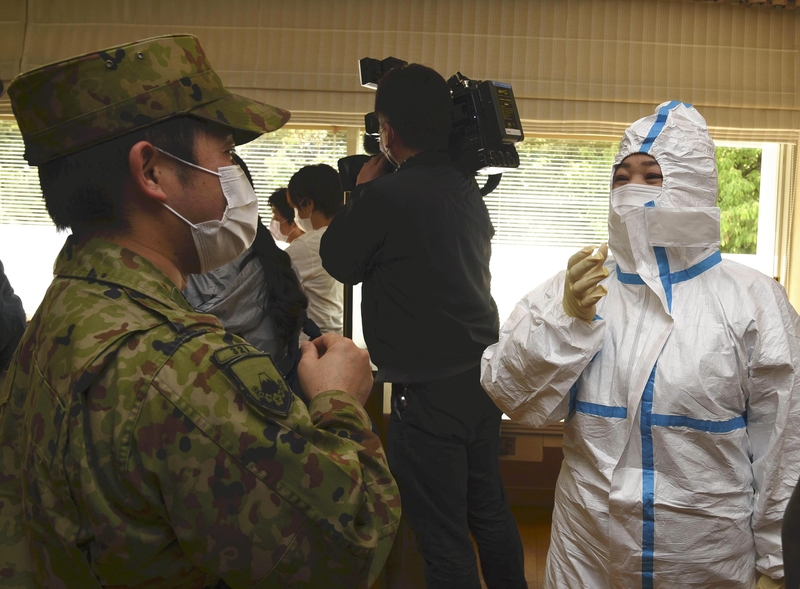
The government's plan of having new coronavirus patients with moderate symptoms stay in hotels rather than at home while they recover has run into some problems.
Following the death of several patients recuperating at home, the Health, Labor and Welfare Ministry hammered out a basic rule that people with mild cases of the virus should stay at accommodation facilities such as hotels until they get better. However, this plan requires having doctors, nurses and other staff permanently stationed at the hotels to monitor the patients' health. Further complicating the situation, some of these patients must continue to stay home while they recover because are taking care of children or elderly relatives.
"We had a doctor shortage in the prefecture even before this," sighed a senior official of the Saitama prefectural government, which has actively urged people with mild coronavirus cases to stay at hotels rather than at home. "Making sure people can recover while at a hotel is not easy."
During April, two coronavirus patients died while recuperating at home in Saitama Prefecture. Both patients were not acute cases when their infection was detected, but their condition quickly worsened while they were at home. Stung into urgent action by these deaths, the prefectural government on April 24 floated a plan to have patients stay in hotels where medical staffers were on hand around the clock, and found three hotels willing to accept such patients. Negotiations with other hotels are continuing.
However, even if hotel rooms are available, finding medical staffers to care for the patients has been a difficult task. The health ministry requires that one doctor and two to four nurses or public health nurses must be available for every 100 infected patients. Saitama Prefecture has 169.8 doctors per 100,000 residents – the lowest figure in the nation. Finding medical professionals to attend to patients in hotels has been a tough struggle.
In addition, other staffers are needed to liaise, coordinate and provide support for the daily lives at patients at the hotels. The Tokyo metropolitan government, which has already secured about 1,500 hotel rooms and wants to get hold of even more, requires that five of its officials must be stationed at each hotel during the day and three at night. "If this policy remains in place for a long time, finding enough officials will become a problem," a Tokyo government official in charge of this issue said.
The health ministry initially planned to let all patients stay at medical facilities while receiving treatment. However, the number of infections in Japan surged from late March, placing an increasingly heavy strain on the medical care system. The ministry became concerned that if the situation continued unabated, the nation would run out of hospital beds for seriously ill patients. In early April, the ministry announced a plan under which people with moderate coronavirus cases – except for elderly people, who are at greater risk of serious health issues due to the virus – would be asked to recuperate at home or in a hotel.
Keeping patients at home also came with risks, such as spreading infections to family members and having a sudden deterioration in their health go unnoticed. Even so, the government opted for this last-ditch course of action so the nation's limited medical care resources could be freed up for patients with severe cases. However, this eventually resulted in the deaths of patients at home in Saitama Prefecture. The feared risks had become reality. On April 23, Health, Labor and Welfare Minister Katsunobu Kato changed the policy and said people with mild cases would, from now on, essentially recuperate at hotels, rather than at home.
Kansai University Prof. Toshio Takatorige, an expert on public health and a doctor who has worked at a public health center, said: "That is the price of not preparing enough hospital beds capable of treating infectious disease patients and failing to quickly secure hotel rooms. We ended up having more people recover at home, which is something that should have been avoided in the first place."
According to Nagasaki University Prof. Hiroshi Mukae, a respiratory medicine expert who has treated people suffering from infectious diseases, the new coronavirus can cause a patient's respiratory condition to quickly deteriorate. "In some cases, a person can develop into a severe condition without them even realizing that this is happening," Mukae said.
Prefectural governments across the nation are scrambling to find enough hotels to accommodate coronavirus patients, who will be shifted to these facilities where medical staffers are constantly stationed and it will be easier to detect any signs of deterioration in their condition than it would be if they were at home. The health ministry said that, as of Monday, about 12,000 hotel rooms had been set aside in 35 prefectures.
For the hotel recuperation plan to advance, it also will be necessary to craft a system that enables patients to be transferred to a hotel soon after they are diagnosed, and to locate businesses able to clean these facilities, provide meals for the patients and do other services.
"It will be impossible to swiftly handle these patients unless government administrators, medical associations, hospitals, business operators and other entities all work together," Mukae said. "The capabilities of the whole region will be tested."
Read more from The Japan News at https://japannews.yomiuri.co.jp/