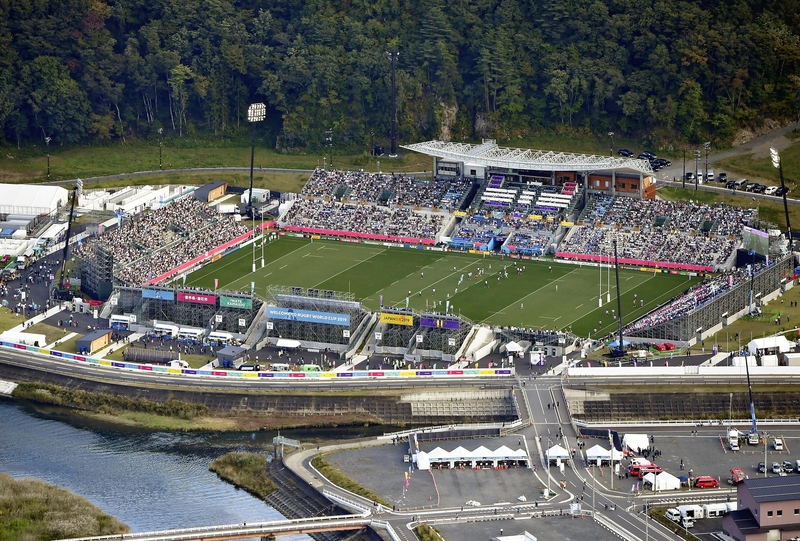
KAMAISHI, Iwate -- Of the 12 stadiums to host Rugby World Cup matches, the Kamaishi Recovery Memorial Stadium in Kamaishi, Iwate Prefecture, is the only venue that was newly constructed. The stadium is also a symbol of recovery that was built on the site of schools destroyed by the tsunami during the Great East Japan Earthquake. With the 2019 Rugby World Cup having ended, discussion has begun on the future of the stadium.
In the Sept. 25 match between Fiji and Uruguay, the stadium was almost full with 14,025 spectators. It was a special day for the city of Kamaishi. In appreciation for the support they received from the national and international community, local children sang a song and unfurled a banner written in English. In front of a monument near the stadium, high school students did storytelling activities. An 18-year-old third-year student at the Iwate prefectural Kamaishi High School, said: "More people than I thought stopped and listened to our stories. I am really glad that I did it."
Around two weeks later, about 40 people concerned gathered in a conference room in the city to discuss the future management of the stadium. There, estimated revenues and expenditures were reported. According to the estimates, total costs such as labor and lawn-mowing costs will amount to 40 million yen a year. On the other hand, 35 million yen in revenue is expected, including revenue from usage fees for matches of the Kamaishi Seawaves rugby football club based in the city. While the estimated revenues included 10 million yen from the sale of naming rights, a buyer has not yet been found.
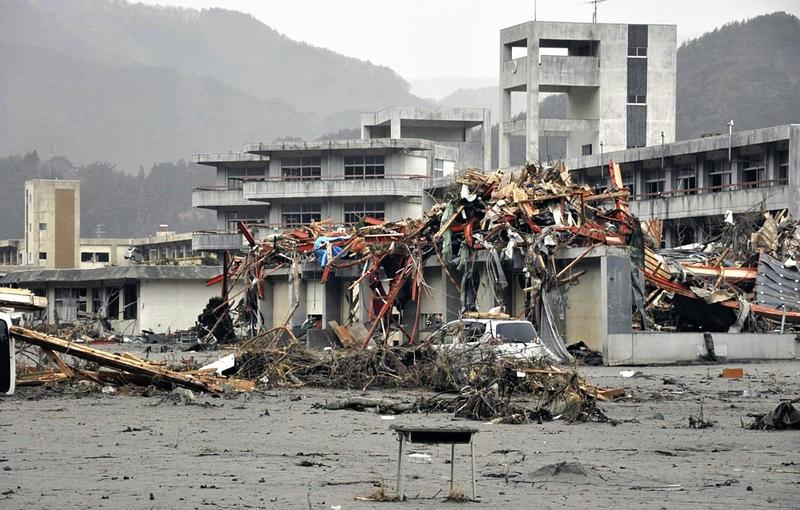
Kamaishi is the "rugby town" that was home to the Nippon Steel Kamaishi rugby club, which won seven straight national championships from 1979 to 1985. After more than 1,000 people died or went missing in the earthquake, the Scrum Kamaishi group was formed mainly by core team members at that time to support reconstruction of the city. Afterward, they began trying to attract Rugby World Cup matches to the city.
While some voiced opposition, saying, "Give priority to reconstruction efforts over rugby," the Kamaishi municipal government considered that it would be a good opportunity to show their reconstruction efforts to the rest of the world, and held meetings in order to further explain their reasoning to the citizens. Through these processes, Kamaishi was selected as a host city for Rugby World Cup matches in March 2015.
The stadium was built on the sites of the Kamaishi municipal Unosumai elementary school and the Kamaishi-Higashi junior high school, both engulfed by the tsunami. The stadium is a symbol of reconstruction and brought excitement to the city. From the time the stadium was completed in August of last year up until July of this year, 730 events had been held there and about 39,000 people had used the stadium.
However, not everything went as planned. The construction cost, which was initially estimated at 3.2 billion yen, ballooned to 4.9 billion yen in the end, due to requests from Rugby World Cup organizers such as expanding the roof over the seats and changing specifications for the temporary stands and lawn. The city government bears about 1.9 billion yen of the total cost. Even taking into account depopulated area development bonds, of which the central government pays 70 percent of redemption proceeds, and special local tax grants, the city has to pay nearly 700 million yen itself.
Of the two matches that were scheduled, the Namibia-Canada match slated for Oct. 13 was canceled due to Typhoon No 19. According to the Iwate prefectural government, a payment of nearly 100 million yen was needed, which included cancellation fees for about 200 buses to transport spectators, labor costs for about 360 security guards and costs for events at a fan zone near Kamaishi Station.
Business owners who had expected direct ripple effects on the regional economy complained that the economic effects were smaller than they expected. However, Kamaishi Mayor Takenori Noda said, "Not only is the stadium located on a site hit by the earthquake, but it has also become the sanctuary of rugby, which is a treasure that cannot be translated into money." Even so, difficult issues remain going forward.
While the municipal government considers a plan to outsource the management and operation of the stadium to a consortium of private companies, Takayuki Katsurada, an official at the Regional Planning Department of the Development Bank of Japan who serves as an adviser to the city, said: "Few companies will take on a big risk in a regional city the size of Kamaishi. It would be a good idea for the municipal government to operate the stadium for a few years to dispel concerns."
While about 40,000 people lived in the city before the earthquake, the population has declined by nearly 20 percent. In the Unosumai district of the city where the stadium is located, the population significantly declined to two-thirds. The city's declining population shows no signs of bottoming out.
"With the end of the Rugby World Cup, we have lost our main goal of showing the reconstructed Kamaishi to the rest of the world. I can hardly imagine what will happen next," said a 62-year-old resident in the district who continues to engage in activities that pass on the experiences of the earthquake to younger generations.
With the enthusiasm for the Rugby World Cup having calmed down, some people are aware of the meaning of the "future." At a first meeting to discuss the future management of the stadium, a participant said, "How should we leave the stadium so it is an asset for our children? We have a responsibility."
Read more from The Japan News at https://japannews.yomiuri.co.jp/