Paris Syndrome, first diagnosed in 1986, is what they call a transient psychological disorder. It isn’t all that well understood, but it sometimes affects first-time visitors to the city, most particularly the Japanese. Symptoms include dizziness, anxiety, and a sense of depersonsalisation and derealisation. It is essentially a severe form of culture shock, brought on by the patient’s overly idealised preconceptions of the place.
There’s also Jerusalem Syndrome, where visitors are overtaken by religious fervour, and Florence Syndrome, in which they’re overwhelmed by all the art. St Andrews Syndrome isn’t listed in the reference books yet, but after some careful study we can begin to compile a preliminary list of its symptoms.
These include a sudden loss of dress sense, leading most particularly to the wearing of plus fours and tam o’shanters; an inexplicable belief that all manner of accessories, from key rings to hip flasks to umbrellas, look better in tartan; and, most unfortunate of all, the conviction that spending hundreds of pounds on a new driver and set of short irons is going to make you play like a pro when you get back home. Evidence gathered from around town in the run-up to the 144th Open suggests that there are already several thousand people suffering from the condition.
St Andrews is, of course, the Home of Golf. And yes they even insist on using capital letters, for extra emphasis. As long ago as 1691 it was described by one local letter-writer as the “metropolis of golfing”. They’ve been playing the game here for more than 600 years. The particular patch of land where the Old Course lies was set aside in 1552, when Archbishop John Hamilton gave the locals the right to play there, a privilege they still enjoy now. There are 16,000 year-round residents, less the 10,000 or so who work and study at the university, and 12 golf courses in the immediate vicinity. Six of those are public links, including the Old Course. Seems the St Andrews Links Trust felt this was insufficient, and so they opened a seventh course in 2008.

This week, they’re expecting around 200,000 tourists in town. Many from Japan and China, but more from the United States. Which means the residents are outnumbered by 12 to one, and probably more given that a lot of them have left town for the week so they can rent out their houses. B&Bs have blossomed like spring flowers, all with little signs in their windows: “No Vacancies.” At the British Golf Museum behind the 1st tee, they’re enjoying what the attendant describes as “the busiest day of the decade, never mind the year”. How many? “Feels like hundreds. Hundreds and hundreds.” Inside, the crowd makes a slow shuffle past glass cases displaying old gutta-percha balls, and sets of clubs which predate the Declaration of Independence.
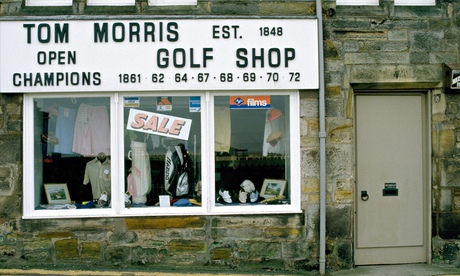
They stop to take photos of the mannequin mock-ups. Strange heroes these, men like Allan Robertson, 19th-century pro and the premier manufacturer of his day, shown at his desk, stuffing a feather ball. The real Robertson is six feet under, in the cemetery by the old cathedral. There are a pair of crossed clubs and a pile of three balls on his gravestone. Across the way is the Morris family plot, where Young Tom and Old Tom, eight Open championships between them, are buried together. This, too, is a place on the pilgrim trail. Coaches stop just by the gates and spill out tourists sporting slacks and anoraks, baggy caps and day-glo macs. They line up to pay their respects. Another St Andrews family the Auchterlonies, are buried there too. The father, Willie, won the Open in 1893, his son, Laurie, was honorary pro at the Royal & Ancient. The golf shop across town still bears their name.
Almost every shop in St Andrews is after a piece of the passing golf trade, from the lingerie store, which has a display of balls and tees alongside the negligees, to the newsagent with signs up advising “We stock Havana cigars” and “American newspapers sold here”. The bookshop must be the only one in the world where Harper Lee’s Go Set A Watchman has been bumped from the front window to make room for titles such as The Legendary Golf Clubhouses of Great Britain.
But it is Auchterlonies that is doing the best trade, the crowd thickest in the main store, where they stock the clubs and other bits of kit. Ask, and they’ll show you the room around the corner, where they keep the special stuff. Dozens of antique clubs with hickory shafts, niblicks, mashies, and cleeks. Among the most expensive of them, an Urquhart iron with an adjustable face, made in 1892. “How much?” asks one elderly Texan accent. £1,250. “Huh. I guess I’ll buy the whole set.” Sorry case of St Andrews Syndrome, that. The man had it bad.