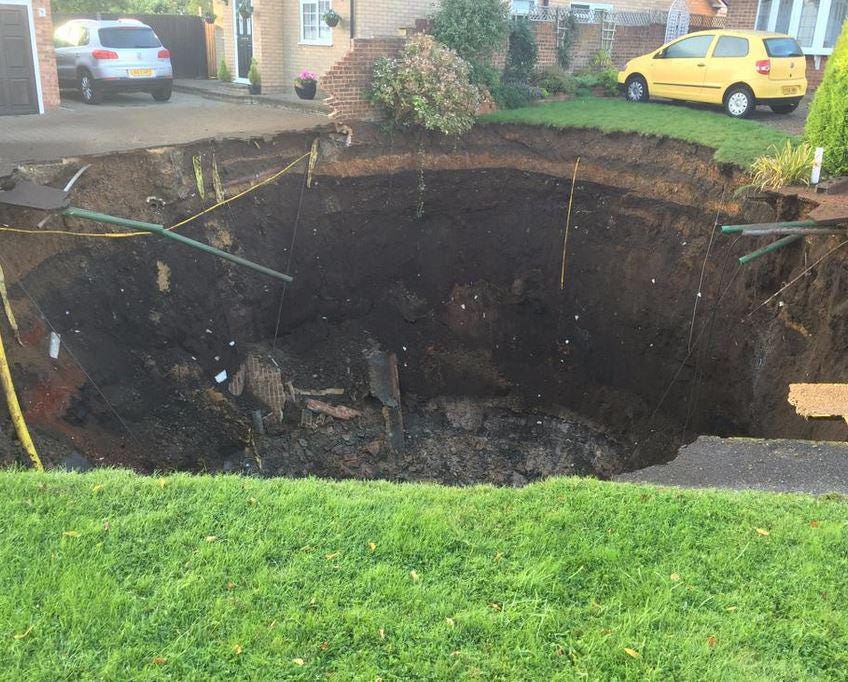
A massive sinkhole has appeared on a residential street in St Albans, prompting the evacuation of at least 10 people.
Hertfordshire Fire and Rescue Service published a photograph of the hole outside two houses on what looks to be a residential street.
The 65ft (20m) diameter hole spreads across a front garden and a driveway on Fontmell Close and is 33ft (10m) deep.
The fire service said at least 10 people were taken to an evacuation centre set up nearby.
A spokeswoman for Hertfordshire County Council told The Independent that they had been notified about a small hole on the footpath on Monday and work had been scheduled to fill it in this morning.
But the fire service received a call at around 1:30am and was told the hole had "opened up substantially" overnight.
One resident, Julie Langford, said she had been warned that the hole could take weeks - or possibly months - before the road is fully repaired.
Ms Langford told Sky News: "I can't walk to work - I have an hour's commute in the morning. The children can walk to school, but when you're a mum with four children it's not easy."
Gas and electric supplies have been cut off to more than 50 properties while emergency crews assess the damage.
In a statement, St Albans City & District Council has said is is arranging overnight accommodation for residents in Fontmell Close and neighbouring Bridle Close.
It said: "We don't yet know how long people will be affected, but it could be some time so we are advising people to plan accordingly."
Councillor Richard Thake, cabinet member for community safety at Hertfordshire Council, said: "Our priority is to ensure the safety of residents in the area and minimise disruption and to resolve the situation as soon as possible".
The council confirmed they "had no reason to suspect" the hole would collapse.
Sinkholes typically occur in areas where the rock beneath the land surface is porous- usually made of limestone, sandstone and other soft rock.
Water builds up in the rock, sometimes due to a burst water pipe, heavy rainfall or groundwater build up, and gradually erodes it till it collapses.
Additional reporting by PA