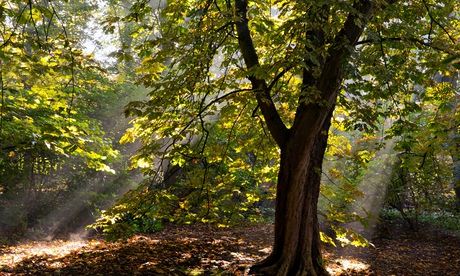
Just as the sticky-buds were about to unstick the tree broke in half. A horse chestnut, well over a century old, was split by the wind; half of it remained upright, half lay on the ground. A white wound of livid timber opened at the end of a huge bough corresponding with its other half in the centre of the crown.
In the space between the two, rain fell and the wind howled. When the storm subsided a little, ewes heavy with lambs nibbled the grass and thrushes paced around looking for worms.
Big, thick, horse chestnut leaf buds were opening on both halves of the tree. The buds on the broken half, although doomed, were the same size as the living side, and days after the crash the buds on each half are still the same. There’s something ominous about this.
The squalls had lasted a few days. They came skidding along the Edge and over Wenlock’s hollow like someone blowing into an empty beer bottle. Earlier I had walked past the horse chestnut tree when it was entire. Pausing to watch a charm of chaffinches in its branches because I thought there were bramblings among them, I had an odd feeling about the tree – not that it was in peril, but it just seemed to stand out.
A week or so back I’d watched a flock of fieldfares there. About 60 gathered, then they took off together; back to Scandinavia, I assumed. It was the Thrushes Field, a gathering place for migrant fieldfares and redwings, but only the local song thrushes, mistle thrushes and blackbirds remained.
The wind shredded clouds and sunlight flooded the field as I watched a pair of herons fly east until they dissolved into the sky. Two buzzards flew down the wind at speed – very fast for these usually sedate birds – and twisted in mock combat.
The air was fizzing with an energy that was sparking through jackdaws and wood pigeons when I left the field. An hour or two later, soaked by the rain, I’d walked back along the field again and almost didn’t notice that the horse chestnut had been split. It was a shock, a sign. But of what?
Paul Evans @DrPaulEvans1