The annual shunto spring wage negotiations between labor and management for 2020 is now underway, with the focus not merely on whether it is possible to continue high pay raises, but also on whether systems for pay hikes based on job performance will spread.
With barriers starting to collapse around core industries that support the Japanese economy, such as electronics manufacturers and automobile makers, as their business operations have diversified, the shunto for 2020 will also focus on reexamining unified negotiations on across-the-board pay hikes in the same industry, and on possible reforms on the Japanese-style employment system.
Merit-based pay
A meeting between labor and management leaders kicked off the spring wage offensive on Tuesday.
Japan Business Federation (Keidanren) Chairman Hiroaki Nakanishi emphasized, "It's crucial to consider how to create an environment where people who are really motivated can work hard."
Behind Nakanishi's remarks are doubts that the current system of pay-scale increases, which raise the level of base pay, has been implemented uniformly for all workers almost regardless of the performance of the individual. He seemed to be calling for the conventional custom to change so that pay increases can differ depending on a person's job performance or level of responsibility for positions.
This sense of urgency is particularly relevant to the leader of a global company like Hitachi Ltd., which Nakanishi is from.
In the fight to gain any possible edge in cutting-edge technologies such as artificial intelligence, global companies are competing for talented young workers, regardless of nationality.
In this battle, Nakanishi sees wages in Japan as inferior, and believes merit-based pay scales would attract excellent workers and prevent an outflow of talent from Japan.
This kind of thinking is starting to permeate labor unions at global companies. For the spring wage offensive, Toyota Motor Corp.'s union has proposed a plan to its members that would widen disparities in wage increases based on personnel evaluations.
"We need to reward people who worked harder," said one of the union's executives. "I don't think sticking to uniformity is one of the union's values."
Calling for big raise
However, the Japanese Trade Union Confederation (Rengo) is arguing that progress has already been made in implementing merit-based pay, and is sticking to a position that large pay raises should be given to everyone, including nonregular employees.
For Rengo, the most important thing is, of course, the level of wage increases.
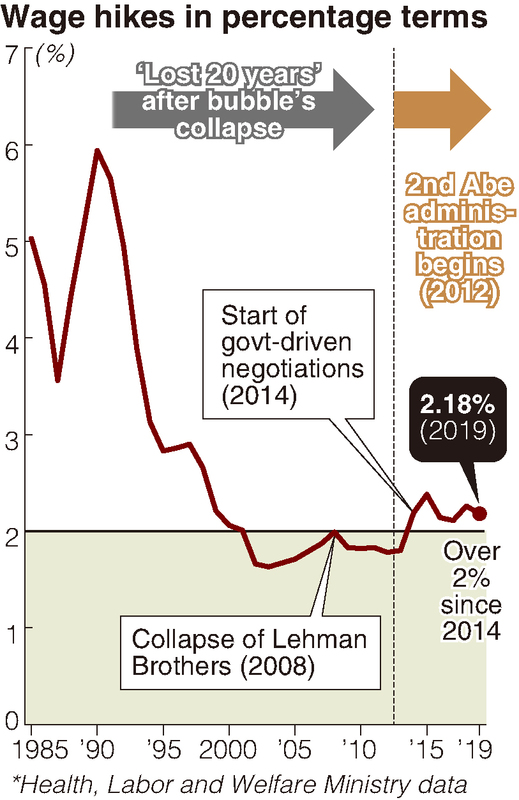
Since the government-driven labor offensive, in which the government calls for pay raises, began in 2014, pay has been raised by more than 2% for six years in a row, which includes increases in base pay. However, with the uncertainty over the future of the global economy, an economist has warned about a possible crisis if pay is not raised by at least 2%.
In fact, the draft wage demands presented by the Toyota union, which tend to set the tone for the entire shunto negotiations, are lower than those last year. So is the level proposed by the Honda Motor Co. union.
The spread of the new coronavirus is another source of concern making it impossible to predict whether large pay hikes will continue. If wage increases slow, it could hinder the economic recovery.
Japanese-style career
Keidanren is also calling for a review of Japanese-style employment, which is characterized by collective hiring of new graduates, long-term and lifetime employment, and seniority-based pay. This is also in the interest of securing excellent workers.
Japanese-style employment means employees can work without worrying about losing their jobs, and companies can spend valuable time training workers. However, as the pace of technological innovation increases, so is the need to acquire external workers who can make immediate contributions.
Therefore, in this year's wage negotiations, Keidanren is calling for a system to be created that is better suited to the real world, which would offer not only Japanese-style employment but a combination of working styles that includes jobs in which wages are determined mostly by ability.
Unlike seniority-based systems, in which salaries increase according to age or length of service, in these jobs performance evaluations play a major role.
Rengo President Rikio Kozu appears cautious about reexamining the Japanese-style employment system.
He is worried that wage disparities that appeared during the "lost 20 years" following the collapse of the bubble economy, due partly to the expansion of nonregular employment, will become larger if changes are made to the Japanese-style employment system.
He said that reforming the Japanese-style employment system "could be inconsistent with resolving issues that have been left behind."
In the debate between labor and management over reforming Japanese-style employment, Japan Research Institute Vice Chairman Hisashi Yamada said: "Merit-based employment may be necessary, but the Japanese-type employment system has created strengths in terms of quality. Both these aspects should be skillfully combined."
Read more from The Japan News at https://japannews.yomiuri.co.jp/