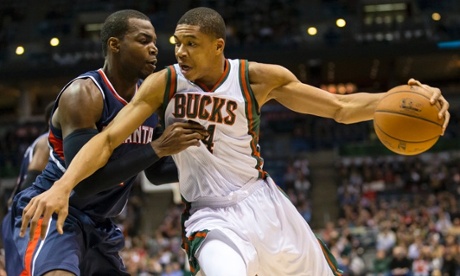
In their quest for a new downtown arena, the Milwaukee Bucks have been running a familiar playbook. Not only have they been making the typical economic arguments, talking up supposedly inevitable growth in the area around the new building, but they have been seizing on the regional pride of Milwaukeeans and Wisconsinites. In his visits to Milwaukee, Adam Silver has repeatedly invoked the “town hall” as comparison, citing a basketball arena’s capability to hold events such as concerts and the circus.
The team has been similarly aggressive in its appeals to civic pride. This video heralding a new arena’s “ripple effect” includes such lines as, “This is our time, a bold new beginning in Milwaukee”, “This is Wisconsin’s home from the court to concerts,” and “A proud heritage is the spark for a bold new future.” This is how the Bucks’ new owners Marc Edens and Wes Lasry, worth a combined $3.6bn, have justified asking for $250m in public funding from Wisconsin and Milwaukee taxpayers.
I am having a difficult time buying these arguments from the Bucks new ownership group, headed by a pair of New York-based billionaires in Edens and Lasry. The Bucks have since engaged in a full rebrand headed by Brooklyn-based design firm Doubleday and Cartwright. The “quarterback” for the new arena project is Mike Fascitelli, former president and CEO of Vornado, a New York-based real estate trust investment company. A Milwaukee architecture firm will at least be involved, Eppstein Uhen, but the project will be headed by Populous, an international architecture firm that specializes in sports stadiums and has offices in London, Brisbane, New York, San Francisco and eight other cities that aren’t Milwaukee.
But primarily, I have a hard time believing Lasry, Edens and the rest of the new Bucks ownership care about Milwaukee because of the buy-out clause included as part of their purchase of the club. ESPN reported shortly after the $550m purchase last April that the deal “includes a provision that allows the league to buy back the team for $575m if construction on a new building in Milwaukee is not underway by the deadline” of November 2017.
It’s a no-lose investment for the new owners, who still come out $25m ahead if they fail to get the arena. And if the arena does get built, Lasry and Edens will be sitting on the easiest and most lucrative investment their money can buy. Just look at the performance of the Milwaukee Bucks as an asset since Herb Kohl purchased them in 1985, as their current arena, the Bradley Center, was being built. Kohl purchased the club for just $19m — $42m in today’s money, adjusted for inflation. With a sale price of $550m, Kohl received a 1,304% return on his investment.
Similar stories can be found across sports. Texas businessman Drayton McLane bought the Astros in 1993 for $117m ($195m after inflation). After he threatened to sell the team to an investor who would move them to Northern Virginia, Houston citizens voted to publicly fund a new stadium, now known as Minute Maid Park. McLane sold the team for $680m to Jim Crane in 2011, a 338% return on investment. Even in Milwaukee, Bud Selig bought the Brewers for $10m in 1970 ($61m after inflation), and after receiving state aid that some estimates put at more than $1bn to build Miller Park, sold the team for $226m to Mark Attanasio in 2005, a 364% return on investment.
There isn’t much easier access to free money than through sports and new stadium deals. The NFL had 29 stadiums either built or renovated between 1990 and 2011 with $6.3bn in public funding covering 61%of the cost. Numbers are similar in MLB, where 26 stadiums were or renovated at a $5.5bn cost to the public covering 59% of the total. In the NBA, $3.1bn in public money was spent on 27 stadiums and covered 51% of the total costs. The NBA, however, is a particularly enticing investment right now, as it is seeing huge growth. According to Forbes, the average franchise is now worth over $1bn for the first time and a $2.6bn yearly television rights deal will be kicking in for the 2016-17 season and feeding the coffers of all 30 teams.
Edens and Lasry are both hedge fund managers, like many owners they may put their own money into a team but they’re hardly acting out of charity. Their jobs are to find investment opportunities low in risk and rich in potential value. Thanks to the buy-out clause, their investment in the Bucks is completely risk free. NBA franchise values are rising faster than any other sports league, as Forbes calculated an average increase of 74% last year to go along with the lucrative TV contract, which will remain in place until 2024. It’s a no-brainer investment for the pair, even as they graciously chip in $150m of their own money — all of 4.1% of their net worth. The only ingredient left is the state’s cooperation, and that can be won with a few economic promises and some riled up sports fans to pine for the arena.
The civic pride argument has been invoked often enough that in 2004, economists Peter Groothuis, Bruce Johnson and John Whitehead published a study examining whether or not it actually exists. The economists refer to civic pride as “a nonuse benefit. Without ever paying the team, people can cheer for it, read about it in newspapers and magazines, and brag about it to out-of-town friends and relatives.” Their study, examining the Pittsburgh Penguins and Pittsburgh Pirates, found that “sports-generated civic pride does not appear to be something a majority of Pittsburghers are willing to pay for with public funds.” However, there is a minority that do show willingness to pay for these benefits, and the authors conclude: “The support growing from sports’ role in creating civic pride may make the job of forming an interest group coalition to extract economic rents from the majority easier.”
To put it simply: yes, there is a real positive impact in city pride from professional sports teams and their new buildings. But this positive impact rarely comes close to justifying the massive costs behind these arenas. In a subsequent study incorporating data from more cities than just Pittsburgh, Johnson found our willingness to pay for civic pride is about one-fifth on average the actual amount we end up spending. That other four-fifths makes up the “economic rents” extracted from the majority by civic pride. Kind of a raw deal if, to use the Bucks example, you’re not one of the only 20,000 Wisconsin households that watched the Bucks last year.
With all this taxpayer money going towards these stadiums, we would at least expect the teams to make an effort to keep their buildings truly public, available to all. The citizens can’t be expected to take pride in something they aren’t allowed to be a part of. But baseball’s Angels, who play in publicly owned and funded Angels Stadium in Anaheim, admitted recently they are actively seeking to price out poorer fans. “We’re taking a different strategy this year,” Robert Alvarado, vice president of marketing and ticket sales for the Angels, told the Orange County Register in June.
“We may not be reaching as many of the people on the lower end of the socioeconomic ladder, but those people, they may enjoy the game, but they pay less, and we’re not seeing the conversion on the per-caps,” Alvarado said, referring to profit per-fan. “In doing so, the ticket price that we’re offering those people, it’s not like I can segregate them, because I’m offering it up to the public, and I’m basically downselling everybody else in order to accommodate them.”
The Angels have increased ticket prices by 76% since the 2011 season, the largest increase in the league over that span. Despite the fact that the city of Anaheim paid for the entirety of Angel Stadium when it was built in 1966 and spent another $30m on renovations in 1996, the Angels are making no effort to make the stadium and their games accessible to the average resident.
In fact, the club has tried to hide its ties with the city. Ever since Arizona billboard magnate Arte Moreno bought the team in 2003, references to Anaheim have disappeared from uniforms and merchandise. The club, which had been the Anaheim Angels since 1996, attempted to rebrand as the “Los Angeles Angels of Anaheim” despite the fact Angel Stadium is 30 miles away from Los Angeles and roughly an hour’s drive away. The city of Anaheim filed a lawsuit, but Moreno was in the clear – the club’s lease with the stadium merely required the team’s name “include the name Anaheim therein.” Technically, Moreno was fulfilling his civic duty, and the often-mocked Los Angeles Angels of Anaheim name has been in place since 2005.
Americans across the country have paid enough – $14.9bn on professional baseball, football and basketball stadiums alone – to demand a better effort, to demand more than technical fulfillment. To benefit from civic pride, there should be civic responsibility attached. Lasry and Edens have been giving the city and state the perfunctory lip service, as usual. But we’ve seen this before. If recent history holds, both in Milwaukee and the nation as a whole, when it comes time to distribute the huge financial gains, Lasry and Edens will benefit the most. The citizens will be left with nothing but the debt and upkeep of an ancient stadium hurtling towards obsolescence.
This has been the standard procedure in the sports world for over half a century. Owners cash out as their stadiums reach the end of their life cycles, and new financiers with nothing to lose – literally, in the case of the Bucks – come in to capitalize on notions of civic pride and the fans’ fear of losing their team. For these owners, sports teams are investments and service is secondary. Next time a team in your city comes begging for money, ask yourself, can you really trust them to hold up their end of the bargain?