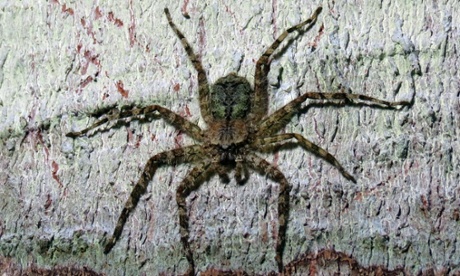
Earlier in the summer, we learned that spiders can ‘sail’ on water, lifting their legs, or abdomen to catch the wind and throwing out lines of silk like anchors. Now it transpires that several species of canopy-dwelling spiders in Central and South America are capable of something approaching flight. It looks like they are skydiving.
My favourite part of a scientific paper is the methods section because it reveals the clever, sometimes batty, often funny things that scientists get up to. This new research on spiders, published today in the Journal of the Royal Society Interface, does not disappoint. In it, the researchers describe how they performed “drop tests” on large arboreal spiders of the genus Selenops. These species look like they’ve spent several days in a flower press, hence their nickname: “flatties”.
“Drop tests were similar to those used in other studies of gliding arthropods,” write the authors, directing my attention to references 2, 4 and 5 at the end of the paper. I make a note to look these up when I have a moment. The researchers collected spiders, weighed them and then released them back to their natural habitat in the rainforest canopy at sites in Panama and Peru.
But instead of putting them safely back on a trunk, they tipped them from a plastic container. “The principal goal of this study was to document the occurrence of directed aerial descent in tropical Selenops species,” write Stephen Yanoviak, a biologist at the University of Louisville, and his colleagues.
They filmed the results.
Of 59 individuals subjected to the drop test, 93% exhibited “directed aerial descent towards a tree trunk, followed by a successful landing.” Follow-up experiments in a wind tunnel reveal how the spiders adopt a head-down posture and make rapid changes in the orientation of their forelegs to change direction. Essentially, the Selenops spiders are doing what Roger Moore does in the Moonraker parachute scene. With eight limbs rather than four, I’m guessing they might be even more accomplished.
This behaviour likely evolved to avoid the potentially fatal consequences of landing in the forest understory, the authors suggest. “These spiders represent a remarkable evolutionary adventure in the animal conquest of the air.”
Yanoviak, S. P., Munk, Y. and Dudley, R. (2015) Arachnid aloft: directed aerial descent in neotropical canopy spiders. Journal of the Royal Society Interface 20150534