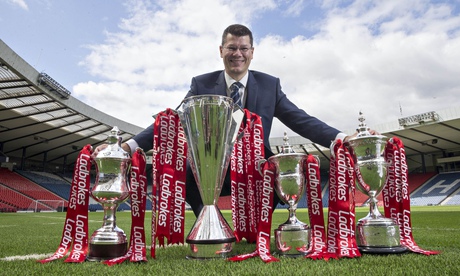
The Scottish Professional Football League and BBC have traded blows, after the corporation was accused of “discriminating” against his business in an astonishing attack by the league’s chairman, Ralph Topping. He also claimed the BBC is “damaging the game” in Scotland with “indefensible double standards”.
Alluding to the rights monies paid for Match of the Day – some £68m per year against the highlights package in Scotland of around £1m per year – Topping insisted the disparity is unacceptable. The issue was raised on Thursday after the BBC’s director of sport, Barbara Slater, admitted at a conference that there is “inequality” between the respective deals.
“The days of the BBC selling Scottish football short are drawing to a close,” Topping said. “There is an overwhelming argument that the public money spent by the BBC on the UK’s national game should be more evenly split.
“There is no doubt that the English Premier League is one of the most powerful leagues in the world, and the BBC is paying £68m per annum over the next three years for its slice of that particular cake, but Scottish football will no longer be satisfied with the crumbs off the table.
“Compared to England, Scots contribute a 10th of the licence fee, yet at less than £1m for TV highlights, our BBC deal is only a sixtieth of what the BBC pays to the English Premier League – and that doesn’t include the money they also pay to the English Football League for highlights. The BBC is damaging the game in Scotland and these double standards are indefensible for a publicly-funded broadcaster.
“It’s a sad reflection of the BBC’s approach to its investment in Scottish football that Gary Lineker’s salary is double the amount the BBC pays for TV highlights of over 250 SPFL games each year.
“In the current deal, the BBC has almost halved the amount they previously spent on Scottish football. There comes a point where you have to say ‘enough is enough’ and we’ve reached it. Fans, clubs, politicians and the Scottish public recognise that, as our national broadcaster, the BBC has a duty to do the right thing.
“The facts could not be clearer – for far too long the BBC has been discriminating against Scottish football and it’s time for the corporation to increase its contribution to the sport in Scotland to properly reflect what our country contributes to the licence fee.”
Topping and his board have come under routinely fierce criticism from dissatisfied Scottish supporters, which will leave some suspecting the chairman of playing the populist card. Such a volley towards a key rights partner has been previously unheard of.
In response, the BBC highlighted how content the SPFL was with its deal at the time of signing. “The SPFL welcomed the current rights agreement with the BBC and other broadcasters when it was announced – [SPFL chief executive] Neil Doncaster saying it was great news for fans of Scottish football – and it’s always been the case that sports rights are negotiated in line with the prevailing market conditions and not according to population quotas,” said a BBC spokesman.
“Ultimately the sports rights market is not controlled by the BBC and we are one of a number of organisations who regularly compete for sports rights. When we negotiate for rights our priority is to get value for money for the licence fee payer. Negotiation is two-way – the SPFL come to the table with their wishes and we decide on how much we can reasonably spend on the rights package on offer.
“Supporters in Scotland tell us they enjoy watching highlights programmes of both the Scottish Premiership and the English Premier League and we don’t believe that audiences in Scotland are being short-changed. We have a long-standing relationship with football’s governing bodies in Scotland and we believe our involvement has a positive impact on the appreciation of the game in this country.”
It remains to be seen whether that involvement will be extended beyond the 2015-16 season and, crucially, if so on what terms.