The government must use the forthcoming spending review to kill off some of its costly projects and to ditch unrealistic targets such as doubling UK exports if it wants to balance the books this decade, a report warns.
The Institute for Government (IFG) thinktank raises concerns over ministers and civil servants’ ability to manage what will be an unprecedented decade of austerity as the chancellor, George Osborne, demands they “deliver more with less”.
The report’s authors also highlight a tougher backdrop to this spending review, due on 25 November, owing to “unrealistic targets” and 517 conservative manifesto commitments.
“The chancellor wants to ‘do more with less’, but less money means doing less. There is a real risk that Whitehall will not implement spending reductions properly, and we are concerned that increased pressures on services will lead to more frequent failures,” said Daniel Thornton, co-author of “Managing with less: the 2015 spending review”. “If ministers want to do this right, they need to stop rather than delay expensive projects.”
Unprecedented decade of cuts
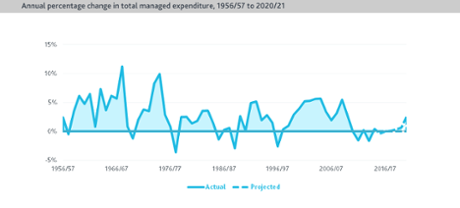
The report sets out ways ministers and civil servants can “make cuts sensibly”. The first is for secretaries of state to cut down their priorities to shorter lists of about 10 key areas, rather than spreading themselves and their departments across dozens.
Related to that, they should ditch targets like the one Osborne set out under the previous coalition government to double UK exports by 2020. In reality, however, there had been little progress on exports growth, the IFG said. The British Chambers of Commerce recently estimated the target would not be met until 2034.
The report also calls for ministers to reprioritise its list of what the government describes as major projects. There are 188 such projects, spanning construction projects such as rail links, defence programmes and changes to the way government delivers services, such as opening rehabilitation up to the market at the Ministry of Justice.
The IFG recommends the major projects lists be scaled back and that any potential new projects are better scrutinised before they are announced. Given the spending cuts the government wants to make, it could not afford costly delays to projects that had already slipped down the priority lists, said Thornton. “It needs to cancel projects rather than kicking them into the long grass,” he added.
The IFG also flags up worries about outsourcing some services given previous failures, such as allegations that security companies had been overcharging for their services in tagging prisoners on probation and the shortcomings of security during the London Olympics which meant the British army was called in to plug the gap.
“Reform through bringing in new providers can introduce innovation and efficiencies into the public sector. However, there are complex challenges in developing and managing effective markets for public services, and there have been several recent failures, such as Olympic security and offender tagging,” the IFG report said.
Thornton suggested continued outsourcing to private companies by the government would influence how many jobs could be cut in the public sector. “There are big challenges for civil servants in managing outsourcing ... you need good capacity in the civil service to do this well,” he said.
The report also recommends the Treasury stay involved in any devolution deals and that the government should continue its push to digitise more of its work and the services it provides to people such as gov.uk websites.
Uneven cuts
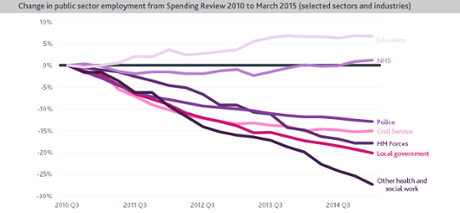
The report stops short of recommending how deep spending cuts should be and where they should fall. But it does warn that the ringfencing of some departments’ budgets means certain areas will be harder hit. That could have implications for jobs in certain areas, the IFG added, as it highlighted the shrinking workforces of local government and in social work while education employment had risen since the last spending review.
Protected social security, health and education
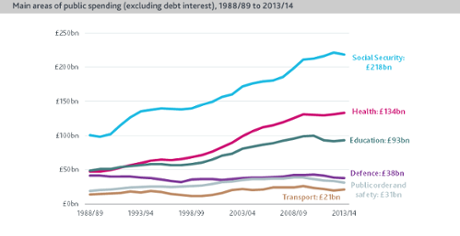
“The pattern will continue to be uneven, with spending on the NHS, pensions, schools, defence and overseas development protected, meaning that reductions will be concentrated on other areas of welfare, police and fire services, courts and prisons, childcare, higher and further education, and local services such as social care, children’s services and local transport,” the report said.