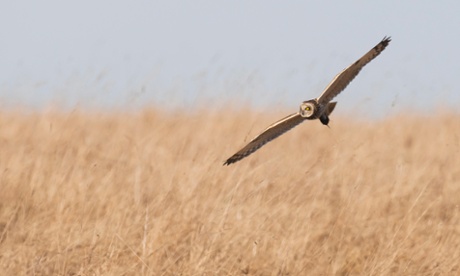
All owls somehow make plainer the magic of life, but for me short-eared owls cast the strongest spell, because they are part of the story of how I became a naturalist.
They bred on Derbyshire moors near our house and each April evening after school I would go and lie in the heather and be amazed at their displays.
Owls in flight seem to love the air more truly than other birds. Each wing stroke is a perfect thing, and short-eareds have longer wings than their four British relatives, so that when they display, all of this purity of movement is slowed and intensified to a form of aerial ballet.
The four birds at Claxton are hunting before they return to breed in places like my home county. The voles on our marsh seem in good supply but the owls do not always get to keep their prey.
One dropped as if on a catch and while I, with binoculars, could not see whether success had occurred or not, a kestrel clearly had. It flew low and hard at the owl’s spot, paused, issued an urgent whinnying cry and flushed the owl up.
A vole was visible in the talons and its owner began a steady circling ascent over the kestrel, which maintained its pursuit. It must have been five minutes before I witnessed the outcome, willing it because of the pain in my arms from holding binoculars.
Up they went, higher and higher, the owl seeming to place its broad span over its opponent to block the kestrel’s upward spiral.
The owl tried to scoop the meat from foot to beak but that failed. Still they rose until they were no more than dots and the kestrel’s relentless shrieks were all but lost in all that vast air.
Then the end came. The vole was dropped and in a second the dot-sized assailant caught the speck. The kestrel’s wings closed and their owner fell to Earth at an angle of about 70 degrees.
Just before the dark teardrop splashed, miraculously and without apparent adjustment, it stopped and landed and vanished.