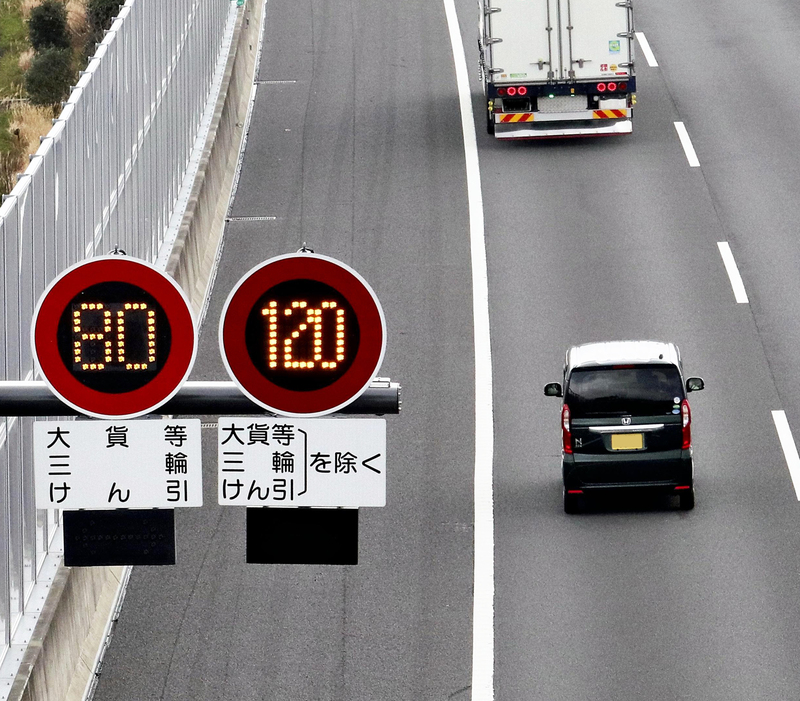
The speed limit for five expressway sections will likely be raised to 120 kph, the National Police Agency decided on Wednesday. The move paves the way for the first permanent increase in the speed limit from the current 100 kph since a section of the Meishin Expressway opened in 1963 as the nation's first intercity expressway.
The NPA made the decision after selecting five candidate sections on four expressways in eastern Japan. The new cap will be introduced on these sections as soon as each prefectural police completes arrangements with expressway operators and the necessary signage is installed.
The NPA will set some conditions for raising the speed limit for the expressway sections. For example, road conditions must safely accommodate vehicles operating at 120 kph with the traffic flow at 100 kph or higher. These sections also must have a low ratio of fatal and injurious accidents.
These conditions will be presented to prefectural police headquarters nationwide as early as next month, with sections having three lanes in each direction receiving priority for the time being.
Regular passenger vehicles, buses and motorcycles will be allowed to drive at 120 kph, while the maximum legal speed will remain unchanged at 80 kph for large trucks, crane and trailer-towing vehicles because they are more likely to cause serious damage in the event of an accident.
The candidates include a section in Shizuoka Prefecture between the Gotemba Junction and the Hamamatsu-Inasa Junction on the Shin-Tomei Expressway, which is undergoing construction to provide three lanes in each direction through the end of March. The speed limit will be raised to 120 kph when the construction is completed at the earliest.
The other candidates are a section in Iwate Prefecture between the Morioka-Minami Interchange and the Hanamaki-Minami Interchange on the Tohoku Expressway; another Tohoku Expressway section between the Sano Smart Interchange in Tochigi Prefecture and the Urawa Interchange in Saitama Prefecture; a section on the Joban Expressway between the Mito Interchange in Ibaraki Prefecure and the Kashiwa Interchange in Chiba Prefecure; and a section on the Higashi-Kanto Expressway between the Chiba-Kita Interchange and the Narita Junction, both in Chiba Prefecture.
Read more from The Japan News at https://japannews.yomiuri.co.jp/