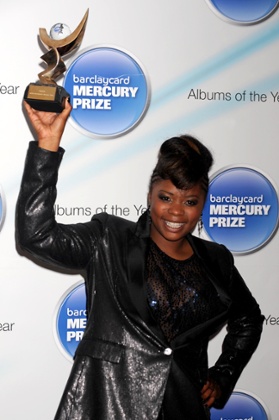
On 8 September 2009, Speech Debelle’s career began to unravel. That evening, the British rapper’s debut beat albums by indie favourites Kasabian, the Horrors and Florence + the Machine to scoop the Mercury music prize. Speech Therapy mixed jazz-leaning beats, which were largely created on acoustic instruments, including the clarinet, with Debelle’s delicate, yet powerful spoken-word rhymes, and featured contributions from left-field talents such as Micachu and Tunng’s Mike Lindsay. Not only was Speech Therapy a precursor to Kate Tempest’s brand of British hip-hop, it was also a rarely aired dispatch from the UK’s alternative rap scene.
The win should have been the highlight of Debelle’s short career so far, but Tim Jonze, the Guardian’s music editor, who was at the Grosvenor House hotel when Speech Therapy’s victory was announced, recalls the reaction in the room as one of surprise, rather than celebration. “The place fell into a shocked silence, except for one little island of elated screams and astonished expressions,” he remembers. “The year before, Elbow triumphed and the whole room united in goodwill for them. But this time you got the feeling half the room didn’t even know who Speech Debelle was, let alone why she’d beaten the likes of Bat for Lashes.”
Even those closest to Debelle tempered their delight with a note of caution. “The morning after I won, my press representative called,” she recalls today backstage at London’s Royal Court, where she’s in rehearsals for a performance of her forthcoming album in its entirety. “He said, ‘You’ve got, like, 100 interviews today and also the tide is about to turn. This country doesn’t like winners.’”
Despite this collective shrug, the rapper couldn’t have been happier. “I felt like I couldn’t ask for anything more. It was a wonderful feeling,” she says, adding that she predicted her victory months earlier. “When I was recording Speech Therapy we were having a smoke break and I said, ‘I think I’m going to win the Mercury’. I laughed it off and then on the night of the Mercury we laughed again.”
Debelle (real name Corynne Elliot) grew up in Crystal Palace, south-east London. She began writing poetry when she was eight and started rapping aged 13. Her expulsion from Harris City Academy in Crystal Palace put a strain on her already tense relationship with her mum, who brought her up singlehandedly after her dad left the family home when Debelle was six. After a particularly fraught argument between mother and daughter, Debelle stormed out the front door and found herself homeless aged 19. For a while she couch-surfed and stayed in hostels (she eventually moved back in with her mum), hardening her resolve to succeed as a rapper.
Her songs about this troubled period (Searching), and those addressing her strained relationship with her largely absent father (Daddy’s Little Girl), characterised her rapping style as confessional and gave Speech Therapy its edge. In 2007, Debelle secured a deal with urban label Big Dada and two years later, she was on the music treadmill. Just months after performing her first live show, in February 2009, Speech Therapy was released and by September she had won the Mercury. When a headlining tour was announced in October, things appeared to be going from strength to strength.
A wake-up call was on the way, though. The record deal she had signed with Big Dada wasn’t all it was cracked up to be. “After I won the Mercury, I got a lawyer who sat down and read my contract. She was like, ‘Oh dear, who on earth allowed you to sign this?’” She sighs, then lets out a laugh.
In person, Debelle is exactly as her recording persona suggests: guarded and tough, but with a vulnerability concealed beneath the surface. Perhaps that’s why she signed on the dotted line without having a manager or an accountant present. She believes, now, that she was taken advantage of.
“When I signed, the label knew I didn’t have a lawyer. I was sat around the table with the head of my record label and someone from A&R and I think now, ‘Your smiles are not what I thought they were.’”
(A spokesperson from the label told the Observer: “We lost money releasing Speech’s records... Speech’s contract was practically the same as many contracts signed by artists who have used lawyers, all of whom know it’s fair.”)
After a year of back and forth, Debelle renegotiated with Big Dada and released her second album, 2012’s Freedom of Speech, through the label. Produced by fellow south-east Londoner Kwes, it was informed by the London riots as well as the demands of touring Speech Therapy.
“I didn’t have the opportunity to write a personal album with Freedom,” she remembers, wearily. “Because when I was on tour, I spent every moment with people. The only time I was on my own was when I was sleeping and even then I’d occasionally share a room with my tour manager.”
The pressure of performing and her experiences with her label eventually pushed her to the edge. “It was all so heartbreaking and made me want to leave the business,” she says, tears welling up. Despite garnering four-star reviews, Freedom of Speech underperformed and Debelle was dropped by Big Dada. “[The label] cut all my funding. In the middle of it all, I was booked to support Basement Jaxx at the O2. I ended up having to pay for that myself,” she says. “Man, it’s a cold business.”
If 2012 was the year in which she “nearly got buried”, 2013 gave her a much-needed break from the music business. She went travelling, helped curate the Strength & Vulnerability Bunker branch of the Koestler Trust’s prisoners’ arts programme at the Southbank Centre and also operated a food truck in east London’s Brick Lane, following a stint on Celebrity MasterChef (“It wasn’t like Big Brother – it was something I was really into”). She was knocked out after her spicy chargrilled vegetables with spicy coconut risotto failed to hit the spot with the judges.
During this period of convalescence, she also quit drinking, forcing her to confront an underlying health issue. “I did that classic thing of quitting drinking in January, which then caused me to have two panic attacks. With one of them, I found it hard to breathe and I almost called an ambulance.”
Sobriety made the rapper realise that she had suffered anxiety attacks for most of her adult life, which alcohol had helped her cope with. It had also helped her wrestle with stage fright. “If you make music you are expected to be a performer. It’s supposed to be a natural thing.” It wasn’t for Debelle. “I wasn’t able to perform without having alcohol in my system. And the rock’n’roll lifestyle allows you to drink all day. The lifestyle says, ‘Here’s a table full of alcohol; give us a show!’”
The more she discusses her drinking habits, the more I wonder how deep her problem went. How much did drinking change her behaviour outside of music? She pauses. “I was talking to my friend [rapper] Realism the other day and he admitted that he thought I was bipolar because I would go from one extreme to another.”
Newly sober – she now enjoys going to the pub and “ordering a cup of tea” – Debelle started work on her new album, returning to her “books and books” of writing and turning words into songs.
Breathe, which she hopes to release early next year, is named after her anxiety attacks. Its working title was Full Circle, a reference to the personal and creative changes she’s experienced. “I found a lot of my writing was how it was when I first started composing. It became introspective again. I’m very open on this album.”
She tells me about an unnamed song created with the album’s co-producer, Nick Trepka, which she describes as consisting of “just a vocal” at the moment. “I’m singing about the time I hit my ex-girlfriend. Before, I would have compartmentalised that; now I’m like, ‘We have to put this on [the album].’”
The ultra-personal tone of Breathe stands in contrast to the tone of Freedom of Speech and hip-hop’s increased political engagement, as shown by Kendrick Lamar’s To Pimp a Butterfly. How politicised does she feel?
“I’m a black British woman who was born in south London. I’m absolutely political. I don’t have a choice.” Race is as much of an issue as it was when she released Speech Therapy. “It’s always there,” she says. “This is a country where racism feeds everything. It’s in all aspects of our country.”
Debelle mentions that she went to the anti-gentrification march Reclaim Brixton, but didn’t feel like those who marched were an indicative sample of the businesses who are being pushed out by developers. “Race wasn’t the issue, but when I was at the Reclaim event it felt like only 20% of the people who were marching were the ones who are being affected.”
Although Debelle’s a Brixton resident, she questions whether she can stay in the capital for much longer. “London’s becoming an impossible place to live. I’m 32 and my generation have got it tough. I think there are going to be a lot of people who are going to have to leave [the city].”
At the end of the month, she’ll premiere Breathe in its entirety before an audience at the Royal Court. It’ll be semi-interactive and the whole thing will be filmed. She’s excited about playing the new songs with a full live band.
For Debelle, Breathe signals a new period of creative control. She hints that she might release the album herself. “I’m in a much better space, creatively. I don’t have to debate about why my vision is the right way to go any more.”
And despite the drama with Big Dada, Debelle hasn’t completely shut the door on re-signing to a label, although it seems unlikely, especially in the current climate. “It’s a tough time to be creative,” she says. “Budgets are small and unless you are making music that’s going to go into the top 10, it’s very hard to get help from record labels. They’re taking less chances.”
Still, she continues, “bitterness doesn’t work well in your system. Despite everything that’s happened, the good outweighs the bad. I’m at a place where I think that I’ve got to share the truth in my music, otherwise what’s the point?”
Speech Debelle will play the Royal Court’s Jerwood theatre , London on 31 July