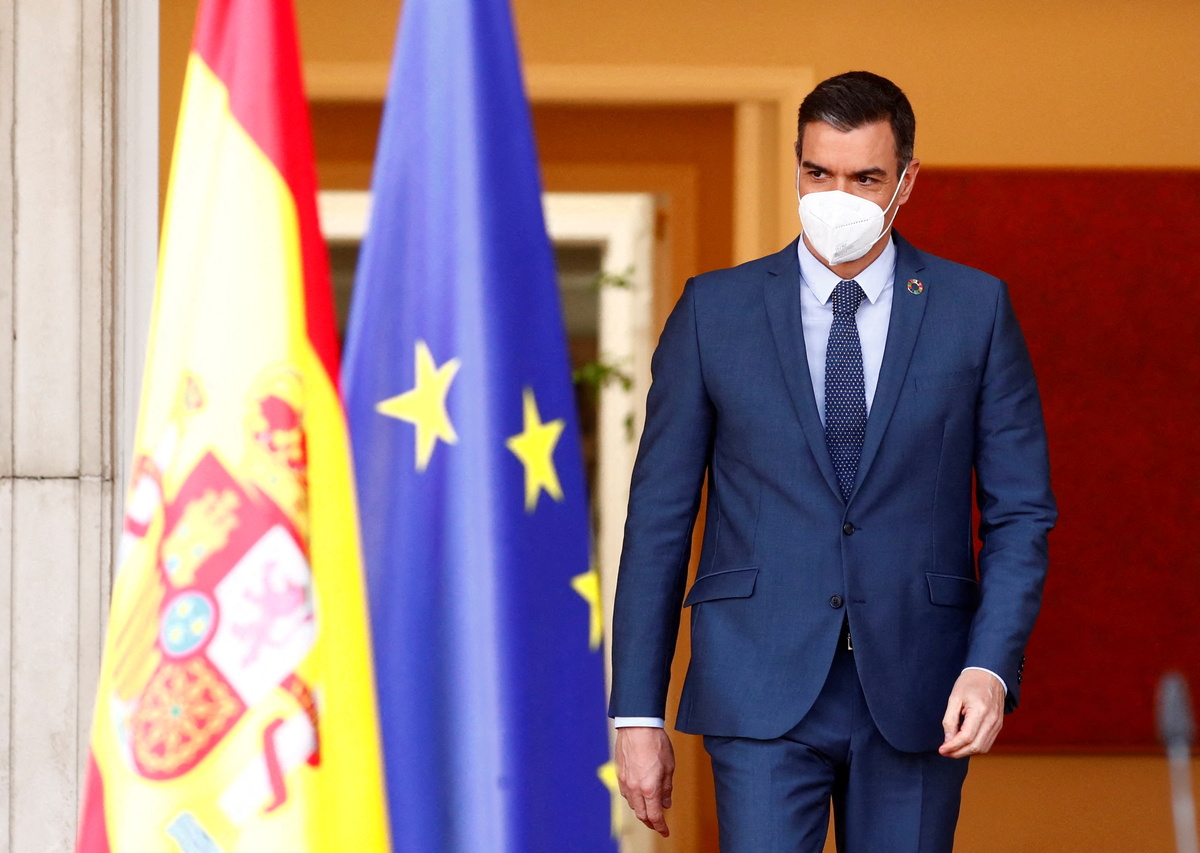
Spain will make it compulsory to wear a face mask outdoors again as part of a package aimed at containing the fast spreading Omicron coronavirus variant, Prime Minister Pedro Sanchez told reporters on Wednesday.
With nearly 80% of its population vaccinated and a booster programme gathering pace, Spain was largely spared the rampant wave of infections that led several northern European countries to toughen restrictions in the autumn.
But the recent arrival of Omicron has sent numbers rocketing, with a record of around 60,000 new infections on Wednesday, though hospital admissions and intensive-care cases remain fairly low compared to previous COVID-19 waves.
Some experts and opposition parties have criticised Sanchez for not reimposing restrictions on movement to due the spread of Omicron, as other European countries such as Portugal or the Netherlands have done, but he rejected this.
"This is not March 2020 or Christmas 2020," said Sanchez, citing the high vaccination rate of the Spanish population in contrast with those earlier stages of the pandemic when vaccines were not available.
Indoor mask-wearing was already mandatory in Spain and many Spaniards choose to cover their faces outdoors too, although the legal obligation to do so was dropped in June.
Mandatory outdoor mask-wearing is to be approved on Thursday at an extraordinary cabinet meeting and take force on Christmas Eve. However, Sanchez said there would be numerous exceptions, such as when people are in open spaces with live-in relatives.
Sanchez's administration also plans to loosen rules on the type of home-testing kits pharmacies can sell and earmark 292 million euros ($331 million) to beef up the struggling primary-care sector, the government said in a statement.
Spain's regions are responsible for their healthcare systems and have the power to limit indoor capacity and business hours, but most have made only non-binding recommendations to citizens.
Stark political differences between the regions complicate any broader agreement on concrete restrictions and mean local approaches to curbing infection vary widely.
($1 = 0.8831 euros)
(Reporting by Inti Landauro and Emma Pinedo; Writing by Nathan Allen, editing by Andrei Khalip, John Stonestreet and Mark Heinrich)