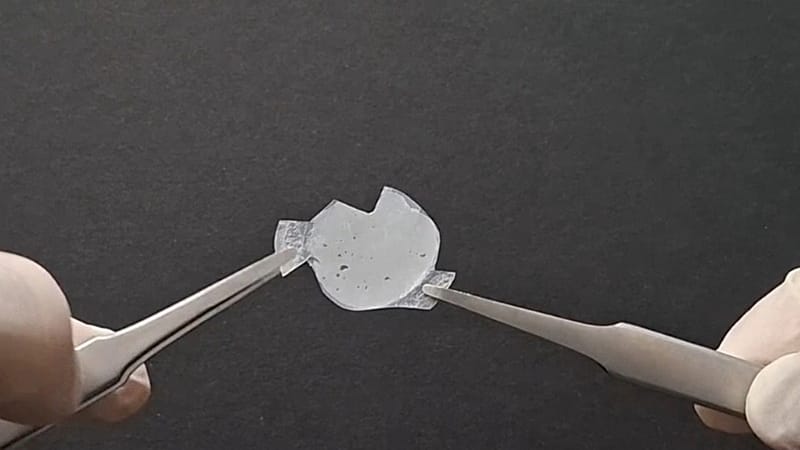
A team of researchers at the Institute of Micro and Nanotechnology (IMN-CNM, CSIC) has developed a nanomaterial capable of cooling sun-exposed surfaces without using electricity, an alternative that could help ease the soaring energy bill for cooling, which already accounts for nearly 20% of global electricity consumption.
The study, led by the Functional Nanoscale Devices for Energy (FINDER) group and published in the journal Nanophotonics, is based on daytime passive radiative cooling, a technique that exploits a peculiarity of the Earth’s atmosphere: there is a band in the infrared spectrum, between 8 and 13 micrometres, through which heat escapes directly into space without being trapped. A material that emits strongly in that window and also reflects solar radiation can end up cooler than the air around it, with no plug or compressor involved.
A polymer with just the right properties
The scientists opted for polyvinylidene fluoride (PVDF), a polymer already known for its ability to emit heat in the infrared. Cristina Vicente, a researcher at IMN-CNM and head of the COOLed project, explains that this material "brings together a combination of properties" that make it ideal: as well as emitting heat efficiently, it withstands ultraviolet radiation and repels water, which gives it a self-cleaning effect, and it stands up well to exposure outdoors.
The key to the breakthrough lies not so much in the material itself as in how it was shaped. The team infiltrated the polymer into nanoporous templates of anodised aluminium oxide, creating three-dimensional structures whose internal geometry they can control with precision, a crucial factor because the optical performance of these coolers depends on their design at the nanoscale.
The figures back up the promise: the optimised version of the material, treated with ultrafast cooling after the polymer infiltration, reflects on average 82.4% of incoming solar radiation and emits 96.7% of heat in the 8 to 13 micrometre infrared window, the band through which that heat escapes into space.
On paper, this combination translates into a cooling capacity of 182.3 watts per square metre under solar irradiance of 1,000 W/m². The rooftop test in Tres Cantos, with peak solar irradiance of 962 W/m², confirmed that figure in real-world conditions.
Almost 13 degrees cooler on the rooftop
The theory was put to the test last summer, in open-air trials on the centre’s rooftop in Tres Cantos, Madrid. After the material was exposed to ultraviolet light treatment that whitens it and enhances its solar reflectance, the results came through: on the hottest, driest and sunniest days, the treated surface stayed up to 12.9°C cooler than a sample without coating.
The researchers themselves stress that the technology is still under development, but point out that the manufacturing process is relatively inexpensive and compatible with existing industrial processes. That opens the door to applications ranging from building façades and roofs to electronic devices, vehicles and even personal cooling systems, all with the same aim: to reduce dependence on air conditioning and the emissions that come with it.
This text was translated with the help of artificial intelligence. Report a problem : [feedback-articles-en@euronews.com].