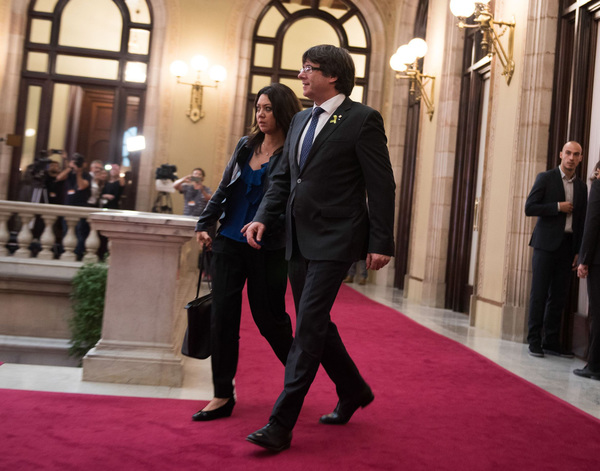
BARCELONA, Spain _ Dueling dramas unfolded Friday in Madrid and Barcelona over the Catalonia secession crisis, with Spain's Senate set to approve direct rule over the restive region and protesters outside the Catalan parliament urging lawmakers to declare independence.
A vote by the upper chamber of Spain's parliament to strip Catalonia of its autonomous powers would be unprecedented in the country's nearly four decades of democracy. The confrontation marks Spain's most serious political crisis in decades.
Spanish Prime Minister Mariano Rajoy told lawmakers that Catalan secessionists had left his government with no choice but to take drastic measures to quell the northeast region's independence drive.
"In my opinion, there is no alternative," Rajoy told the Senate, repeating Spain's longstanding assertion that unilateral efforts to secede are unconstitutional. He called Catalan leaders' actions a "mockery of democracy."
Spanish lawmakers were to vote on whether to trigger Article 155 of Spain's constitution, which gives the central government broad powers to act against any region which is in grave breach of the law. Under the measure, Spain is expected to remove the Catalan leadership and assert control over the regional police force and the affluent region's finances.
In Barcelona, the mood was defiant as Catalan lawmakers prepared to weigh a unilateral declaration of independence put forth by secessionist parties. That could set the scene for a showdown with Spanish authorities seeking to impose control in the region.

The dispute, which has grown more bitter with each passing day, is sending shock waves across Europe. Powerful neighbors including France and Germany have indicated they would not recognize an independent Catalonia.
And crucially, the fledgling republic would not be granted automatic entry to the European Union � a state of affairs which has triggered the flight or planned exodus of hundreds of corporations from Catalonia, Spain's most affluent region.
As the crisis has dragged on, the political divide has grown deeper. Spanish national flags flutter from balconies in Madrid, answered by ubiquitous displays of the Catalan banner in Barcelona.

Rajoy's government has strong backing among Spaniards for his vigorous anti-independence stance.
Opinion is more divided within Catalonia, but pro-secession sentiment was galvanized by a heavy-handed Spanish response to an Oct. 1 referendum that a Spanish court had ruled was illegal. Images of police beating would-be voters drove some into the independence camp.
The referendum result was overwhelmingly in favor of independence, but with a turnout of less than half the Catalan electorate. The Spanish government had urged voters to stay away from the polls, citing a constitutional court ruling that the vote was invalid.
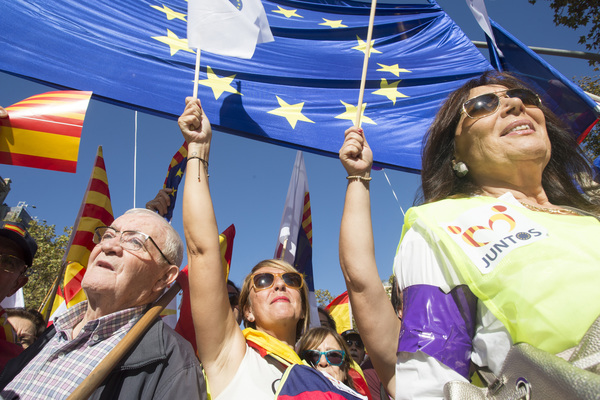
In Barcelona, thousands of protesters, many waving flags and chanting for independence, gathered outside the regional parliament before the start of Friday's session. The region's president, Carles Puigdemont, on Thursday told parliament to go ahead and take up the independence question.
Puigdemont has said the referendum outcome was a mandate to declare independence, but suspended the result in the hopes of starting talks with Madrid. Rajoy's government said there could be no negotiations until Catalonia renounced its secession bid.
In his speech to the Senate, Rajoy said the triggering of Article 155 was not intended to deprive Catalans of liberty, but rather to protect the rights of them and other Spaniards. The prime minister was greeted with applause when he entered the chamber, and his speech was repeatedly interrupted by lawmakers' clapping.
Under Spain's constitution, Catalonia and the country's 16 other regions have a degree of self-government while leaving powers such as taxation, external borders and military affairs to the central government.
Catalonia has for centuries maintained its own language and culture, and has some trappings of statehood including its regional parliament. But many of its citizens feel that the region, which accounts for one-fifth of Spain's economy, bears a disproportionate tax burden, discontent that deepened following a 2008 financial crisis.
(Times staff writers Hennessy-Fiske reported from Barcelona and King from Washington. Special correspondent James Badcock contributed from Madrid.)