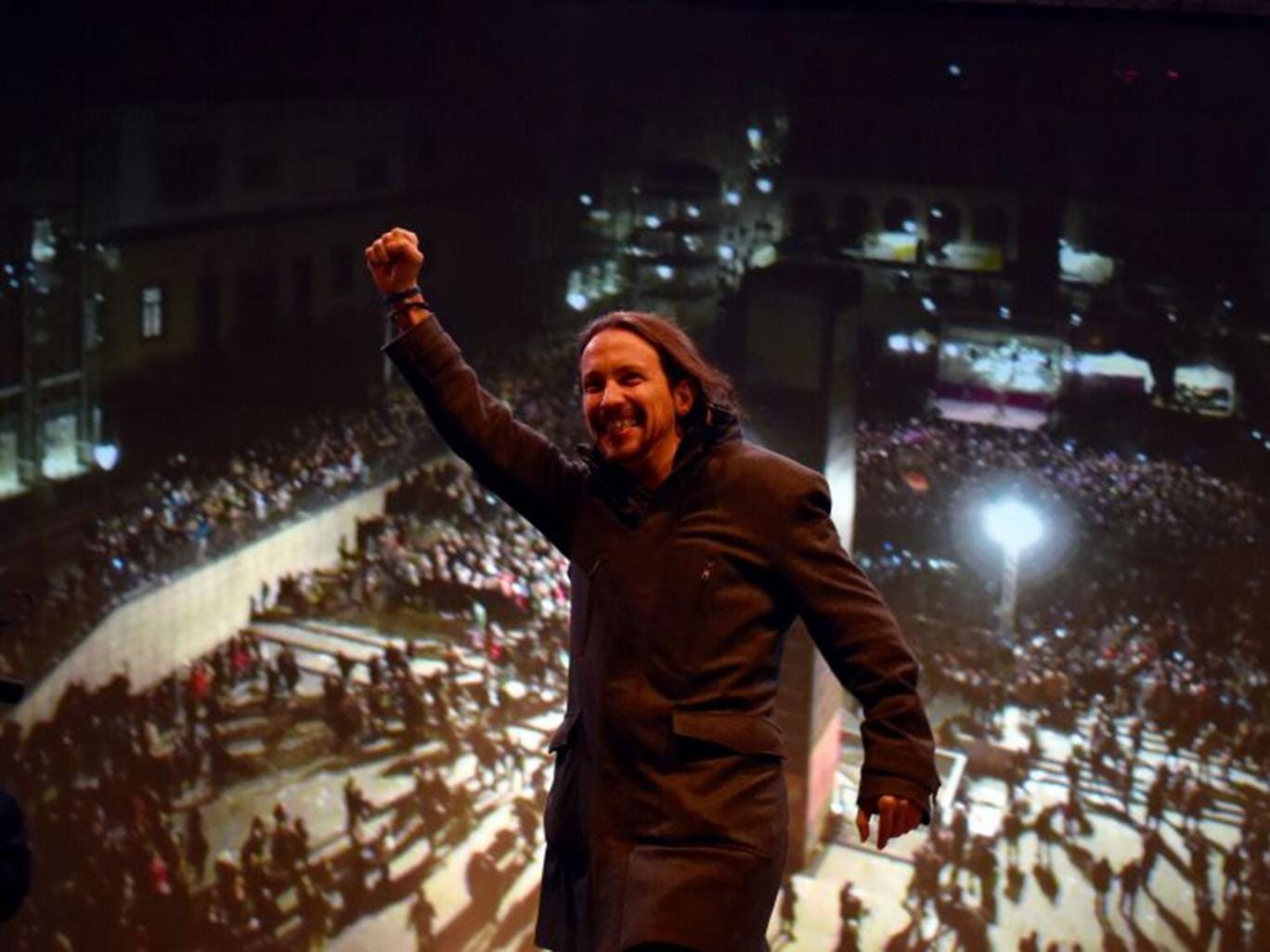
Packed tightly into a square outside Madrid’s famous Reina Sofía museum on Sunday night, thousands of Podemos supporters waited until well past midnight for the man of the moment.
Pablo Iglesias, the ponytailed politics lecturer and the biggest winner in Sunday’s general election, received a welcome usually reserved for rock stars when he and the party leadership eventually made it to the stage. Warmed up with the now customary blast of the Ghostbusters theme tune, the crowd’s chants soon turned to the familiar “Yes we can”. They can, and in fact, they did.
“I’m just very happy for the future, and that we’ve got a chance to fight,” Luis Perez, a 34-year-old museum curator, told The Independent. “OK, the Partido Popular (PP) is still around, but at least now Podemos is there too.”
The leftist party had been written off just a few weeks ago as opinion polls showed it lagging in fourth place. In the end, it was the established parties that lost scores of seats as Podemos emerged as the night’s biggest success story.
The party, which two years ago did not exist, finished third, capturing 20.66 per cent of the vote, more than five million ballots, and 69 seats in Madrid’s all-powerful Congress of Deputies. In doing so, Podemos has broken 40 years of majority rule by the governing centre-right PP, and the Socialists, the PSOE.
As a protest movement Podemos has been able to ride on the back of public disgust at the myriad of corruption scandals facing the government and the malaise caused by the financial crisis.
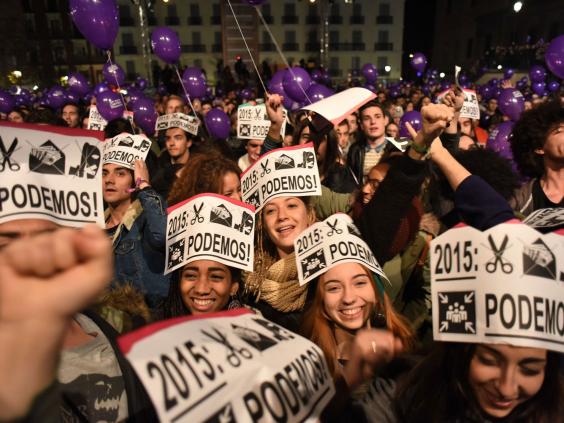
Mr Iglesias’s speech to the faithful on Sunday night referred to Podemos’s beginnings as a movement for social change, known as the 15M, which was formed in the wake of the financial crisis to protest against austerity. “15M sowed the beginning of a new transition led by the people”.
Podemos has said it will renegotiate the terms of Spain’s spending limits with Brussels. Its success, along with the election of Syriza in Greece, and now the establishment of an anti-austerity government in Portugal, shows the EU’s assumption that governments can pass extreme austerity measures is surely a thing of the past.
Yanis Varoufakis, the former Greek Finance Minister who became a thorn in the side of the EU during negotiations over Greece’s debt earlier this year, took to Twitter to congratulate Podemos. “Bravo Podemos! A small step that may turn into a large fault line shattering the eurozone’s crisis denial & austerian [sic] contempt for democracy.”
Meanwhile, the Ibex 35, Spain’s main share index, closed the day down 2.8 per cent. Speaking at the rally on Sunday night, Mr Iglesias told his supporters “a new political phase has opened in our country”.
The 37-year-old has taken delight at poking holes in conventions – he gave King Felipe a box set of Game of Thrones earlier this year and on Saturday’s “day of reflection”, when parties were not supposed to campaign, he went to see the new Star Wars film.
But for all the undoubted success as a protest movement, now comes the reality. At a press conference todday, Mr Igeslias said that he would consider proposals “for the country” and, described himself as a candidate for the next prime minister.
That Spain is in for a period of flux is beyond doubt. The PP Prime Minister Mariano Rajoy has been much praised outside the country for slashing public spending, and overseeing a return to growth. But the cost has been high, with unemployment still above 21 per cent.
Both the PP and PSOE also held rallies in Madrid on Sunday night. Mr Rajoy and Pedro Sanchez, the PSOE leader, were each met with chants of “Presidente!” but both know that they each may need to depart the scene for their parties to have any chance of power. “The only coalition configuration with a stable majority would be a PP and PSOE grouping,” said Brian Lawson, an analyst at IHS Country Risk. “This looks hard to achieve, not least because of a highly acrimonious recent relationship between Rajoy and Sanchez.”
The PP lost its majority along with 64 seats, meaning that its much-floated pact with the fourth-placed party on Sunday, the centrist Ciudadanos, falls short of the 176 seats needed to command parliament.
The PP was due to hold a closed meeting of its senior members on Monday night. While Mr Rajoy only needs a simple majority to be reconfirmed as prime minister when parliament reconvenes on 13 January, his party’s only realistic chance of an absolute majority seems to be through a deal with the PSOE.
A spokesman for the PSOE made his party’s position clear. “We are going to vote against the PP and against Rajoy,” he said. PP sources told the state television channel, RTVE, that Spain was now “ungovernable”.