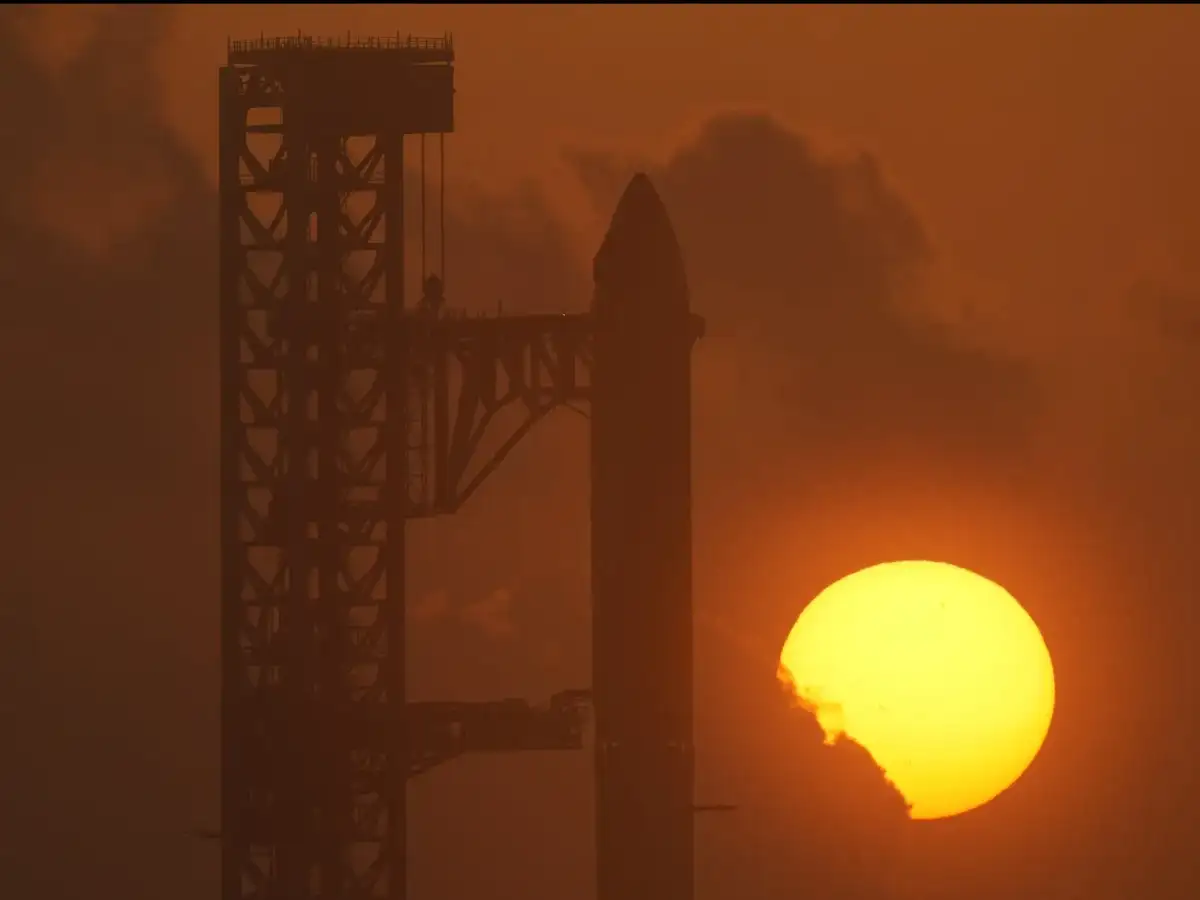
SpaceX's latest Starship test flight looked familiar at first glance, with the world's biggest and most powerful rocket lifting off from Texas before ending its journey in the Indian Ocean.
However, Flight 13 included several changes from recent missions, from engine replacements and new Starlink deployments to fresh heat shield experiments that could help shape future missions to the Moon and Mars.
Also Read: SpaceX launches Starship on another test flight
The 407-foot (124-metre) Starship rocket blasted off on Friday from SpaceX's Starbase facility at the southern tip of Texas. NASA closely monitored the flight because Starship is central to the agency's Artemis programme, which plans to use the spacecraft as a lunar lander for astronauts returning to the Moon.
The mission also carried 20 of SpaceX's most advanced Starlink satellites, making the latest Starship flight about more than another launch and splashdown.
SpaceX Starship returns after engine replacements and launch delays
The mission followed a series of setbacks for Starship. A launch attempt on July 16 was aborted at the last moment after six of the first-stage booster's 33 engines failed to ignite. SpaceX replaced those six engines before making another attempt.
The previous Starship flight in May also experienced engine trouble, preventing the booster from making a controlled return.
This time, all 33 engines fired at liftoff, allowing Starship to climb into space as planned. During the booster's descent, however, not enough engines reignited, causing it to descend too quickly before crashing into the Gulf of Mexico instead of making a controlled return.
The Starship spacecraft continued eastward on its planned flight.
Also Read: Musk leaves door open to Tesla-SpaceX merger
SpaceX Starship releases advanced Starlink satellites during the mission
A key feature of the latest Starship flight was the release of 20 of SpaceX's most advanced Starlink satellites.
Flying around 124 miles (200 kilometres) above Earth, Starship deployed the satellites one by one using its Pez-like dispenser.
After separating from Starship, the new Starlinks successfully communicated through laser links with older Starlink satellites already operating in orbit. With more than 10,000 Starlink satellites providing internet services, SpaceX says it operates the world's largest satellite constellation.
The Starlinks completed all of their planned tasks before re-entering over the Indian Ocean.
Starship records its best re-entry yet, according to SpaceX
Another major focus of the mission was testing Starship's return through Earth's atmosphere.
According to SpaceX, the spacecraft achieved its best re-entry so far. The stainless steel vehicle hovered upright above the Indian Ocean before gently dropping into the water more than 10,000 miles (16,000 kilometres) from its launch site. It remained afloat as the company's webcast came to an end, prompting cheers from employees gathered back at Starbase.
“We're really pumped about this,” SpaceX engineer Kate Tice said, calling it “lucky flight 13.”
The mission also included new heat shield experiments. Most of the thermal protection tiles were black, while some were deliberately painted white to simulate missing tiles as part of a test of the shield's durability. Sensors were also installed to measure the extreme pressure experienced during launch.
Six of the newly launched Starlink satellites carried cameras that photographed Starship's heat shield near the end of the flight, sending back sharp images even while the spacecraft floated in the ocean.
“Excited for what will be learned from this mission,” NASA Administrator Jared Isaacman said on the social platform X.
NASA and SpaceX looking beyond this Starship test
The latest mission was the 13th flight of Starship and the second this year using the upgraded Version 3 vehicle. Like the previous demonstration flight, neither the booster nor the spacecraft was intended to be recovered, with both planned to end their journeys in the sea.
SpaceX wants to prove Starship's heat shield can withstand the intense heat of atmospheric re-entry before attempting to return the spacecraft to the Starbase launch site near the Texas-Mexico border. The company has already used giant mechanical arms at the launch tower to catch a returning booster and plans to use the same approach for the spacecraft as it works towards making Starship fully reusable.
That progress is also important for NASA. The agency needs Starship to complete testing and reach orbit soon so the four Artemis III astronauts — three Americans and one Italian — can practise docking their capsule with the spacecraft next year.
Starship remains at the centre of SpaceX's Moon and Mars ambitions
Beyond NASA's lunar programme, Starship is also the vehicle Elon Musk wants to use to build a city on Mars. Musk has already begun taking bookings for future tourist trips to both Mars and the Moon.
The latest Starship test was delayed twice before finally lifting off. The first delay followed the July 16 launch abort caused by engine problems. A second attempt on Thursday was postponed because thick clouds linked to Tropical Storm Bertha prevented the launch.
Although the booster was lost during its descent, Flight 13 showed how Starship is moving beyond simply reaching space. The mission combined engine improvements, advanced Starlink deployment, heat shield experiments and what SpaceX described as its best re-entry so far, providing new data for future flights that will support both NASA's Moon programme and the company's longer-term plans for Mars.