
Earth, sponsored by SpaceX?
This month, Business Insider reported that the spaceflight firm plans to send an advertising billboard into space. The project will consist of a tiny CubeSat-sized satellite with a pixelated screen on one side. The satellite is expected to launch in early 2022, and followers will see the screen from Earth thanks to an attached selfie stick pointed at the action.
In the race to commercialize space, an ad billboard is perhaps one of the least desirable outcomes — even though this one will likely be far smaller than anything you might see at the side of a highway.
Agreements like the 1967 Outer Space Treaty govern how nations and groups use space. Still, there is no current legislative reason why SpaceX (or anyone else) can’t launch a satellite like this into space — even if it could disrupt the night sky.
“Things may change later on,” Ram Jakhu, associate professor at McGill University and a researcher on international space law, tells Inverse.
“There’s a lot of voices coming out of the United States and outside the U.S. with respect to the threat of observation by astronomers. That is not very clear at this stage.”
These discussions are motivated in part by Starlink, SpaceX’s giant internet constellation, which has disrupted astronomers’ work already.
Want to find out more about SpaceX’s plans for the future? Subscribe to MUSK READS+ for exclusive interviews and analysis about spaceflight, electric cars, and more.
SpaceX’s billboard: What is the company planning?
The company plans to launch a CubeSat satellite in 2022. This is a standard unit of measurement: A one-unit CubeSat measures 10 centimeters by 10 by 10 (2.5 inches). The satellite will launch on a Falcon 9 rocket.
Canadian startup Geometric Energy Corporation will build the satellite. It will use a built-in selfie stick to record the billboard once it is in space and Livestream the ad — or whatever else the screen might show — via YouTube and Twitch.
Customers here on Earth will be able to buy advertising space on the billboard using one of five cryptocurrency tokens:
- A beta token lets people choose the X coordinate of their pixel
- A rho token lets people choose the Y coordinate
- A gamma token lets people choose the pixel’s brightness
- A kappa token covers the pixel’s color
- An XI token determines the duration of the ad
People will be able to buy the tokens with Ethereum. Dogecoin, the cryptocurrency of choice for SpaceX CEO Elon Musk, may become a future payment option.
SpaceX’s billboard: Is it legal?
Jakhu explains that the project will likely require approval from both American and Canadian authorities.
On the American side, SpaceX will need a license from the Federal Aviation Administration. Jakhu is unaware of any advertising restrictions that could hamper the project. He also notes that the United States has “a very powerful piece of legislation” in the First Amendment to the Constitution — freedom of speech.
“That’s pretty broad,” Jakhu says, referring to the Amendment.
On the Canadian side, the Geometric Energy Corporation could face more opposition from authorities. Jakhu is unaware of any regulation which might apply here, however.
For now, SpaceX likely has the all-clear to launch its small billboard. But it could face greater oversight in the future if its missions start to disrupt the view of the night sky.
David Koplow, a professor at Georgetown University who specializes in international law, points out to Inverse that SpaceX has already faced legal challenges over its Starlink internet service constellation.
The constellation has come under scrutiny from astronomers since the first batch of 60 satellites launched in May 2019. The satellites operate at a much lower altitude than competing constellations — around 550 kilometers or 340 miles above Earth. The company has applied for permission to launch up to 42,000 satellites.
Reports emerged in 2019 that early batches have already disrupted astronomers’ work. Gwynne Shotwell, president of SpaceX, told SpaceNews at the time that these issues were unexpected. The company has since taken steps to reduce the satellites’ visibility.
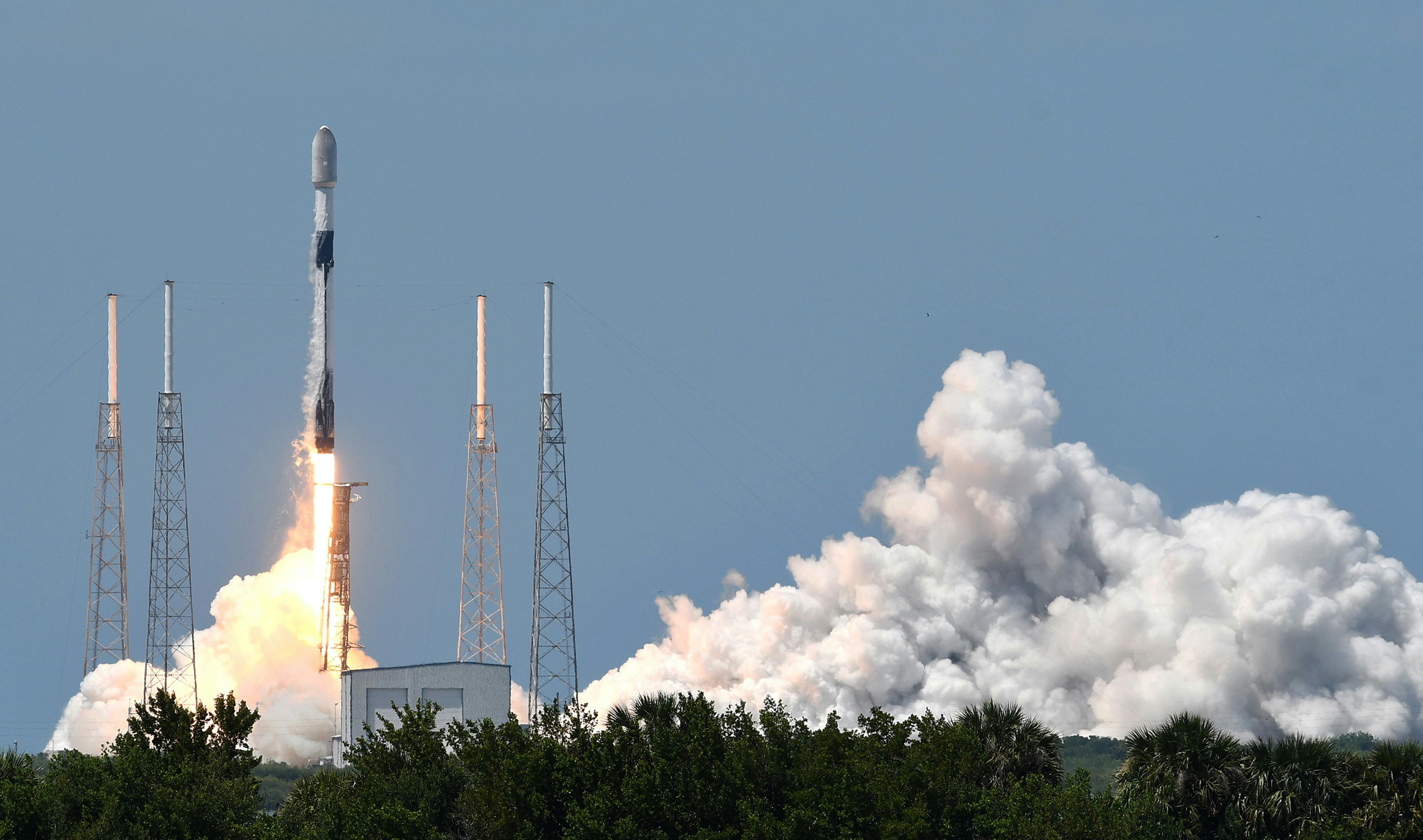
But SpaceX’s Starlink plans have faced legal opposition. Viasat, a telecommunications firm that also operates a satellite internet service, submitted a U.S. Court of Appeals filing in the District of Columbia in May 2021. The filing seeks to force a rethink of the Federal Communications Commission’s decision to enable SpaceX to launch nearly 3,000 more Starlink satellites.
“Everyone agrees that we can tell that what’s happening has an impact on the atmosphere, it has an impact on the night sky, and it has an impact on space,” John Janka, chief officer of Viasat’s global regulatory and government affairs, told Scientific American at the time. “But nobody has quantified it or determined how best to mitigate it.”
Discussions are underway about how best to navigate these issues in the future. Jakhu says that an international conference slated for October this year will consider how best to implement the findings of a December 2020 report into these problems.
The Dark and Quiet Skies Conference for Science and Society will take place in Santa Cruz de La Palma, Spain, from October 3 to October 7, 2021. It is being organized by the United Nations Office for Outer Space Affairs, the International Astronomical Union, and the Instituto de Astrofísica de Canarias.
The December 2020 report the conference is based on made four recommendations for the satellite-constellation industry:
- “Raise awareness amongst key stakeholders.”
- “Design missions to minimize negative impacts on astronomical observations.”
- “Design satellites to minimize negative impacts on astronomical observations.”
- “Conduct satellite operations in a manner that minimizes negative impacts on astronomical observations.”
Even if SpaceX's billboard leads to bigger and more visible satellites in the future, there are already moves underway to ensure the skies stay clear. But until there is more decisive action, watch this space.
SUBSCRIBE TO MUSK READS+, A PREMIUM NEWSLETTER THAT COVERS THE WORLDS OF ELON MUSK, SPACEX, TESLA, AND EVERYTHING BETWEEN.