A warning system for storms on the sun, a robotic capsule crashing into the sea, and a rocket system that tries to land on a floating barge – these are the missions of SpaceX engineers and scientists on Tuesday, as the company makes its second attempt this year to test reusable rockets.
At 6.05pm ET on Tuesday evening, the company plans to launch its DSCOVR satellite, which is designed to monitor weather in space, including solar storms whose explosive bursts of solar particles can cause blackouts and disrupt communications here on Earth.
Ten minutes later, the booster that launches the satellite is scheduled to land on an unanchored barge in the Atlantic ocean, from which it will be recovered and used again.
Tuesday’s planned launch follows an earlier attempt in January that ended in a spectacular explosion, which the company’s chief executive, Elon Musk, euphemistically dubbed a “rapid unscheduled disassembly”.
SpaceX will manage the launch at the Cape Canaveral launchpad in central Florida, owned by Nasa. The satellite will take a month to reach its operational orbit above the Earth, more than a decade after it was conceived as a joint project of Nasa, Noaa and the US air force.
The $340m DSCOVR project began as a pet of the then vice-president Al Gore, was put on hold in the early 2000s due to setbacks at Nasa under President George W Bush, and then refurbished over the course of the next decade for launch on Sunday – until weather and a radar glitch forced another short delay until Monday and then Tuesday night. Forecasters say there is an 80% chance of favorable weather to launch on Tuesday night.
The satellite will also take photos and watch Earth, monitoring how much energy radiates from the surface – a sign of whether carbon emissions trap energy.
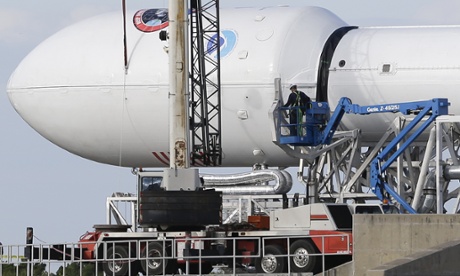
The rocket taking DSCOVR into deep space, about four times further from Earth than the moon, is integral to the company’s aims. SpaceX will make its second attempt to land reusable rocket technology, what Musk conceives of as the next generation of spacecraft.
The rocket, which uses repeated thruster bursts to slow its incredibly fast descent back towards Earth, used up too much of its hydraulic fluid, Musk said, and then lost control just before hitting the ship’s deck.
For Tuesday’s launch, Musk said on Twitter that given the distance of the mission, “rocket re-entry will be much tougher this time around” because of almost twice the amount of force and four times the heat involved in re-entry. The company described the challenge of landing the rocket, which stands about 14 stories tall, as akin to “trying to balance a rubber broomstick on your hand in the middle of a wind storm”. After releasing the satellite into space the rocket will return to Earth several hours later.
The reusable rocket technology is important to SpaceX for its potential effect on the costs of spaceflight and for improving thruster technology necessary to land on other planets. “The reason that there’s low demand for spaceflight is that it’s ridiculously expensive,” Musk told an MIT symposium in October. “These spaceships are expensive and they’re hard to build,” he said. “You can’t just leave them there.”
SpaceX and the US air force announced an agreement on Tuesday for the company to use Cape Canaveral as a landing site for returning Falcon rockets. “The way we see it, this is a classic combination of a highly successful launch past morphing into an equally promising future,” Brigadier General Nina Armagno said in a statement.
Also on Tuesday, SpaceX will retrieve a robotic Dragon cargo capsule sent to supply astronauts on board the International Space Station last month. That capsule should splash down somewhere off the coast of Baja California late on Tuesday afternoon, after which SpaceX engineers will recover it and the cargo of experiments and supplies from the station.