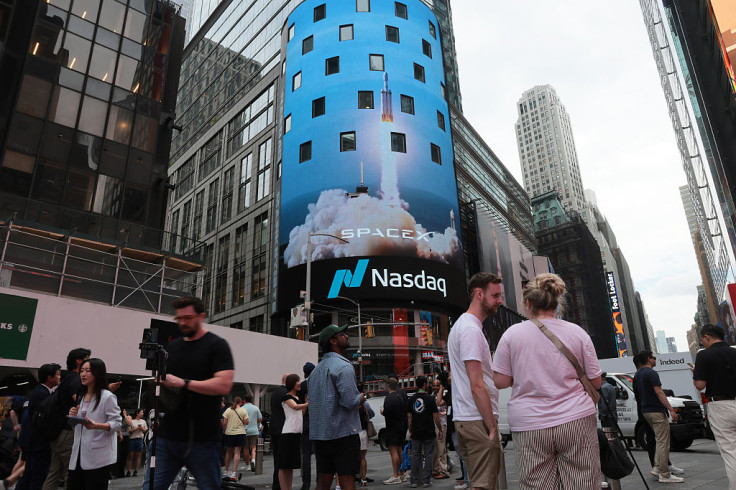
SpaceX continued climbing in its full trading session on Monday, building on large gains from last Friday, when it marked the biggest initial public offering in history.
Shares of the company gained more than 7.5% at 10:13 a.m. ET, standing above $173 each and building on the 19% surge from Friday, which put the company's market capitalization above $2 trillion.
Company underwriters officially exercised their overallotment of shares in the IPO, CNBC reported, taking the amount raised by the company from $75 billion to $85.7 billion. Commonly known as "greenshoe," it is bigger than almost all tech IPOs on record, the outlet added.
Its CEO, Elon Musk, said in a social media post on Sunday that the company could "be able to reach approximately" $1 trillion in revenue by the end of the decade. "And I would be surprised if revenue is not greater than $1T in 2031," he added. The company reported $18.7 billion in revenue last year.
Musk said in a livestream before the IPO on Friday that the company has been cash-flow positive for more than 10 years. He added that he wanted to take the company public to take the company into a "significant growth phase" that involves putting more than 100,000 satellites in orbit for communications. The company also wants to build AI data centers in space.
Musk became the world's first person worth than a trillion after the company began trading. When the stock was at $150 a share, his stake in the company was worth more than $766 billion. He is now getting close to being worth over a trillion from SpaceX alone. He also has some $280 billion worth of Tesla stock. Other Musk ventures include Neuralink, which develops brain-computer interface technology, and The Boring Company, which focuses on transportation infrastructure projects.
SpaceX has completed hundreds of successful launches and now operates the Falcon 9 rocket, Falcon Heavy launch system, and the Starship spacecraft program. One of SpaceX's most valuable assets is Starlink, the satellite internet network that has deployed thousands of satellites into low-Earth orbit.
SpaceX also plays a critical role in U.S. space operations. The company transports astronauts and cargo to the International Space Station under contracts with NASA and has become a key partner for the Department of Defense. In recent years, it has secured major government contracts.