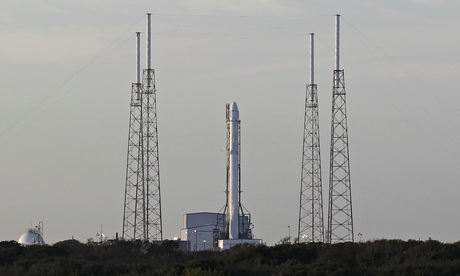
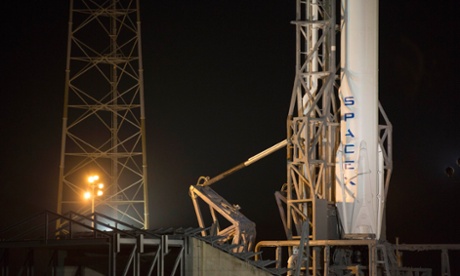
The private space company SpaceX has postponed the launch of its Falcon 9 rocket to the International Space Station after a technical glitch arose moments before blastoff.
Mission controllers at Cape Canaveral in Florida aborted the company’s fifth cargo resupply mission to the station one minute and 28 seconds before the rocket was due to blast off at 11.20 GMT on Tuesday. They will now try for a launch on Friday at 10.09.
The launch was called off after SpaceX officials noticed a problem with the actuator used to steer the second stage of Falcon 9 after the first stage has detached and fallen back to Earth.
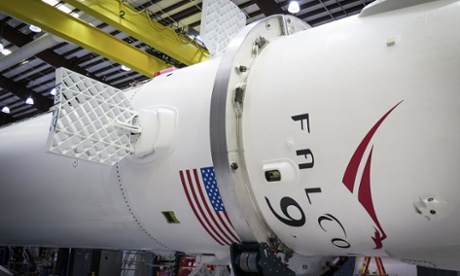
As part of its push towards reusable spacecraft, SpaceX hoped to land the first stage of the rocket on a 50m x 90m floating barge in the Atlantic. Elon Musk, founder of the company, said the landing bid was risky and put the odds of success at no more than 50%.
Provided SpaceX can correct the misbehaving actuator, they have another chance to launch the rocket from Cape Canaveral later in the week. “Need to investigate the upper stage Z actuator. Was behaving strangely. Next launch attempt on Friday at 5am,” Musk tweeted.
The company has already demonstrated that it can bring the first stage of Falcon 9 back to Earth by using three rocket burns to stabilise and slow its descent. In a test last year, the rocket stage came down and hovered over the ocean before tipping over and breaking apart.
To land on the platform the rocket must hit its target with an accuracy of 10m and remain upright. The rocket extends four feet shortly before it lands. The 14-storey first stage can stand upright because most of its weight is in the engine at the base of the rocket.
If the company can perfect the landing they could slash the costs of space missions by reusing rockets that are now left to burn up on re-entry before they are lost in the ocean.
“If one can figure out how to effectively reuse rockets just like airplanes, the cost of access to space will be reduced by as much as a factor of a hundred,” Musk said. “A fully reusable vehicle has never been done before. That really is the fundamental breakthrough needed to revolutionise access to space.”