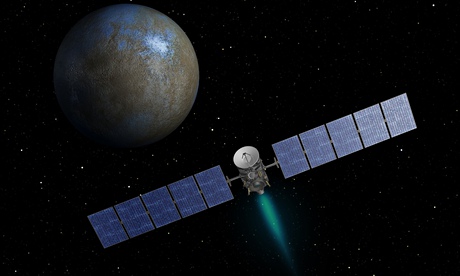
Nasa has two dwarf planets in its sights for 2015. The first, Ceres, is some 950km wide and orbits within the asteroid belt between Mars and Jupiter. Nasa’s Dawn mission, built with European partners and launched in 2007, orbited the asteroid Vesta, 525km across, from 2011-2012.
Now approaching Ceres, it should settle into orbit in March for an intended year of research. It is likely that Dawn’s German-built cameras will soon return images to surpass those by the Hubble space telescope.
The space highlight for the coming year, though, may well be the flyby of the dwarf planet Pluto by Nasa’s New Horizons mission on 14 July. Long range observations of Pluto are due to begin on 15 January, but it will be mid-May before it has sharper views than Hubble.
Launched nine years ago, New Horizons is also to study Pluto’s main moon Charon and the lesser ones, Hydra, Nix, Kerberos and Styx, as it sweeps within 10,000km of Pluto at a relative velocity of almost 14km per second. The former-planet Pluto itself is 2,370km wide.
The year just past saw more launches that reached Earth orbit or beyond than in any year since 1992. The final tally of 90 launches in 2014 compares with 78 in 2013 and 75 in 2012.
Last year’s total includes 23 launches by the US and 36 by Russia, including five Russian launches that used Europe’s spaceport in French Guiana. In third place is China, whose 16 launches include a flurry of 10 in the final three months of the year. The European Space Agency contributed another six, India and Japan four each and Israel one.