The rental of unoccupied commercial spaces for telework use, such as unreserved tables at restaurants and free spaces at hotels, is becoming increasingly widespread.
These space-sharing services are likely to gain even more traction because those who rent such spaces are able to secure a place to work for a nominal fee, while those providing the spaces are able to recoup some of their losses from the decline in customer figures caused by the novel coronavirus outbreak. The provision of such spaces also affords businesses the opportunity to attract new customers.
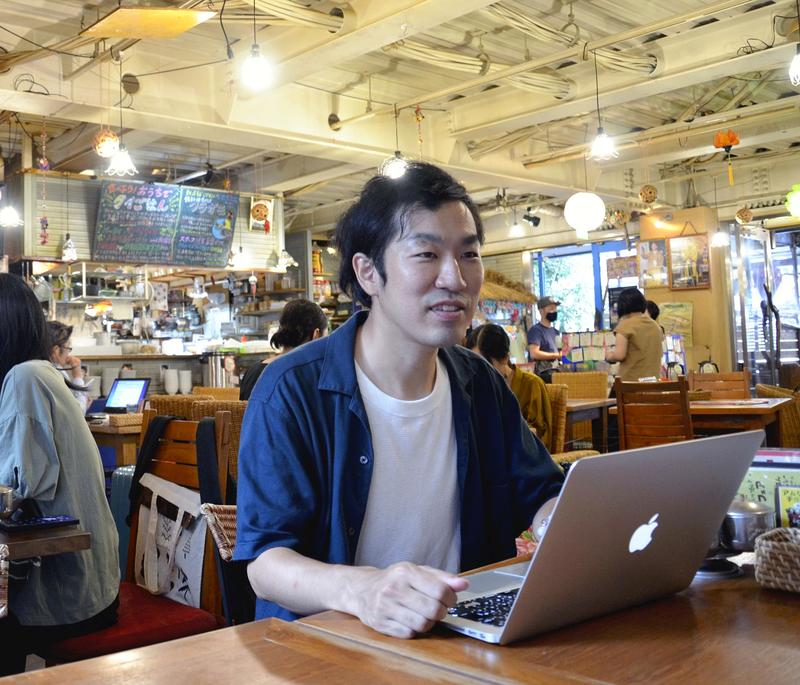
Tax accountant Hiroaki Tanaka, a resident of Kunitachi, Tokyo, began working at an empty table in Amrita Shokudo, a Thai restaurant in Kichijoji, Tokyo, shortly after 2 p.m. one afternoon after most of the establishment's lunch customers had left. Tanaka is participating in the trial run of a space sharing service provided by Oneseat Co., a Tokyo-based space-sharing intermediary agency. The company started the service on a trial basis in August. As a trial participant, Tanaka can reserve an empty table at one of about 10 eating establishments in Musashino, Kunitachi and other western Tokyo cities. For the trial-rate fee of 30 yen per 15 minutes, he is free to concentrate on his work while being under no obligation to order anything from the restaurant's menu.
"Because I've got a kid at home, I can't really concentrate on my work. So this service is really helpful," Tanaka said.
Tomoyuki Nakatsuka of the Amrita restaurant also has high expectations for the service.
"It would be great if [service users] order a drink while they work or come to dine with us on another occasion," Nakatsuka said.
Oneseat is planning the paid service's official launch as early as October.
"Users are able to secure a place to work, and commercial facilities have more opportunities to attract new customers. It's a win-win situation," said Atsushi Suzuki, Oneseat's chief operating officer.
Space-sharing services are becoming widespread because telecommuting and the sharing economy, or the renting of empty spaces, are becoming more commonplace.
The number of telecommuters is indeed on the rise. A survey conducted by the Tokyo metropolitan government shows that 16% of the employees of about 3,900 companies staffed with 30 or more employees were telecommuting in December 2019. This percentage sharply increased to 49% in April when a coronavirus-related state of emergency was declared. Space sharing is convenient for those who want to work from home but can't find a suitable space to do their job. According to the Sharing Economy Association Japan, the size of the space-sharing market was 503.9 billion yen in fiscal 2018. It is expected to expand to more than 1.6 trillion yen in fiscal 2025.
Major companies suffering from profit loss as a result of the virus are also making the most of space-sharing services. Washington Hotel Corp. became a member of the space sharing agency Timework in June. Through the agency, the Aichi Prefecture hotel chain rents out the lobby spaces of its 24 branches of the R&B Hotel. After the breakfast service finishes in the lobby area, space-sharing users can rent a table for 600 yen an hour, and have access to free wi-fi and a complimentary cup of freshly ground coffee.
"We've received positive responses from our users, saying things like they appreciate being able to work under our bright lights," said Shingo Kunitomo of Washington Hotel, the deputy chief of the corporation's R&B Hotel division.
Meanwhile, six temples in Yamanashi, Wakayama and other prefectures started offering space sharing in May, hoping to create opportunities for people to become more familiar with them. Temple halls and accommodations were rented out as workplaces through ShareWing, Inc., a Tokyo-based company that finds accommodation for its users in temples. Positive reviews, such as users saying that they could concentrate on their work in a quiet environment in a peaceful state of mind, have been received.
"Customers are not coming because of the novel coronavirus, so more and more establishments are taking part in hassle-free space sharing," said Daisuke Shigematsu, the head of the Sharing Economy Association Japan.
Shigematsu stresses the importance of users checking both the terms and conditions and the facility's shared equipment in advance.
"We'd like users to be considerate toward those who will use the space after them by doing things like cleaning up after themselves during their reserved time to ensure that everyone can use the space comfortably," he said.
Read more from The Japan News at https://japannews.yomiuri.co.jp/