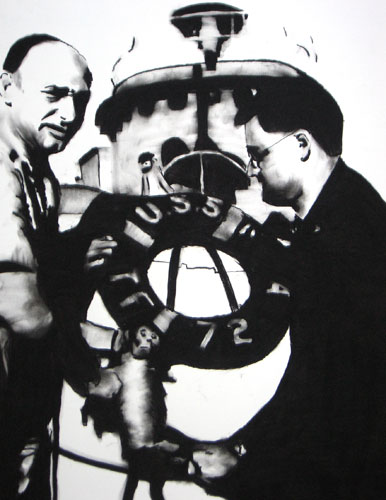
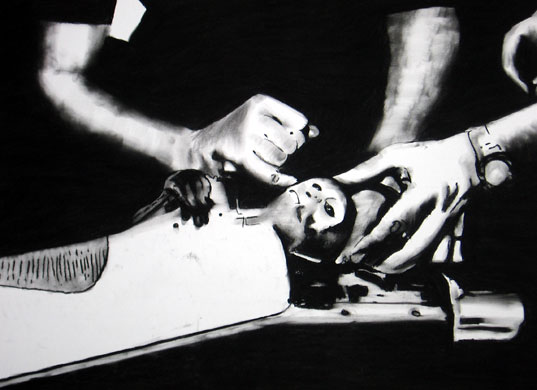
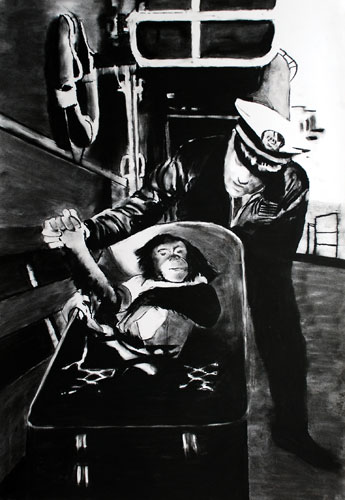
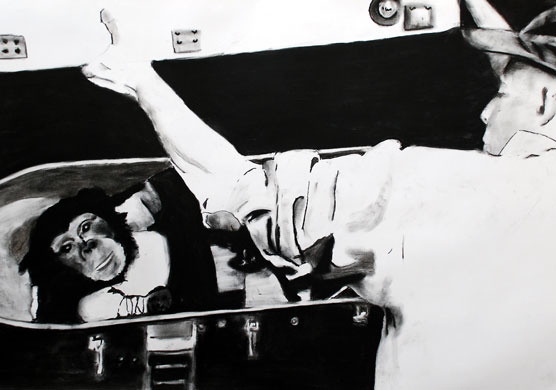
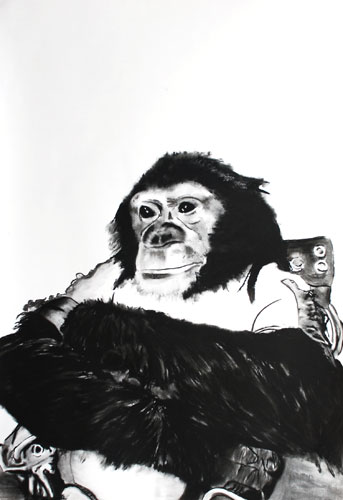
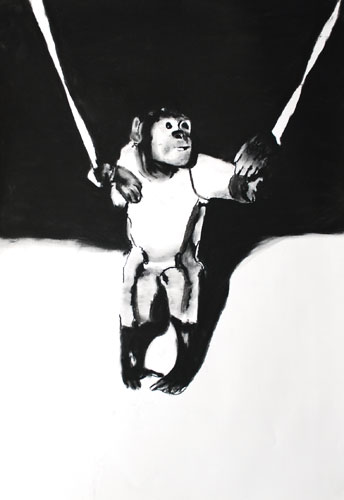
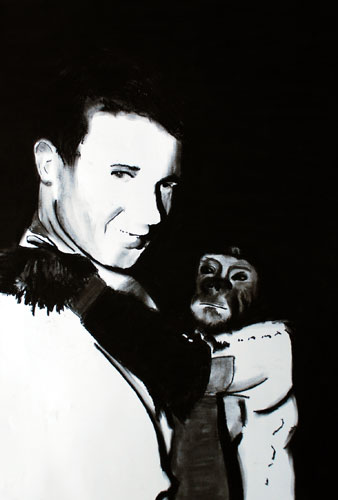
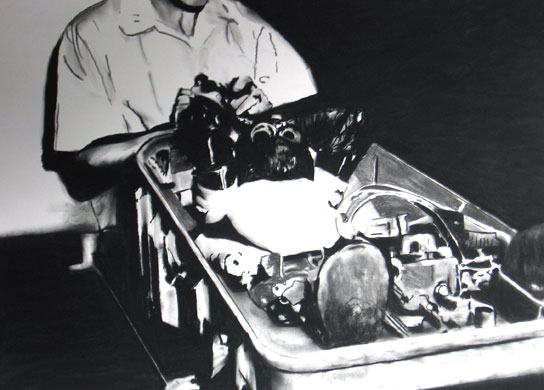
Simon Hollington used contemporary documentation to create his work, employing the backdrop of early space exploration to observe our difficult relationship with the animals that are man’s nearest biological relatives. Here two monkeys, Abel and Miss Baker, who on 28 May 1959 became the first living beings to return to Earth after travelling in space. Photograph: Simon HollingtonHollington's drawings take subject matter that moves from extreme sentimentality to dark, questionably abusive scenes of human-animal interaction. Here Abel is inspected after his return from space.Photograph: Simon HollingtonHollington reminds us that outer space was experienced for the first time by a great ape on 31 January 1961, when Chimp 65 made a flight lasting 16 minutes and 39 seconds. When he returned alive he was renamed Ham and became an overnight media sensation. Photograph: Simon Hollington
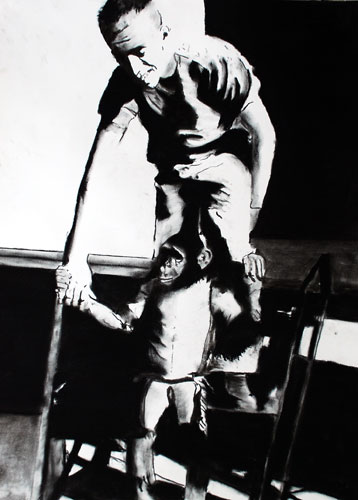
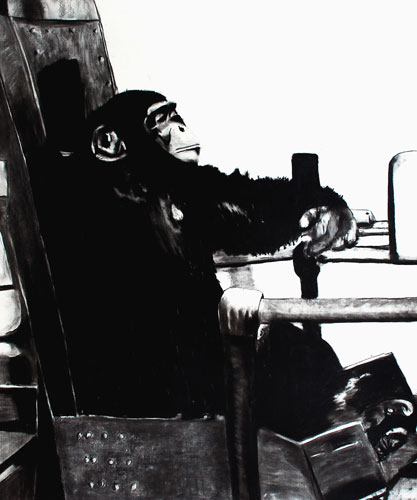
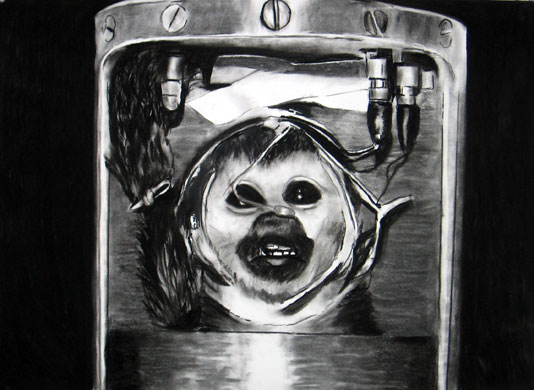
Ham was named after Lieutenant Colonel Hamilton Blackshear who looked after him. He has been called the first American in outer space, even though he was born in Cameroon. He has also been called the first astronaut because he was not a mere passenger, but carried out basic operations. Photograph: Simon HollingtonHollington's drawing shows the space couch that Ham was strapped into for his flight. The cocoon allowed him to perform his tasks aboard the suborbital Mercury 2. Photograph: Simon HollingtonHam was trained to operate controls in spacecraft by following coloured blinking lights. Photograph: Simon HollingtonHollington reminds us that these earthlings went into space before humans, scientifically and culturally paving the way for manned space flight. In many ways, it may be said that they are the ones that defined the 20th century. Photograph: Simon HollingtonHollington's drawing of Ham, a 17kg, three-year-old chimp, who was taken from Cameroon. Photograph: Simon HollingtonEnos was the second chimp to enter outer space and complete an orbital flight. His training was more extreme than Ham's, and he was exposed to weightlessness and g-forces for longer periods of time. Enos completed more than 1,000 hours of training at the University of Kentucky. Photograph: Simon HollingtonEnos was selected to make the first orbital animal flight only three days before the launch. He flew into space on board Mercury Atlas 5 on 29 Novermber 1961, completing his first orbit in one and a half hoursPhotograph: Simon HollingtonWith 2009 marking the 40th anniversary of man's historic landing on the moon, Hollington's drawings interrogate the ethical and scientific significance of the first space explorers. Photograph: Simon Hollington
Sign up to read this article
Read news from 100’s of titles, curated specifically for you.